Do you think IIT Guwahati certified course can help you in your career?
Introduction
Knowledge representation stands at the core of artificial intelligence (AI), serving as the means through which computers can understand, process, & use human knowledge. This facet of AI is pivotal, bridging the gap between human understanding & machine processing.
It's not just about storing data, but about enabling machines to interpret, reason, & make decisions in a manner akin to human thought processes.
What is Knowledge Representation?
Knowledge representation in AI is akin to creating a framework that allows computers to emulate human reasoning. It involves the structuring of real-world information into formats that AI systems can understand & process. This is crucial for developing AI applications that can perform tasks such as problem-solving, decision-making, & learning. Through knowledge representation, AI systems gain a structured way of dealing with complex, abstract concepts, making them more efficient & intelligent.
Types of knowledge
AI systems deal with a diverse range of knowledge types, each serving a unique purpose & requiring different representation techniques. Let's explore these types:
Declarative Knowledge
This is about facts & statements. For instance, "Paris is the capital of France." It's straightforward & forms the basis of knowledge databases.
Procedural Knowledge
This involves knowledge of how to perform tasks. For example, the steps involved in solving a math problem. It's more about processes & methods.
Semantic Knowledge
This relates to understanding the meanings & relationships between different concepts. For instance, understanding that a 'tree' is a type of 'plant'.
Episodic Knowledge
This is knowledge about events & experiences, like remembering a past event. It's tied to specific contexts & times.
Heuristic Knowledge
Often used in problem-solving, it's based on rules of thumb, educated guesses, & intuition. It's less about hard facts & more about probable solutions.
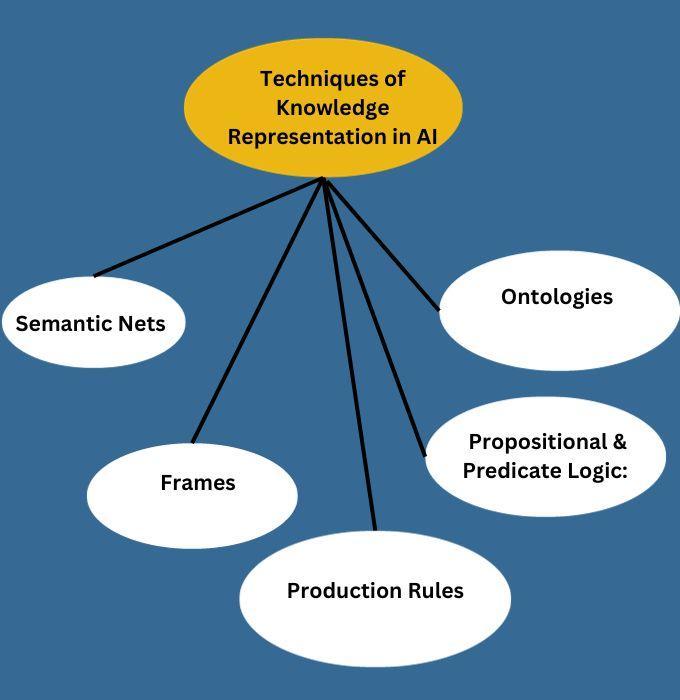
Techniques of Knowledge Representation in AI
Knowledge representation in AI is not a one-size-fits-all scenario. Various techniques are employed to encode different types of knowledge effectively.
Let's explore some of these key techniques:
Semantic Nets
These are graphical representations used to depict relationships between objects and concepts. Imagine a web of nodes connected by links, where each node represents an object or concept, and each link describes the relationship between them. For instance, a semantic net could illustrate the relationship between different types of vehicles.
Frames
Frames are data structures for representing "stereotyped situations." Think of them as templates filled with slots for specific details. For example, a 'car' frame would have slots for color, make, model, etc. Each slot can contain either static information or pointers to other frames or data structures.
Production Rules
These are if-then rules used to represent procedural knowledge. They are particularly useful for expert systems. A production rule might look like, "If a patient has a fever & sore throat, then consider a diagnosis of strep throat."
Propositional & Predicate Logic
Logic is used for formal reasoning. Propositional logic deals with propositions that can be true or false. Predicate logic, on the other hand, involves the use of predicates and quantifiers like 'all' or 'some', offering a more detailed way to represent knowledge.
Ontologies
An ontology is a formal representation of a set of concepts within a domain and the relationships between those concepts. It’s used to reason about the properties of that domain and can be used for complex decision-making processes.
Cycle of Knowledge Representation in AI
The cycle of knowledge representation in AI is a continuous process, encompassing the acquisition, storage, processing, and updating of knowledge. Understanding this cycle is crucial for effectively utilizing AI systems. Let's break down the stages:
Knowledge Acquisition
This is the initial phase where knowledge is gathered from various sources like databases, sensors, user inputs, or expert systems. It involves collecting facts, rules, heuristics, and relationships relevant to the AI's domain.
Knowledge Encoding
Once acquired, this knowledge must be encoded using suitable representation techniques (like semantic nets, frames, etc.). This transformation is vital for making the knowledge understandable and usable by AI systems.
Knowledge Processing and Reasoning
With the knowledge encoded, AI systems use it to perform reasoning tasks. This involves applying algorithms to process the information, make inferences, solve problems, or make decisions based on the available knowledge.
Knowledge Refinement and Update
AI systems continually learn and evolve. As new information becomes available or as the environment changes, the knowledge base needs to be updated. This can involve adding new knowledge, modifying existing knowledge, or even discarding outdated or incorrect information.
Feedback and Learning
The final stage involves learning from the outcomes of knowledge processing. The system adjusts its behavior based on feedback, which can lead to more accurate and efficient performance over time.
Relation Between Knowledge and Intelligence
The relationship between knowledge and intelligence can be understood in the following ways:
Knowledge as Information: Knowledge refers to information, facts, and skills acquired through learning and experience. It involves understanding concepts, principles, and procedures related to various domains.
Intelligence as Cognitive Ability: Intelligence, on the other hand, is the capacity for reasoning, problem-solving, abstract thinking, and adapting to new situations. It encompasses the ability to learn, comprehend relationships, and apply knowledge effectively.
Interaction: Knowledge can enhance intelligence by providing a foundation for making informed decisions and solving problems. Intelligence, in turn, facilitates the acquisition, retention, and application of knowledge more effectively.
Dependence: While knowledge relies on gathering and storing information, intelligence involves processing and using that information to solve problems and make decisions. Thus, intelligence can influence how effectively knowledge is applied.
Development: Knowledge can be developed through education, study, and experience, while intelligence is often considered more innate but can also be enhanced through cognitive exercises and challenges.
Dynamic Relationship: The relationship between knowledge and intelligence is dynamic; as individuals acquire more knowledge, their capacity for intelligent reasoning and problem-solving may increase, and vice versa.
Frequently Asked Questions
How does knowledge representation in AI differ from simple data storage?
Knowledge representation in AI goes beyond mere data storage. It involves structuring data so that AI systems can not only store but also understand, interpret, and reason with it. Unlike simple data storage, which deals with raw data, knowledge representation encodes data into meaningful patterns and relationships, enabling AI to mimic human-like understanding and decision-making processes.
What is knowledge representation using frames?
Frames organize knowledge into structures with slots and values to represent concepts and their relationships succinctly.
What is an extended semantic network for knowledge representation?
It expands on semantic networks by incorporating richer structures to represent complex relationships and attributes among concepts.
What is knowledge representation using propositional logic?
It expresses knowledge using propositions (statements) composed of variables and logical connectives, suitable for representing simple facts and relationships.
What are the four types of knowledge representation?
They include semantic networks (graph structures), frames (structured data), logical formalisms (propositional and predicate logic), and ontologies (formalized knowledge structures).
Conclusion
Knowledge representation is the backbone of AI, bridging the gap between raw data and intelligent machine processing. Through various techniques like semantic nets, frames, and ontologies, AI systems are endowed with the ability to process information in a human-like manner. The cycle of knowledge representation, from acquisition to learning, ensures continuous improvement and relevance of AI systems in an ever-evolving world. Understanding and effectively implementing knowledge representation techniques is key to unlocking the full potential of AI technologies.







 5+ registered

