Do you think IIT Guwahati certified course can help you in your career?
Introduction
Are you feeling confused about the difference between monolithic and microservice architectures? No need to worry! In this blog post, we will explore the difference between these two architectural styles, their advantages, and disadvantages, so we can decide which one suits best for our next software project.
So, let's get started and explore the world of monolithic and microservice architectures together!
What is Monolithic architecture?
In the past, software development was less structured, and each programmer had a way of building applications. But over time, some design patterns became popular. One of these patterns is monolithic architecture, which has been used for many years for large-scale applications. Let us understand monolithic architecture.
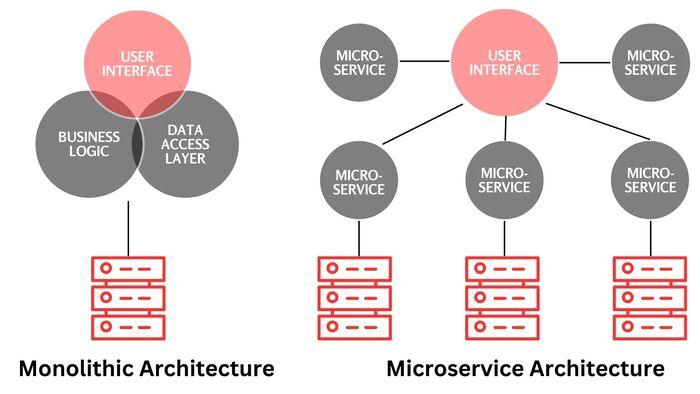
Monolithic architecture is a software design pattern where an entire application is designed as a single, self-contained unit. In this architecture, all application components, such as the user interface, database, and backend logic, are tightly coupled and run on a single process or server.
We can think of monolithic architecture like a sandwich, where all the ingredients are stacked together to create a complete sandwich.
Monolithic architecture was a common approach to building large-scale applications before the rise of distributed computing and microservices architectures.
Monolithic architecture works well for small applications that do not require complex integration or high scalability. However, monolithic architecture may not be the best choice for large and complex systems requiring high scalability and fault tolerance. This is because maintaining and scaling a monolithic architecture can be challenging as the application grows. Making changes to one part of the system can affect the entire system, which becomes difficult to maintain and upgrade individual components.
Advantages of Monolithic Architecture
Monolithic architecture may not be suitable for large and complex applications, but there are many advantages to using monolithic architecture. Here are some of the advantages of monolithic architecture:
A monolithic architecture is relatively easier to design, develop and deploy as all components are combined into a single unit leading to faster development time and easier maintenance.
Monolithic architecture is easy to scale; scaling can be achieved by replicating the entire application in multiple instances. This means multiple copies of the entire application are created and run simultaneously to handle increased traffic or load.
Since the application is a single unit, testing, and debugging can be simplified, saving time and effort during development.
A monolithic architecture can be cost-effective as there is no need for additional infrastructure and equipment to manage the various components. This can be beneficial for small applications or startups with limited resources.
Disadvantages of Monolithic Architecture
When it comes to monolithic architecture, there are some downsides. Some of them are as follows:
One of the most significant issues is the tight coupling between different application parts. This means that if we want to change one component, we may also need to change other parts of the system. This can make development cycles longer and limit flexibility.
Another issue is scalability. If we need to scale up a monolithic application, we often have to scale the entire system rather than just the parts that need more resources. This can lead to wasted resources and increased costs.
Monolithic architectures also have a single point of failure. If one part of the system experiences a failure, it can bring down the entire application. This can result in more extended downtime and lost revenue.
In addition, monolithic architectures can be technology-locked, which means switching to a different technology stack or integrating new tools and technologies may be challenging.
Finally, monolithic architectures can be challenging to maintain. As the system grows in complexity, debugging and troubleshooting issues can be difficult without impacting other system parts. This can result in longer development cycles and slower time-to-market for new features.
What is Microservices Architecture?
Microservices refer to an architectural approach where an application is designed and built as a collection of small, independent services that work together to provide the system's overall functionality. This approach differs from the traditional monolithic architecture, where the entire application is built as a single unit.
In a microservices architecture, each service is responsible for a specific function or feature of the application. These services communicate with each other through APIs (application programming interfaces) and can be developed, deployed, and scaled independently of the rest of the application.
Advantages of Microservices
Here are some advantages of microservices:
Microservices can be developed, updated, and deployed independently, making it easier to add new features or services to the application.
Microservices are designed to handle failures gracefully, so if one service goes down, the rest of the application can continue functioning.
Different services can use different technologies, which allows teams to choose the best tool for the job.
Each microservice has a specific responsibility, making identifying and fixing issues or bugs easier.
Each microservice can be scaled independently, allowing the application to handle increased traffic or demand.
Overall, microservices provide many benefits that can help improve software applications' efficiency, scalability, and flexibility.
Disadvantages of Microservices
Here are some disadvantages of microservices:
Microservices can introduce additional complexity, as each service may have its own architecture, technology stack, and deployment process.
Managing multiple services can require additional overhead, such as monitoring and coordination.
Communication between microservices over a network can introduce latency, affecting application performance.
Testing microservices can be more challenging than testing a monolithic application, as each service may have its own dependencies and interactions with other services.
Microservices can introduce additional security concerns, as each service may have authentication and authorization requirements.
Frequently Asked Questions
Q. Which is better monolithic or microservices?
Monolithic is simpler but less scalable, while microservices offer flexibility but complexity. Decide based on project goals and resources. Hence, the choice depends on need of the project.
Q. Is Docker monolithic or microservices?
Docker itself is not a monolithic or microservices architecture. It's a containerization platform that can be used to package and deploy both monolithic and microservices-based applications, depending on your design choices.
Q. Is Kubernetes a microservice?
No, Kubernetes is not a microservice itself. It's an orchestration platform that helps manage and deploy containerized applications, including both monolithic and microservices-based applications.
Q. Is microservices a VM or container?
Microservices are typically deployed as containers, not virtual machines (VMs). Containers offer lightweight, isolated environments that are well-suited for microservices architecture, making them more flexible and efficient.
Q. How does monolithic architecture impact fault tolerance?
Monolithic architecture can make fault tolerance more challenging, as a fault in one component can bring down the entire application.
Conclusion
In conclusion, both monolithic and microservices-based architectures have their own advantages and disadvantages.
In monolithic architecture, the entire application is built as a single unit, which is easier to develop but can be challenging to update and scale as the application grows.
On the other hand, in microservices-based architecture, the application is built as a set of small independent services that communicate with each other over a network. It provides greater flexibility and scalability but can be more complex to manage.
When deciding which approach to use, it is essential to consider what the application needs. If it's short and simple, monolithic architecture may be best. However a microservices-based architecture may be a better choice if it is large and complex.
Explore our System Design-guided path to continue learning and improving your skills. This comprehensive resource covers everything you need to know to get started with system design.
We hope this blog has provided helpful insights, and we welcome your feedback in the comments section.
Live masterclass
Amazon-Ready Excel & AI Skills: Ace 20L+ Data Analyst Roles
by Prerita Agarwal
15 Oct, 2026
11:30 AM
Crack GenAI Interviews: Fix AI Hallucinations, Latency & Cost
by Shantanu Shubham
12 Oct, 2026
11:30 AM
PowerBI Dashboard Using T20 World Cup Data
by Sumit Shukla
13 Oct, 2026
11:30 AM
Build a GenAI Copilot: Upgrade from SDE to AI Engineer
by Saurav Prateek
14 Oct, 2026
11:30 AM
Amazon-Ready Excel & AI Skills: Ace 20L+ Data Analyst Roles
by Prerita Agarwal
15 Oct, 2026
11:30 AM
Crack GenAI Interviews: Fix AI Hallucinations, Latency & Cost






 5+ registered

