Do you think IIT Guwahati certified course can help you in your career?
Introduction
The concept of neural style transfer (NST) is a great one. The main principle behind NST is that it is possible to separate the style and content representations in a CNN learned during a computer vision task (e.g., image recognition task).
NST uses a pre-trained convolution neural network (CNN) to transfer styles from one image to another, based on this notion. This is accomplished by creating a loss function that attempts to minimize the disparities between a content image, a style image, and a generated image, all of which will be addressed in greater depth later.
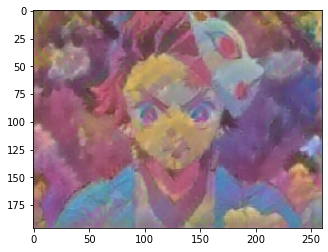
In simpler terms, Neural style transfer is an optimization technique that blends three images — a content image, a style reference image, and the input image we want to style — so that the input image looks like the content image. Still, it is "painted" in the style of the style image.
Architecture Of Neural Transfer Style
As previously said, neural style transfer employs a convolutional neural network that has been pre-trained. NST then defines the following inputs to produce a loss function that seamlessly blends two photos to generate visually pleasing art:
A content image (c) is how we want to apply a style.
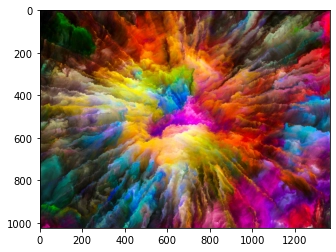
A style picture (or images) – the image we want to transfer the style.
The picture that contains the result (g) is an input (produced) image (g) (the only trainable variable)
The model's architecture, as well as how the loss is calculated, are shown below. We don't need to have a deep understanding of what's going on in the image below because each component will be discussed in detail. The goal is to provide a high-level overview of the procedure during style transfer.
Now, we may wonder what these different types of losses are and how NST works. To answer that, let us first look at how NST works.
Working Of NST
According to the basic theory behind Neural Style Transfer, "It is possible to decouple the style representation, and content representations in a CNN trained during a computer vision task (e.g., image recognition task)."
We already know many cutting-edge models such as AlexNet, VGG, RESNET, and many others. These models have one thing in common: they were trained on the ImageNet Dataset (14 million images with 1000 classes), which allows them to understand the ins and outs of each image. By separating the content and style parts of an image and giving a loss function to maximize the needed outcome, we can use the quality of these models.
As previously stated, we define a pre-trained convolutional model and loss functions that visually blend two images, so we'll need the following inputs.
A Content Picture is an image that will be used to impart style.
A Style Image - the look and feel we wish to convey
A created input image – the final content and the appropriate style image.
We'll look at several intermediate layers in our model to gain our image's content and style representations. As you travel deeper into the map, the middle levels reflect feature maps that grow higher organized. We're utilizing the VGG19 network architecture, a pre-trained image classification network. These intermediate layers are required to define our photos' content and style representation. We will match the corresponding style and content target representations for an input image at these intermediate layers.
Now the question arises why intermediate layers?
Why Intermediate Layers?
You might be asking why we can define style and content representations using intermediate outputs from our pre-trained image classification network. This phenomenon can be explained at a high level by the fact that a network needs understand the image to do image classification (which our network has been trained to do). This entails taking the raw image as input pixels and constructing an internal representation using transformations that convert the primary image pixels into a complex understanding of the image's properties. This is also one of the reasons why convolutional neural networks generalize well: they can capture invariances and define features inside classes unaffected by background noise and other annoyances. As a result, somewhere between where the raw image is fed in and where the categorization label is produced, the model acts as a complicated feature extractor, allowing us to define the content and style of incoming images by accessing intermediary layers.
Loss Functions
To obtain the intended image, we must define a loss function that optimizes the losses to achieve the desired output. The concept of per-pixel losses will be used here.
Per Pixel Loss is a statistic for determining the differences between photographs at the pixel level. The output pixel values are compared to the input pixel values. (Perpetual loss functions are another option, which we shall examine briefly later in this blog.) Each pixel loss can have its own set of difficulties when displaying every relevant trait. That's where the problem of repeated losses comes into play. We'll be concentrating on the following loss terms:
Content Loss
Style Loss
Content Loss
It ensures that the content we desire in the resulting image is efficiently captured. The higher tiers of the network, according to CNN, capture information about the content, but the lower levels are more focused on particular pixel values. Our concept of content loss is reasonably straightforward. We'll send the requested content image and base input image to the network. Our model's intermediate layer outputs (from the layers defined above) will be returned. The Euclidean distance between the two intermediate representations of those images is then calculated. Content loss is calculated by:
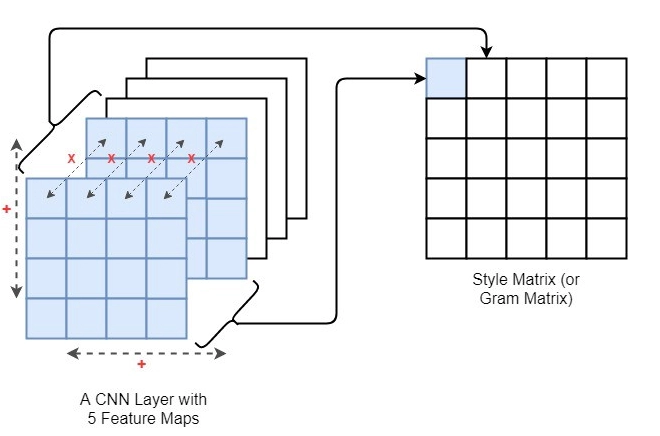
Because computation involves numerous levels, defining the loss function for style takes more time than defining the loss function for content. The correlation between the feature maps per layer determines the style information. For computing style loss, we use the Gram Matrix. What is a gram matrix, exactly?
The gram matrix is a metric for capturing the distribution of features across a collection of feature maps in a layer. So, while you're computing or limiting the style loss, you're also ensuring that the amount of feature distribution in both the styles and generated images is the same. The aim is to create style and generated picture gram matrices, and compute their difference. The Gram matrix (Gij) is the sum of a layer's ith and jth feature maps multiplied by their height and breadth.
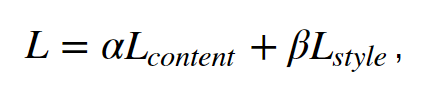
As a result, we'll compute a weighted sum of both the calculated content and style losses to arrive at the final loss.
The above code completes the final integration of losses by traveling through the layers and determining the final loss by taking a weighted summation in the second last line. Finally, we'll need to define an optimizer (Adam or SGD) to minimize the network's loss.
Implementation
Importing the Libraries
import tensorflow_hub as hub
import tensorflow as tf
from matplotlib import pyplot as plt
import numpy as np
import cv2
You can also try this code with Online Python Compiler
1. In the Neural Style Transfer, what is the style loss?
Ans. Total variation loss imposes local spatial continuity between the pixels of the combined image, resulting in visual coherence. Deep learning is retained in the style loss, determined using a deep convolutional neural network.
2. In terms of style transfer, what is a gram matrix?
Ans. By using a gram matrix to combine characteristics extracted from convolutional neural networks. The Gram Matrix can be calculated using the following formula: V. gram=V. gram=V. gram=V. gram=V Multiply with the transpose of V, which is an arbitrary vector.
3. What is total variation loss, and how does it affect you?
Ans. The total variation loss is the sum of the absolute differences for contiguous pixel-values in the input images. This metric determines how much noise is there in the photographs.
4. Is supervised learning possible with Neural Style Transfer?
Ans. The neural style transfer inputs two images (x) and trains a network to produce a new, synthesized image as a supervised learning task (y).
Key Takeaways
Let us brief the article.
Firstly, we saw the basics of neural style transfer and how it can create effects. Later, we saw the architecture of NST, followed by the working of the NST. Moving on, we saw different types of losses in NST, and lastly, we saw the basic implementation of NST.
I hope you all like this article.
I hope you all like this article. Want to learn more about Data Analysis? Here is an excellent course that can guide you in learning. Can also refer to our Machine Learning course.
Happy Learning Ninjas!
Live masterclass
Google SDE Roadmap to land 30L+ CTC
by Saurav Prateek
25 May, 2026
03:00 PM
Zero to Data Analyst: Amazon Analyst Roadmap for 30L+ CTC
by Abhishek Soni
24 May, 2026
06:30 AM
Top GenAI Skills to crack 30 LPA+ roles at Amazon & Google
by Sumit Shukla
24 May, 2026
08:30 AM
PowerBI + AI for Data Analytics: Secure 30L+ CTC at Netflix
by Ashwin Goyal
25 May, 2026
11:30 AM
Google SDE Roadmap to land 30L+ CTC
by Saurav Prateek
25 May, 2026
03:00 PM
Zero to Data Analyst: Amazon Analyst Roadmap for 30L+ CTC







 5+ registered