Do you think IIT Guwahati certified course can help you in your career?
Introduction
Compiler design is an important topic in computer science that deals with the process of converting high-level programming languages into machine-readable code. A parse tree is a diagram used in compiler design to visually organize and display how a program is built according to its grammar rules. It helps show the arrangement and relationship of elements within the program, which makes it easier to understand and process the code correctly. Parse trees play a crucial role in understanding how a program is organized & how its components fit together.
In this article, we will learn what parse trees are, the rules for drawing them, and see examples to show how they work.
What is a Parse Tree?
A parse tree, also known as a syntax tree or an abstract syntax tree (AST), is a graphical representation of the syntactic structure of a program or a sentence in a programming language. It visually depicts how the compiler interprets the source code based on the language's grammar rules. In a parse tree, each node represents a construct in the source code, such as a statement, expression, or variable declaration.
The tree structure follows a hierarchical pattern, with the root node at the top representing the entire program or statement. The internal nodes represent non-terminal symbols, which are symbols that can be further expanded into other symbols or terminals. The leaf nodes, or the bottom-most nodes, represent terminal symbols, which are the actual tokens or lexemes in the source code that cannot be further divided.
Parse trees provide a clear & organized way to understand the structure of a program. They help in visualizing the relationships between different parts of the code, such as the nesting of statements or the precedence of operators. With the careful examination of the parse tree, developers can identify potential syntax errors, perform code analysis, and apply transformations or optimizations to the program.
Rules to Draw a Parse Tree
To draw a parse tree, we need to follow a set of rules that are important in its construction. These rules ensure that the parse tree accurately represents the syntactic structure of the program according to the grammar of the programming language. The main rules for drawing a parse tree are :
1. Start with the root node: Begin by placing the start symbol of the grammar as the root node of the parse tree. The start symbol represents the entire program or statement.
2. Expand non-terminal symbols: For each non-terminal symbol encountered, create child nodes based on the production rules of the grammar. Non-terminal symbols are those that can be further expanded into other symbols or terminals.
3. Apply production rules: Look for the appropriate production rule in the grammar that matches the non-terminal symbol being expanded. The right-hand side of the production rule determines the child nodes to be created.
4. Repeat the process: Recursively apply steps 2 and 3 for each non-terminal symbol until all non-terminal symbols have been expanded and only terminal symbols remain as leaf nodes.
5. Verify the parse tree: Ensure that the resulting parse tree is consistent with the grammar rules and accurately represents the syntactic structure of the program.
Let’s see a simple example to show the process of drawing a parse tree:
Consider the grammar:
A → B + C
B → x
C → y
To draw the parse tree for the expression "x + y", we start with the root node A. Then, we expand A using the production rule A → B + C, creating child nodes B, +, and C. Next, we expand B and C using their respective production rules, resulting in the terminal symbols x and y as leaf nodes.
The final parse tree would look like this:
    A
   / | \
  B  +  C
  |     |
  x     y
Examples
Now that we have covered the rules for drawing parse trees, let's look at a few more examples to improve our understanding.
We'll consider a simple arithmetic expression grammar and see how parse trees are constructed for different expressions.
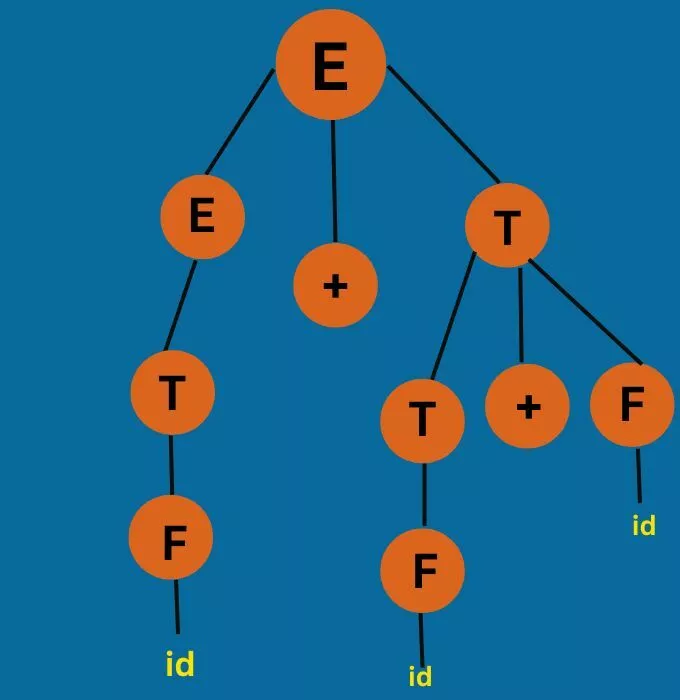
Example 1
Grammar:
E → E + T | T
T → T * F | F
F → ( E ) | id
Expression: id + id * id
Parse Tree:
    E
   / \
  E   +   T
  |      / \
  T     T   *   F
  |     |       |
  F     F       id
  |     |
 id    id
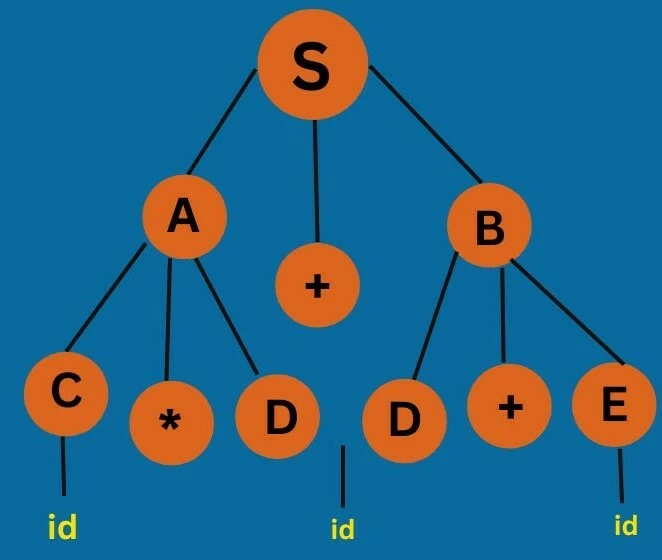
Example 2
Grammar:
S → A + B
A → C * D
B → D + E
C → id
D → id
E → id
id * id + id + id
Parse Tree:
        S
       / \
      A   +   B
     / \     / \
    C   *  D  D   +  E
    |      |  |      |
   id     id id     id
In these examples, we can see how the parse trees are constructed by recursively applying the production rules of the grammar. The parse trees visually represent the structure of the expressions, showing the relationships between operators and operands.
Note: Parse trees can be more complex for real-world programming languages with extensive grammars and numerous production rules. However, the basic principles of constructing parse trees remain the same.
Uses of Parse Tree
1. Syntax analysis
Parse trees are primarily used in the syntax analysis phase of a compiler. They help in verifying whether a program is syntactically correct according to the grammar rules of the programming language. By constructing a parse tree, the compiler can determine if the program adheres to the specified syntax and identify any syntax errors.
2. Semantic analysis
After the parse tree is constructed, it serves as an input to the semantic analysis phase. The parse tree provides a structured representation of the program, allowing the compiler to perform various semantic checks, such as type checking, scope resolution, and identifier binding. The semantic analyzer traverses the parse tree and applies semantic rules to ensure the program's correctness.
3. Intermediate code generation
Parse trees can be used to generate intermediate code representations, such as three-address code or quadruples. The parse tree's structure helps in determining the order of evaluation and the generation of appropriate intermediate code statements. The intermediate code is a lower-level representation of the program that is closer to the target machine code.
4. Code optimization
Parse trees can be utilized for code optimization techniques. By analyzing the parse tree, the compiler can identify opportunities for optimization, such as constant folding, dead code elimination, or code reordering. The parse tree's hierarchical structure enables the compiler to apply optimization algorithms effectively.
5. Program transformation
Parse trees facilitate program transformations, such as code refactoring or code instrumentation. By manipulating the parse tree, developers can restructure the code, introduce new nodes, or modify existing nodes to achieve desired transformations. Parse trees provide a convenient way to perform these transformations while preserving the program's correctness.
6. Error reporting
When a syntax error is detected during the construction of the parse tree, the compiler can provide informative error messages to the programmer. The parse tree helps in locating the exact position of the error in the source code & generating meaningful error messages that assist in debugging and fixing the issue.
Note: Parse trees are not only used in compilers but also in other areas like natural language processing, where they are used to represent the grammatical structure of sentences. They provide a foundation for various language processing tasks, that includes syntax-based machine translation, sentiment analysis, and information extraction.
Frequently Asked Questions
Can parse trees handle ambiguous grammars?
Yes, parse trees can represent ambiguous grammars, resulting in multiple valid parse trees for the same input.
Are parse trees and syntax trees the same?
Parse trees & syntax trees are similar but not identical. Parse trees include all the details, while syntax trees omit some non-essential information.
Can parse trees be constructed for any programming language?
Parse trees can be constructed for any programming language with a well-defined grammar, including both high-level & domain-specific languages.
Conclusion
In this article, we have learned about parse trees, their definition, and the rules for constructing them. We saw different examples of parse trees for different expressions & discussed their various uses in compiler design, like syntax analysis, semantic analysis, intermediate code generation, code optimization, program transformation, & error reporting. Parse trees provide a structured representation of programs, enabling compilers to perform critical tasks effectively.








 1+ registered

