Do you think IIT Guwahati certified course can help you in your career?
Introduction
The problem is based on Strings’ data structure, which plays a vital role in our programming language. We will be heading to various approaches to solve this problem of The Longest word in a dictionary.
Without any delays, let’s move on to our problem statement.
Problem Statement
In our problem, we will have an array of strings having words represented as an English dictionary. You have to find the longest word from the array such that all its prefixes already exist in the array.
Note:
You have to find the string which has the longest length.
If two words contain the prefixes in the array and are the same length, return the longest word with the smallest lexicographical order.
Example: Input: "a","banana","app","appl","ap","apply","apple" Output: apple
Explanation:
appl a ap app appl These four prefixes are present in the word ‘appl’ and in the array, which is why this can be a possible word as the output.
apply a ap app appl apply The word ‘apply’ has prefixes present in the array; therefore, this can be a possible word as the output.
apple a ap app appl apple The word ‘apple’ has prefixes present in the array; therefore, this can also be the output of our problem.
Now, we aim to find the longest word in the dictionary, as appl has a smaller length than words ‘apply’ and ‘apple.’ So it can’t be our output. If we see lexicographically, the word ‘apple’ comes before the word ‘apply.’ Therefore, the output will be “apple.”
The brute force approach will use HashSet Data Structure to store the prefixes present in the array. Using HashSet, we can check whether prefixes exist in the array or not.
class Solution {

    public String longestWord(String[] arr) {

      Arrays.sort(arr);

      // To store the prefixes
      HashSet<String> hash = new HashSet();
      // To store the final word in a new variable.
      String res= "";
      for(String str : arr){
          if(str.length() == 1 || hash.contains(str.substring(0, str.length()-1))){
              if(str.length() > res.length())
                    res= str;
              hash.add(str);
          }
      }
      return res;
    }
}
You can also try this code with Online Java Compiler
This approach will create a problem: if two strings have almost identical prefixes, they will repeatedly check. It will work multiple times, so our main work will be now to reduce this problem.
Approach2: Efficient
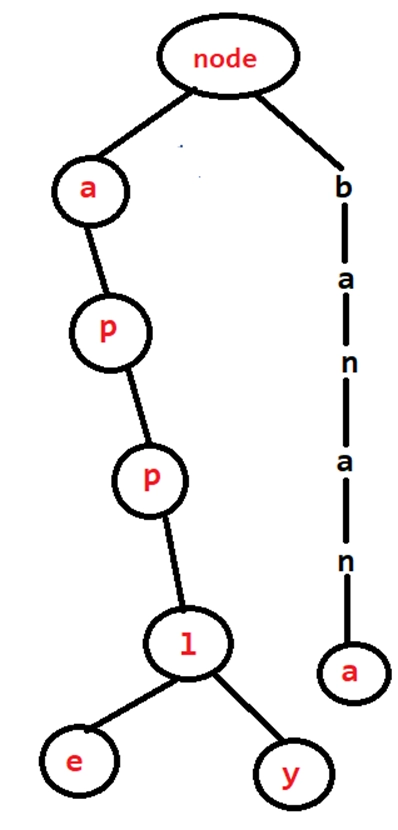
To reduce the repeated search of the same prefix, we will use the Trie Data structure to locate specific keys within a set.
These keys are often strings, with links between nodes defined not by the entire key but by individual characters.
The Trie is traversed depth-first, following the links between nodes, which represent each character in the key.
Something like this,
Traversal using DFS Algorithm by using travel and change strategy. As soon as we get the longest string, we update that variable.
In Node class, we will create an array containing the characters lexicographically, i.e., the smallest character at the front and the largest character at the end.
We will be traversing in such a way that we get the longest and lexicographically smaller string.
import java.io.*;
import java.util.*;

public class Main {
  public static class Node {

          // words contains lowercase letters only
Node[] children = new Node[26];
String word;


}

// To insert a word into the Trie
public static void insert(Node curr, String word) {

for (char c : word.toCharArray()) {
if (curr.children[c - 'a'] == null)
curr.children[c - 'a'] = new Node();
curr = curr.children[c - 'a'];
}
curr.word = word;
}

// To traverse the words character by character using DFS for finding the longest word
public static void dfs(Node node) {
if (node == null)
return;

if (node.word != null) {
if (node.word.length() > result.length())
result = node.word;
else if (node.word.length() == result.length() && node.word.compareTo(result) < 0)
result = node.word;
}

for (Node child : node.children)
if (child != null && child.word != null)
dfs(child);
}
static String result="";
  public static String longestWord(String[] words) {
    Node root=new Node();
    for(String s:words){
        insert(root,s);
    }
    dfs(root);
    return result;

  }

  public static void main(String[] args) throws Exception {
    BufferedReader read = new BufferedReader(new InputStreamReader(System.in));

    int n = Integer.parseInt(read.readLine());

    String[]words = new String[n];

    for (int i = 0; i < n; i++) {
      words[i] = read.readLine();
    }

    String result = longestWord(words);
    System.out.println(result);

  }
}
You can also try this code with Online Java Compiler
Time Complexity: To solve the efficient approach, the Time complexity is O(number of words * word length). Space Complexity: The space complexity to solve the efficient approach is O(number of words).
FAQs
What is the Time and Space complexity to solve the above approach? The time complexity of the efficient approach is O(number of words * word length). The space complexity of the efficient approach is O(number of words).
What is the use of the Trie Data Structure? Trie is a search tree to locate specific keys from within a set.
Key Takeaways
In this blog, we covered the following things:
What the problem statement is about.
Approach 1 uses HashMap to check the prefixes in the array.
Approach 2 uses a Trie data structure that follows the DFS traversal technique following the links between the nodes. Also check out - Data Dictionary In Software Engineering
You can use Coding Ninjas Studio for various DSA questions typically asked in interviews for more practice. It will help you in mastering efficient coding techniques.
Happy Coding!!!
Live masterclass
Google SDE Roadmap to land 30L+ CTC
by Saurav Prateek
06 Apr, 2026
03:00 PM
Python + AI Skills to ace 30L+ CTC Data roles at Amazon
by Prerita Agarwal
05 Apr, 2026
06:30 AM
Beginner to GenAI Engineer Roadmap for 30L+ CTC at Amazon
by Shantanu Shubham
05 Apr, 2026
08:30 AM
Data Analysis for 20L+ CTC@Flipkart: End-Season Sales dataset
by Sumit Shukla
06 Apr, 2026
01:30 PM
Google SDE Roadmap to land 30L+ CTC
by Saurav Prateek
06 Apr, 2026
03:00 PM
Python + AI Skills to ace 30L+ CTC Data roles at Amazon






 24+ registered

