Do you think IIT Guwahati certified course can help you in your career?
Introduction
Curious about microcontrollers? Let us see what microcontrollers are. The 8051 microcontroller, introduced by Intel in 1981, is an 8-bit device featuring 40 pins in a dual inline package (DIP). With 4KB of ROM storage and 128 bytes of RAM, it also includes two 16-bit timers. Additionally, it offers four parallel 8-bit ports that can be programmed and addressed as needed.
Let us now start with understanding the Microcontroller: 8051 Architecture.
What is an 8051 Microcontroller?
The 8051 microcontroller is a Harvard architecture 8-bit microcontroller. It has a RISC (Reduced Instruction Set Computing) architecture. It features a single accumulator, 16-bit program counter, and 8-bit data bus. It has 4KB of on-chip program memory (ROM). It also haves 128 bytes of on-chip data memory (RAM) with a built-in memory controller.
It has four 8-bit I/O ports that can be programmed to be input or output. It also has two 16-bit timers/counters, a serial communication port, and an interrupt controller. The architecture supports direct addressing, register indirect addressing, and immediate addressing modes. Many manufacturers produce 8051 microcontrollers. Their variations are increased memory, additional peripherals, and improved clock speeds.
What is 8051 microcontroller architecture?
The 8051 microcontroller architecture is a widely used and versatile microcontroller architecture that was originally developed by Intel. It is an 8-bit microcontroller, meaning its data bus is 8 bits wide and it primarily operates on 8-bit data. Here's a breakdown of its key components and features:
CPU (Central Processing Unit): The 8051 features a robust CPU that can efficiently handle instructions related to arithmetic, logic, and control operations. It operates with a limited set of instructions that makes programming simpler.
Memory: The 8051 microcontroller contains both on-chip program memory (ROM or flash memory) and data memory (RAM). The size of these memories can vary, but a standard 8051 microcontroller has 4 KB of ROM and 128 bytes of RAM.
I/O Ports: It typically includes four 8-bit I/O ports (P0, P1, P2, and P3), totaling 32 I/O lines which can be used for input or output operations. These ports are bit-addressable, offering flexibility in interfacing with external devices.
Timers/Counters: The 8051 includes two 16-bit timers/counters (Timer 0 and Timer 1) that can be used in various modes to perform tasks like time delays or counting external events.
Serial Communication Control: It supports serial communication through its serial port, allowing for easy data exchange with other devices over serial protocols like RS-232.
Interrupt System: The 8051 architecture provides a robust interrupt system with five interrupt sources (two external interrupts, two timer interrupts, and one serial communication interrupt), facilitating the handling of asynchronous events.
Special Function Registers (SFRs): These registers control various aspects of the microcontroller's operation, including I/O port configuration, timer control, serial communication control, and interrupt handling.
Oscillator and Clock Circuit: The 8051 microcontroller requires an external oscillator for its clock source, which dictates the speed at which the microcontroller operates.
The 8051 architecture is known for its simplicity, wide availability, and extensive support in the form of development tools and software libraries.
Construction of 8051 Micro Controller
The construction of the 8051 microcontroller consists of the following main components:
CPU (Central Processing Unit) – Executes instructions and controls operations.
Memory – Includes 4KB ROM (for program storage) and 128B RAM (for data storage).
I/O Ports – Four 8-bit ports (P0, P1, P2, P3) for external communication.
Timers & Counters – Two 16-bit timers (T0, T1) for timing operations.
Serial Communication – UART (Universal Asynchronous Receiver/Transmitter) for serial data transfer.
Interrupts – Five interrupts (two external, two timer, one serial) for handling events.
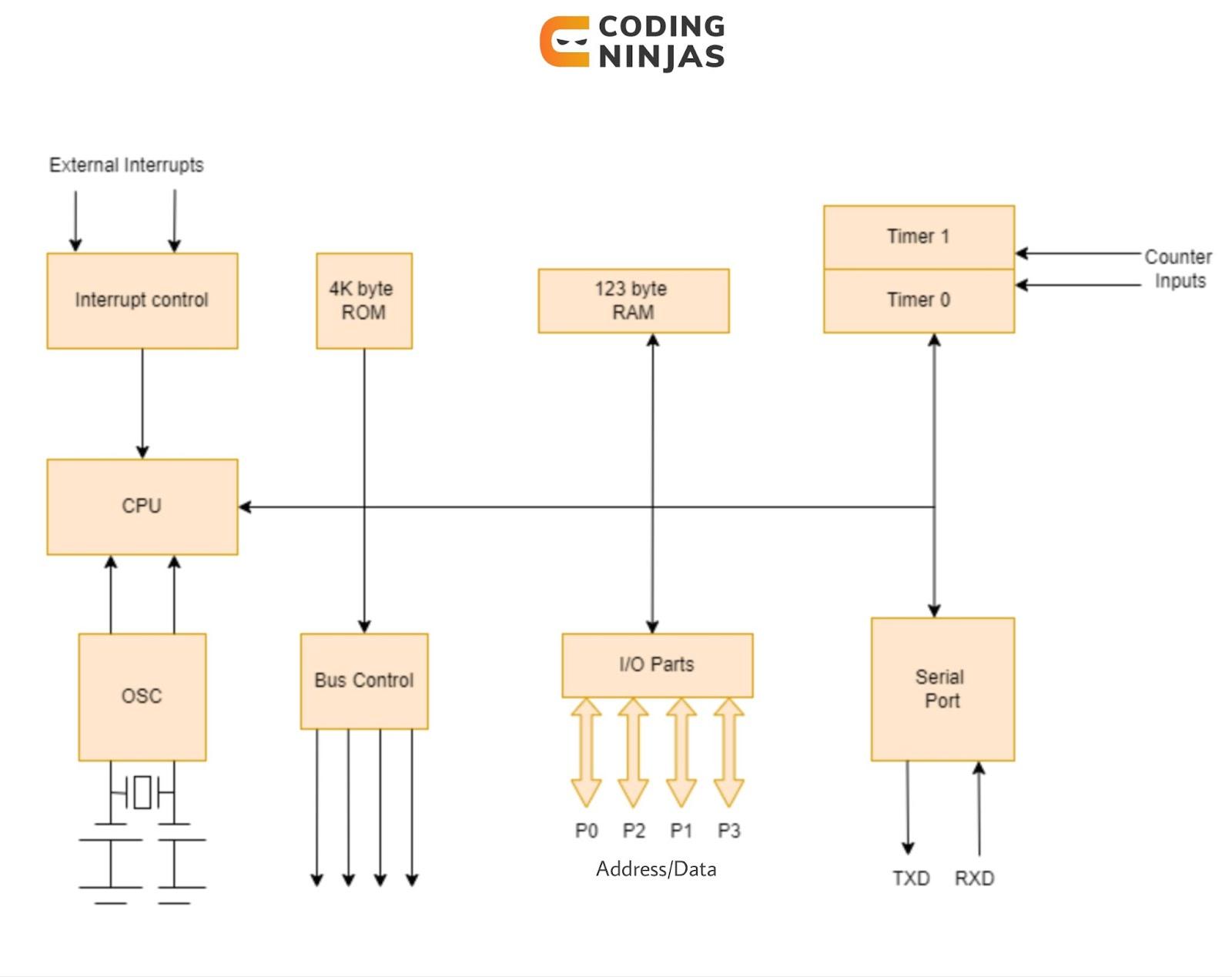
In this section, we will discuss the 8051 microcontroller architecture. The 8051 microcontroller architecture block diagram is:
The basic units present in the 8051 microcontroller architecture are:
CPU (Central Processing Unit)
The CPU is the brain of any processing machine. It is the part that is responsible for managing all the tasks of the microcontroller. The CPU is an independent unit. Users can not interfere with the CPU controlling how it should function. It identifies the tasks present in the ROM and then processes them. In the 8051 microcontroller architecture, the CPU is responsible for managing registers. Registers are a type of memory in a computer. They can store and manipulate data.
Interrupts
In the 8051 microcontroller architecture, interrupts stop the microcontroller’s current task. Interrupts are caused when some other program has a higher priority request for execution. When an interrupt occurs, the ongoing task stops, the sub-routine for the interrupt is executed, and then the previous job resumes.
Types of interrupts in 8051 Microcontroller
The following are the types of interrupts in the 8051 microcontroller architecture:
INT0
It is an external interrupt having code 0. External hardware cause this interrupt.
INT1
It is an external interrupt having code 1. External hardware cause this interrupt.
TF0
This is for timer 0 overflow interrupt.
TF1
This is for timer 1, overflow interrupt
RI/TI
This is a serial communication interrupt.
Memory
The next part of the 8051 microcontroller architecture is the memory. For any data manipulation to occur, we require a set of instructions. These programs need to be saved in memory. This memory where the program resides in the controller's memory is called code memory or program memory. It acts as ROM memory for the 8051 microcontroller architecture. In the 8051 microcontroller architecture, the microcontroller has 4KB ROM and 128 bytes of RAM.
Bus
A bus is a group of wires. Communication within the microcontroller happens through this bus. There are either 8 or 16 or more wires in the bus. If the 8051 microcontroller architecture has 8 wires, it can carry 8 bits of data. If the 8051 microcontroller architecture has 16 wires, it can carry 16 bits of data.
Types of Buses
Address Bus: The address bus in the 8051 microcontroller architecture is 16 bits. This bus transfers data from the CPU to the memory.
Data Bus: In 8051 microcontroller architecture, the data bus is 8 bits. It helps in carrying the data from one place to another.
Oscillators
The microcontroller requires a clock to perform operations. In the 8051 microcontroller architecture, we have an oscillator that functions as a clock for the CPU.
Input/Output Ports
A microcontroller controls small operations for a system. It is embedded in the systems. We might sometimes need to connect the microcontroller to other devices. In the 8051 microcontroller architecture, we have 4 input/output ports. We connect other input/output peripherals using these ports.
Timers/Counters
In the 8051 microcontroller architecture, we have two timers. They are each 16 bits. We have the timers to generate gaps between two events. The two timers generate two delays(gaps), and the suitable one is chosen.
Data Types
In 8051, there is only one data type of 8 bits, from the MSB (most significant bit) D7 to the LSB (least significant bit) D0. With an 8-bit data type, any data type larger than 8-bit must be broken into 8-bit chunks by the programmer before it is processed.
Stack
The stack is a section of RAM used by the CPU to store information such as data or memory address on a temporary basis. The CPU needs this storage area considering the limited number of registers. There are registers inside the CPU to point to the stack. A Stack Pointer register is used to access the stack. This stack pointer is 8 bits wide. The operation of storing the data in a stack is known as PUSH and getting it back into a CPU register is known as POP.
Registers
Registers are memory storage devices used in the CPU to temporarily store information. This information could be data to be processed or, an address pointing to the data to be fetched. The most widely used registers of the 8051 are
A (accumulator)
B register
R0-R7
DPTR (Data Pointer)
PC (Program Counter)
Stack Pointer (SP)
All these registers are of 8 bits, except DPTR and PC.
Addressing modes
Addressing modes in the 8051 microcontrollers are a way of specifying the location of an operand in memory. The addressing mode affects the number of bytes that the instruction takes up in the memory and the speed at which it is executed. We choose different addressing modes according to specific applications.
There are six different types of Addressing Modes.
Immediate Addressing Mode
Register Addressing Mode
Register Indirect Addressing Mode
Implied Addressing Mode
Direct Addressing Mode
Indexed Addressing Mode
Features of 8051 Microcontroller Architecture
Following are some of the features of the 8051 Microcontroller:
Supports direct addressing, registers indirect addressing, and immediate addressing modes.
Multiple variants with different enhancements and modifications.
Relatively easy to program.
Widely used and supported by many manufacturers and third-party tools.
Suitable for a wide range of applications. It includes industrial control systems, robotics, automotive systems, and consumer electronics.
Applications of 8051 Microcontroller Architecture
Some of the applications of the 8051 microcontrollers are as follows:
The 8051 microcontrollers are used in light sensing and controlling devices.
The microcontroller is used in fire-sensing devices.
It is also present in automobile and defence applications.
It is also used in a voltmeter.
8051 Pin Diagram
The 8051 microcontroller is a popular microcontroller in embedded systems. It has 40 pins, each of which has a specific purpose. An explanation of the 8051 pin diagram is provided below:
Port P0(Pins 32–39)
An 8-bit bidirectional I/O port is port 0.
It can be applied to operations involving input and output.
A different name for it is the "low-order" address bus.
Port P1 (Pins 1–8)
Another 8-bit bidirectional I/O port is Port 1, which is.
It can be applied to operations involving input and output.
A different use for it is to offer a collection of all-purpose I/O pins or external interrupt pins.
Port P2 (Pins 2–28 )
An 8-bit bidirectional I/O port is known as Port 2.
It can be applied to operations involving input and output.
Additionally, it functions as the high-order address bus for accessing external memory.
Port 3 (P3) (Pins 10-17)
A bidirectional 8-bit I/O port with additional specific functionality is port 3.
It contains two external interrupt pins (INT0, INT1) that can cause hardware interruptions from outside the device.
TXD and RXD, two additional pins, are provided for serial communication.
ALE (Address Latch Enable) (Pin 30):
A memory read/write operation uses ALE to latch the address of external memory devices.
It is a pulse signal produced by the 8051 to let other devices know that the data on the address bus is legitimate.
EA/VPP is used for two different functions depending on its logic level.
When connected to VCC (5V), it enables the 8051 to fetch code from external memory.
When connected to VPP (12V), it enables programming of the 8051's ROM.
PSEN (Program Store Enable) (Pin 29)
PSEN is used to indicate that external program memory is being accessed.
When activated, it informs the external ROM that the 8051 is fetching instructions.
RST (Reset) (Pin 9):
RST is an active-low reset input.
When pulled low, it resets the microcontroller, initializing it to its starting state.
XTAL1 and XTAL2 (Pins 18 and 19)
These are the connections for an external crystal oscillator or resonator.
They are used to provide the clock signal for the microcontroller.
VCC and GND (Pins 20 and 40)
VCC is the supply voltage pin (typically +5V).
GND is the ground reference pin.
Comparison with Other Microcontrollers
8051 vs PIC Microcontroller
Aspect
8051
PIC
Architecture
CISC (Complex Instruction Set)
RISC (Reduced Instruction Set)
Memory
Limited internal memory
More flexible memory architecture
Performance
Slower execution speed
Faster due to pipelining and RISC design
Application
Simple embedded projects
Automotive, industrial, real-time systems
Programming
Relatively less flexible
Wide compiler and tool support
8051 vs AVR Microcontroller
Aspect
8051
AVR
Ease of Programming
More traditional and assembly-heavy
C-friendly, supported by modern IDEs
Peripheral Support
Basic peripherals
Advanced I/O, timers, ADC, and PWM
Processing Speed
Up to 20 MHz
Typically 16–20 MIPS at same clock speed
Modern Usage
Declining in complex systems
Widely used in Arduino and DIY projects
When to Use 8051?
The 8051 is ideal for low-cost, low-power embedded applications where simplicity is key. It suits basic automation, educational kits, and small-scale control systems. With widespread legacy use, it remains practical for projects with minimal processing needs, especially when cost and board size are constrained.
Uses of 8051 Microcontroller
• Embedded Systems Used in basic embedded applications such as digital meters, alarms, and controllers. 8051’s ease of integration with other components makes it a go-to for many small embedded solutions.
• Automotive Systems Useful in vehicle systems like light control, dashboard systems, or engine temperature monitoring, where real-time processing is minimal and cost is a constraint.
• Robotics Powers basic robots for movement control, obstacle detection, and motor interfacing. Ideal for educational robotic kits and simple automation robots.
• Consumer Electronics Found in gadgets like microwave ovens, washing machines, and remote controls where predefined control logic is sufficient.
• Communication Systems Supports protocols in RS232/RS485 for UART-based communication. Useful in devices like intercoms, wireless modules, or GSM-based controllers.
• Medical Devices Employed in heart rate monitors, temperature sensors, and infusion pumps, where real-time but low-complexity control is needed.
• Industrial Control Systems Used in conveyor systems, PLCs, and stepper motor controllers. The 8051 excels in consistent, repetitive tasks with minimal downtime.
Common Issues in the 8051 Microcontroller
• Limited Memory 8051 microcontrollers typically have small on-chip RAM and ROM, which restricts the complexity of programs and data they can handle.
• Limited Processing Power The 8051 lacks high-speed processing, making it unsuitable for intensive or real-time applications involving complex calculations or multiple I/O tasks.
• Limited Peripheral Support It comes with basic I/O support and lacks built-in modern peripherals like USB, CAN, or advanced ADCs, restricting its scope in newer tech designs.
• Limited Development Tools Fewer modern IDEs and debugging tools support 8051 compared to newer microcontrollers, slowing development and reducing efficiency for advanced applications.
• Limited Security Features 8051 lacks advanced hardware security mechanisms, making it vulnerable in applications requiring secure communication or data protection.
Advantages of 8051 Microcontroller Architecture
The 8051 microcontroller architecture offers several advantages, making it popular in embedded systems:
Wide Availability: It's one of the most widely used microcontrollers, with numerous variants and extensive support available.
Low Cost: The 8051 is cost-effective for a wide range of applications, making it a go-to choice for budget-sensitive projects.
Simple Architecture: Its straightforward architecture is easy to understand and program, ideal for beginners and complex projects alike.
Power Efficiency: It is designed for low power consumption, extending the battery life of portable devices.
Versatile I/O Operations: Provides a variety of built-in I/O operations, including timers, serial communication, and interrupt handling, facilitating diverse applications.
Large Community and Resources: There's a vast community of developers and an abundance of resources, tools, and compilers, which eases the development process.
Embedded C Compatibility: It supports programming in Embedded C, a popular language for microcontroller programming, alongside assembly language.
Robust Peripheral Support: Offers strong support for interfacing with various peripherals, enhancing its applicability in complex embedded systems.
Disadvantages of 8051 Microcontroller Architecture
The 8051 microcontroller architecture, while widely used, has several disadvantages:
Limited Memory: The standard 8051 comes with only 4KB of ROM and 128 bytes of RAM, which may not suffice for more complex applications.
Single Accumulator: Reliance on a single accumulator for operations can lead to bottlenecks in processing and increased instruction execution time.
No Power Management: Older 8051 models lack advanced power management features, leading to higher power consumption compared to modern microcontrollers.
Slower Speed: Compared to contemporary microcontrollers, the 8051's clock speed is relatively slow, affecting performance in time-sensitive applications.
Fewer I/O Ports: With only four 8-bit I/O ports, the 8051 provides limited direct interface capabilities for peripherals and sensors.
No In-built ADCs: Absence of built-in Analog-to-Digital Converters (ADCs) necessitates external components for analog signal processing, increasing complexity and cost.
Limited Interrupt Sources: With a fixed number of interrupt sources, the 8051 cannot handle multiple simultaneous interrupts efficiently, impacting real-time response.
Primitive Serial Communication: The 8051's serial communication capabilities are basic, lacking support for more advanced protocols directly.
Non-Scalable Architecture: The traditional 8051 architecture is not easily scalable for more demanding applications, requiring significant external components to extend functionalities.
Complex Programming Model: The programming model of the 8051, based on an 8-bit architecture with specific instruction sets, can be more challenging for beginners compared to more modern microcontrollers with user-friendly development environments.
Frequently Asked Questions
Which architecture is microcontroller?
There are two architectures Harvard architecture and von Neumann architecture in which microcontroller architecture can be based upon. Both of them offer different methods for exchanging data between processor and memory.
What is the full name of 8051?
The full name of the 8051 microcontroller is "Intel MCS-51." It is a single-chip microcontroller (MCU) series developed by Intel in 1980 for use in embedded systems.
What is A in the 8051 microcontrollers?
A (Accumulator) in 8051 microcontrollers is the most widely used register. B, R0-R7, DPTR(data pointer), and PC (program counter) are some other registers that are used. All these registers are of 8 bits, except DPTR and PC.
Is 8051 architecture CISC or RISC?
A Complex Instruction Set Computer, or CISC, architecture is what the 8051 architecture is known as. It has an extensive instruction set that includes many complex instructions for arithmetic, logic, and control operations. These instructions are made to be flexible and adaptive for programming activities.
Why is 8051 microcontroller used?
The 8051 microcontroller is a popular choice because of its affordability, dependability, and adaptability. It provides a wide range of compatibility with a broad range of development tools and resources, flexibility of programming, wide availability, and a comprehensive set of integrated peripherals.
Conclusion
In this article, we learned what a Microcontroller: 8051 Architecture is. We saw who designed the 8051 microcontrollers and which category it falls into. We learned about the architecture of the 8051 microcontrollers. Its architecture includes seven major components: CPU, interrupts, timers/counters, oscillators, I/O ports, bus, and memory.







 7+ registered

