Do you think IIT Guwahati certified course can help you in your career?
Introduction
Hello there, Ninjas!! Have you heard about Asio C++ Library? Do you know what Asio-Pipes are? If not, then don't worry. We will help you to clear all your doubts. Asio is for those who want to know how to connect a language to networking and have input and output of connections in C++.
In this article, we will discuss what Asio-Pipes are. We will also discuss how we can use them. But first, just have a brief introduction about Asio, and we recommend you freshen up your C++ fundamental knowledge.
Asio
Asio is an open-source asynchronous input-output and cross-platform C++ library. It is designed for input, output, and networking. It was developed in 2003 by Christopher M. Kohlhoff and was released under Boost Software License. It provides an asynchronous model to the developers using a modern approach of C++. Many platforms, like Windows, macOS, Linux, etc., support it.
Applications ranging from mobile apps to the quickest stock markets in the world are using Asio. There are two types of Asio:
Boost
Non-Boost
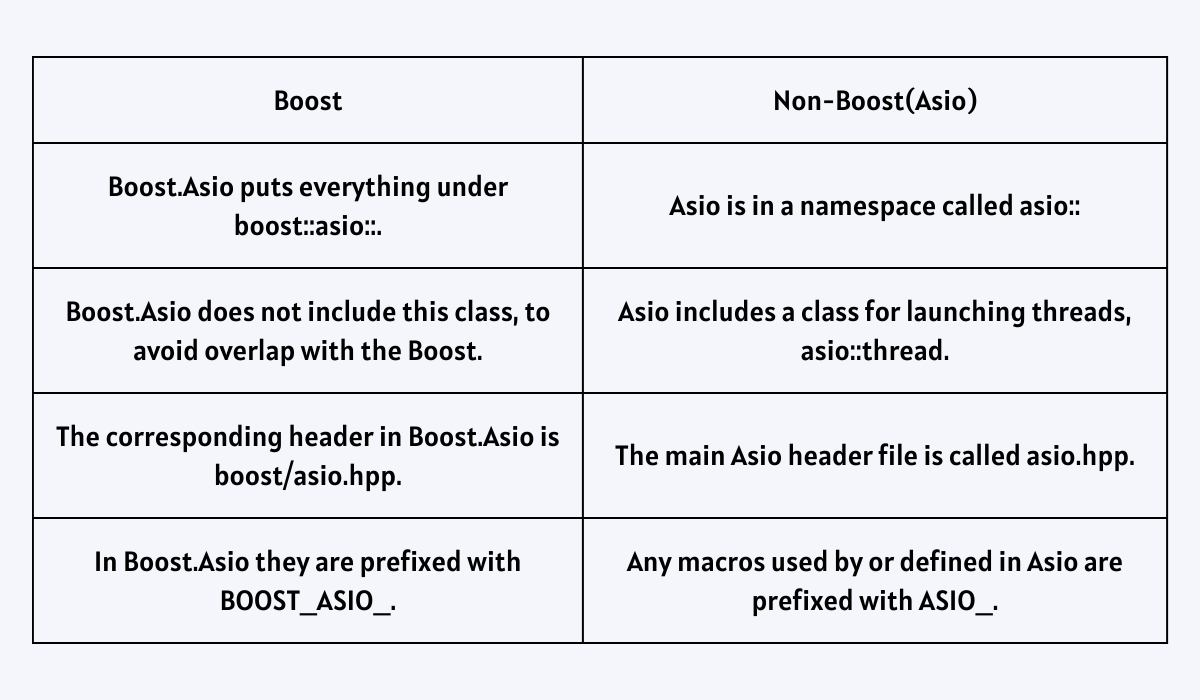
So the difference between Boost and Non-Boost or normal Asio are mentioned below:
The pipe is a method where we try to use the output of one program process as input to another. Asio pipes are a means of communicating between processes using the Asio library in C++. They allow you to send data between processes using a pipe, which is a unidirectional data channel that can be used to pass information from the output of one process to the input of another. Asio pipes can be used to create a pipeline of processes, where the output of one process is fed as the input to the next, and so on. This can be useful for creating complex processing flows or for enabling interprocess communication. There are five ways by which we can provide different types of functionality.
basic_writable_pipe
basic_readable_pipe
connect_pipe
readable_pipe
writable_pipe
basic_writable_pipe
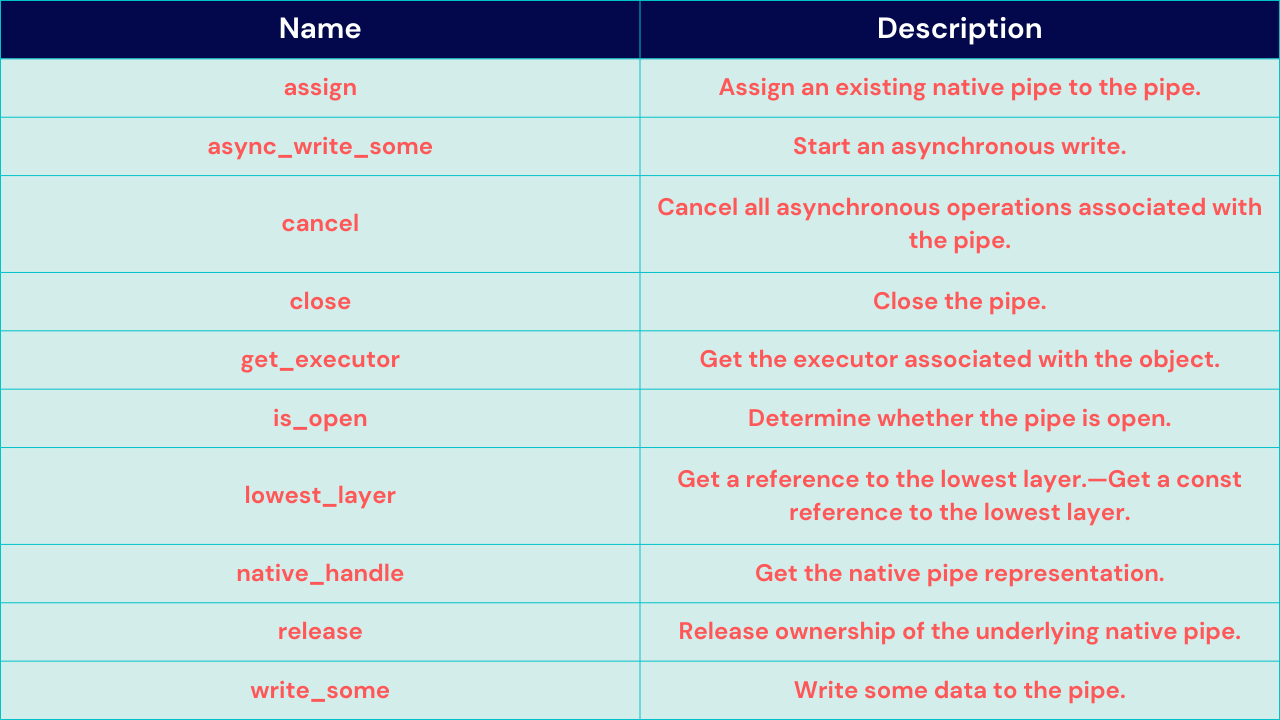
It provides different functionality to Asio Pipes and has the same types as basic_readable_pipe. The basic_writable_pipe class provides a wrapper over Pipe functionality.
Member Functions
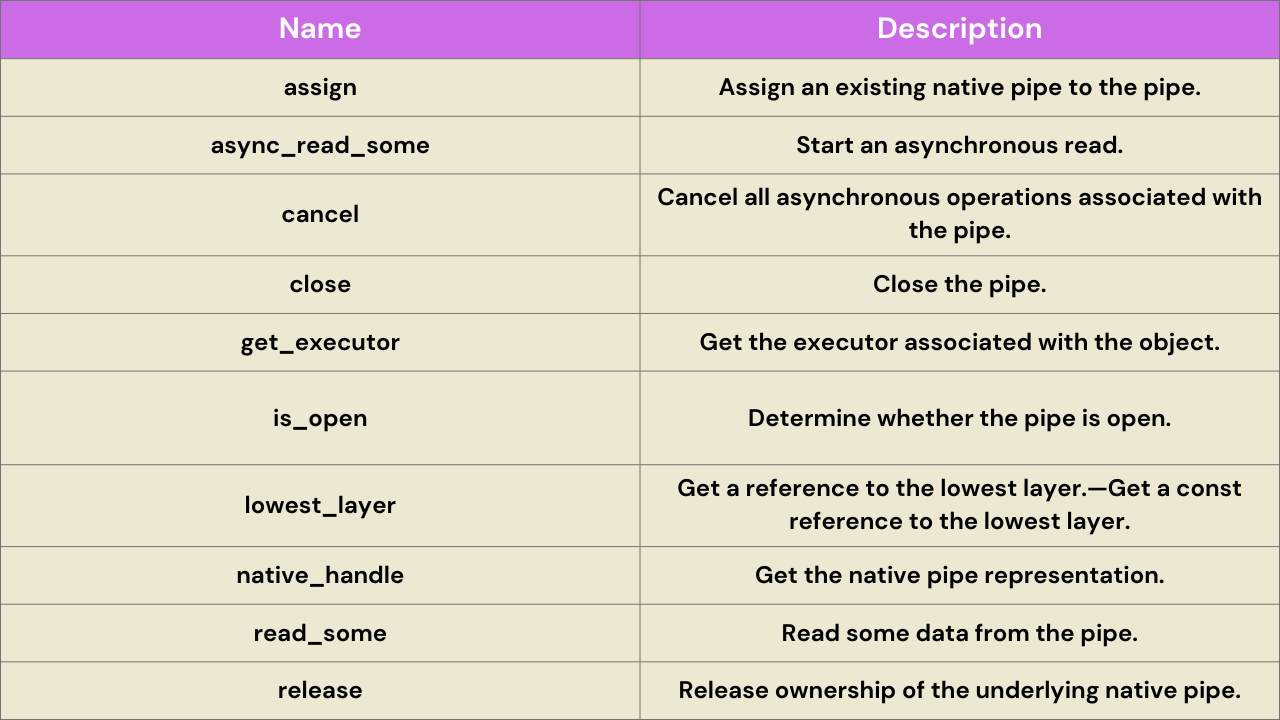
These are some functions, and some of them are common for every type of Asio Pipe.
basic_readable_pipe
basic_readable_pipe provides different types of functionality in the Asio Pipes. The basic_readable_pipe class wraps around pipe functionality.
There are four types of basic_readable_pipe:
⭕rebind_executor rebinds the types of Pipe to another executor.
⭕executor_type is used for the types of executors that are associated or linked with the object.
⭕lowest_layer_type is like the other name of basic_readable_pipe, which is the lowest layer.
⭕native_handle_type is used to represent Pipes like
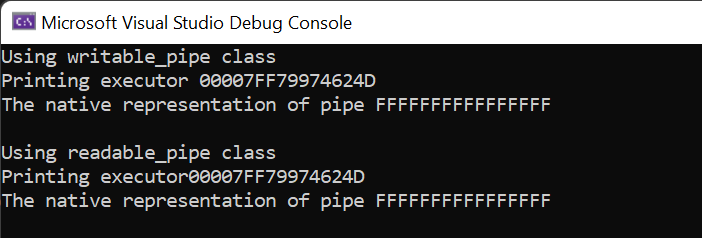
In the above example, we created an instance(io) of asio::io_context. Then we passed this instance(io) to the pipe1 instance of asio::writable_pipe. After this, we called the native_handle function(native_handle()) on the asio::writable_pipe::native_handle_type. We used this function to obtain the Native Pipe representation. Similarly, we worked on the readable_pipe.
The basic_channel class is used for sending messages across different parts of the same application.
What are the advantages of the Asio library?
Asio is used in projects such as the WebSocketPP library and the DDT3 remote debugger for the Lua programming language. Asio is free and open-source software licensed under the Boost Software License, and it runs on Linux, Windows, macOS, and FreeBSD.
What does asynchronous mean?
Asynchronous means that a process is independent of the execution of any other process. The execution is not blocked for operations if more than one is in progress.
What is the use of the Asio library?
Asio helps in doing network programming using C++ language. It allows the processing of data asynchronously by providing asynchronous I/O models.
Conclusion
We have discussed Asio Pipes in this article. We have covered Asio, Asio pipes, basic_readable_pipe, basic_writable_pipe, etc. We hope this article helps you enhance your knowledge of Asio pipe. We recommend you read some more articles on Asio.







 13+ registered