Table of contents
1.
Introduction
2.
Cayley Hamilton Theorem and History
2.1.
History
3.
Examples of Cayley Hamilton Theorem
3.1.
For 2 x 2 Matrix
3.2.
For 3 x 3 Matrix
4.
FAQs
5.
Key Takeaways
Last Updated: Mar 27, 2024

Cayley-Hamilton Theorem

Author Naman Kukreja
0 upvote
Career growth poll
Do you think IIT Guwahati certified course can help you in your career?

Introduction

When you are working with matrices, you may have observed many cases when you want to use many powers of the same matrix. And even when you want to use the matrix in the linear equation, it is a lot of nuisance to calculate all these powers and equations again and again by just a tiny difference. So is there any method to solve this problem?

The answer to the above question is yes. We can solve all these problems with the Cayley-Hamilton theorem. We will learn more about this theorem while moving further with our blog so without wasting any time, let's proceed with our topic.

Cayley Hamilton Theorem and History

Cayley-Hamilton theorem states that every square matrix satisfies its characteristic equation when it is presided over by a commutative circle. A matrix with an equal number of rows and columns is known as a square matrix. 

We use many terms in its equation to satisfy the characteristic equation. To find the characteristic polynomial of A, the equation is:

p(x) = det(xI- A)  ——— equation 1

In the above equation, A is a Square matrix, det refers to the determinant, I is the identity matrix, x is the variable, and p is the polynomial of the variable x.

This theorem states that in equation 1 when you substitute x with A, the result will be a zero matrix.

p(A) = 0

History

This theorem was made for working with linear algebra. It was theorized in the 17th century by two great mathematicians, Arthur Cayley and Rowan Hamilton. Arthur Cayley had given the basic idea, and Rowan Hamilton assisted him in succeeding with his idea.


Examples of Cayley Hamilton Theorem

We will prove the theorem for a 2 x 2 square matrix and a 3 x 3 square matrix.

For 2 x 2 Matrix

Let’s take an example where A is the square matrix and is equal to 

We are now putting the value of A and x as λ in equation 1. We will get the following equation:

Now solving the above determinant will result in the following equation:

To prove the Cayley Hamilton theorem, we need to put A in the above equation in place of λ, and the result must be equal to a zero matrix.

It is coming equal to a zero matrix. Hence it satisfies the Cayley Hamilton Theorem.

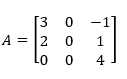
For 3 x 3 Matrix

Let’s take a 3 x 3 square matrix A as below:

We will now put the value of A and the value of x as λ in equation 1. By making the following changes, the equation will look like this:

We need to get an equation to prove the Cayley Hamilton theorem that we will get by solving the above determinant. 

Solving the above determinant, the equation will be like this:

To satisfy the Cayley Hamilton theorem, we will substitute A in place of λ in the above equation, so the above equation will convert into the below equation:

Now substituting the value of A into the equation:

The result is a Zero matrix. Hence the Cayley Hamilton theorem is satisfied.

FAQs

1. What do you understand by Cayley Hamilton's theorem?
As per this theorem, all the square matrices satisfy their characteristic equation.
 

2. What is the formula or equation for Cayley Hamilton's theorem?
p(x) = det(xI- A) is the equation where A is the square matrix and x is the variable of the polynomial p.
 

3. On what type of matrix is this equation applicable?
This equation applies to square matrices.
 

4. What do you mean by characteristics of a polynomial?
These refer to the polynomial properties that give information about the matrix.

Key Takeaways

In this article, we have extensively discussed the Cayley-Hamilton theorem, its equation, how to find them, and all this with examples to better understand.

Check out this problem - Matrix Median

We hope that this blog has helped you enhance your knowledge regarding Linear Algebra. If you would like to learn more, check out our articles on Code studio. And if you want more specifics about matrices like their type, then look at this blog. It will clear all of your doubts. Do upvote our blog to help other ninjas grow.

 “Happy Coding!”

Live masterclass