Do you think IIT Guwahati certified course can help you in your career?
Introduction
Hey Ninjas! As we all know, handling a database is essential while creating an application. And there are many types of patterns present in the database. Today, we will discuss one of the software design patterns in the database.
This blog will discuss the topic of the CQRS Design Pattern in detail. Let's first understand what the CQRS Design Pattern is.
CQRS Design Pattern
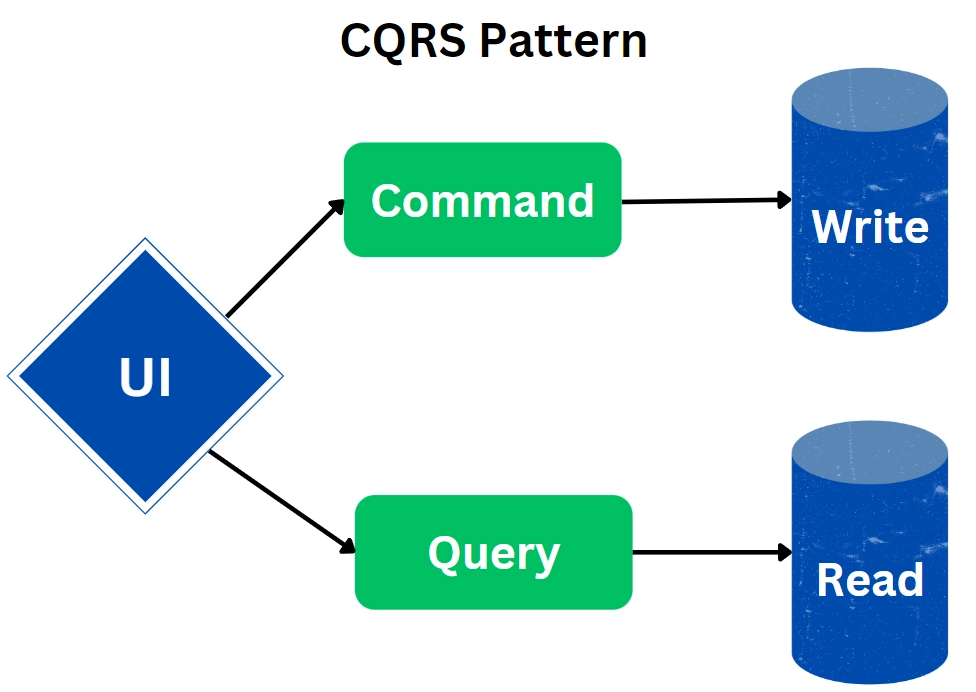
CQRS means Command and Query Responsibility Segregation. This is a type of pattern that separates the read and update operations for a data store. The CQRS is divided into two parts that are Command Side and Query Side.
Command Side: This is used to handle modification requests like CREATE, UPDATE, and DELETE.
Query Side: This is used to handle the data accessing requests like Reading requests.
Usage of CQRS
CQRS is helpful in many ways. Some of them are mentioned below:
CQRS is useful when a consistent system is acceptable for the read/access queries.
CQRS is useful in handling frequent changes in an application.
CQRS is helpful in handling complex systems.
We can scale the storage capacity more effectively based on actual demand with the help of CQRS designs.
Working of CQRS
We will first look at the working chart of the CQRS design pattern.
Let's take an example to understand the implementation of the CQRS design pattern. As we all know, the CQRS design separates the command and query sides. So, this example will do the same.
Suppose we have a shopping application where we can view the product and add the product to the cart.
When the user views any product, it simply means "a read to the database".
We can read the database using NoSQL key-value stores like Redis.
The key-value pair stores all the required data about the product in one place.
Now, a microservice picks all the data from the key-value pair and displays it to the user on the web page.
The front-end developer can completely handle this process. Hence, the "read" of data is separated from the "write" as per the CQRS rule.
The command/write side of the design is more complex than the query/read side. Assume if a user cancels a product, then this single change by the user will be copied in many places. And all the CRUD operations, like UPDATE and DELETE, will occur in the database.
The command will copy the instruction given by the user in the command handler.
Then, the command handler will write a model.
At last, the database will be updated according to the user's request.
There is a connection between the "write" and the "read", i.e., Events. Events help the web page to reflect the changes that happen in the database.
Implementation Issues
You may face some kind of issues while using the CQRS design. The list of issues is as follows:
Complex Structure: The structure of the CQRS design is a bit complex. So this might be difficult to understand and can create issues. The common issue faced by the user while using the CQRS is Event Sourcing Pattern.
Consistency: The major problem while using the CQRS design is eventual consistency. After the separation of the read and write, changes in one of them must be reflected in the other.
Messaging: It is common to use messaging for commands, but the CQRS does not use this feature. Hence this may lead to issues for the users.
When to use the CQRS Design?
We can use the CQRS design in the following situations:
While separating the reading and writing parts.
For eventual consistency.
While making asynchronous UIs.
While collecting the events of an application.
Advantages of CQRS Design
The advantages of CQRS Design are as follows:
It is used in the complex business logic. The CQRS divides the problem into the command and query parts.
When your UI is based on workflows and uses the Interface pattern, it is easier to identify users' intents and translate them into domain events.
When you are already using event sourcing, it works well with CQRS because the write side can store the current state as a set of events.
The user can optimise the read and write side independently when performance is critical with the CQRS design pattern.
Disadvantages of CQRS Design
The disadvantages of CQRS Design are as follows:
The CQRS design pattern does not fit in the simple user interface.
If the business logic is too easy, then using the CQRS is vast.
Ensuring data consistency requires special concern in terms of Service Level Agreements.
Frequently Asked Questions
What is the full form of CQRS?
The full form of CQRS is Command and Query Responsibility Segregation.
What are Software Design patterns?
Software design patterns are proven practices. Experienced software developers used worldwide to produce good quality software. It ensures that the final product is reusable.
What are structural software design patterns?
Structural Software Design Patterns are the practices that are used for developing different designs of classes and objects. Here, you can create new objects with new features that can be a composition of two or more existing classes. They make the software more efficient and flexible.
How do you choose the right design pattern for a specific problem?
To choose the right design pattern for a specific problem, developers should consider the problem domain, system requirements, and scalability.
What is the Prototype design pattern?
The Prototype design pattern creates new objects by cloning existing ones instead of creating them from scratch.
Conclusion
This article discusses the topic of the CQRS Design Patterns in detail. We have seen the definition, usages, working, pros and cons of the CQRS Design Pattern.
We hope this blog has helped you enhance your knowledge of the CQRS Design Pattern. If you want to learn more, then check out our articles.
But suppose you have just started your learning process and are looking for questions from tech giants like Amazon, Microsoft, Uber, etc. In that case, you must look at the problems, interview experiences, and interview bundles for placement preparations.
However, you may consider our paid courses to give your career an edge over others!
Happy Learning!
Live masterclass
Ace Data Analyst Interviews with Amazon SQL Case Studies
by Prerita Agarwal
23 Oct, 2026
11:30 AM
One Prompt, Three AI Agents: Build a Portfolio Project for 25L+ GenAI Roles
by Saurav Prateek
19 Oct, 2026
11:30 AM
AI vs You: Crack a Data Analyst Interview Case with Claude + Excel
by Abhishek Soni
21 Oct, 2026
11:30 AM
Build Your Own Perplexity-Style App: Stand Out in GenAI Job Interviews
by Sumit Shukla
22 Oct, 2026
11:30 AM
Ace Data Analyst Interviews with Amazon SQL Case Studies
by Prerita Agarwal
23 Oct, 2026
11:30 AM
One Prompt, Three AI Agents: Build a Portfolio Project for 25L+ GenAI Roles







 1+ registered

