Do you think IIT Guwahati certified course can help you in your career?
Introduction
Embedded systems are specialized computing devices that perform specific tasks within larger electronic systems. These systems are designed for efficiency and reliability, and they are commonly found in a wide range of applications, such as automobiles, home appliances, medical devices, and industrial control systems.
So, have you ever wondered how powerful are they? Not to worry.
In this article, we will discuss what embedded systems are. We will also discuss the Key components followed by the challenges and many more.
What is System?
A system is a structured arrangement with components tracking detailed rules. It involves collecting, performing, or executing tasks based on a pre-determined plan. The system efficiently performs a single or a few tasks and often has defined resources and processing capacity. They find applications in different fields, such as consumer electronics, automotive designs, industrial automation, medical instruments, etc.
So, let us start with understanding about the embedded systems:
What is an Embedded Systems?
An embedded system is a special type of computer that is designed to perform a specific task. Unlike regular computers, which can be used for many different purposes, embedded systems are built to do just one thing, such as controlling a car's engine, operating a medical device, or running a washing machine.
The reason why embedded systems are so special is that they are built right into the device they are controlling.
This makes them really efficient and effective at their job.
They don't need to communicate with other computers or devices because they are already part of the system.
History of Embedded Systems
In the history of embedded systems, several essential milestones shaped their development. It all started in 1960 when Charles Stark Draper used the first embedded system for the Apollo Guidance System at MIT. Later, in 1965, Autonetics developed the D-17B computer for the Minuteman missile guidance system.
They released the first embedded system for vehicles in 1968. Texas Instruments designed the first microcontroller in 1971. The year 1987 witnessed the release of the first embedded operating system, VxWorks, by Wind River. In 1996, Microsoft presented Windows Embedded CE. By the late 1990s, the first embedded Linux system emerged.
The embedded market encountered quick growth, achieving $140 billion in 2013, and experts anticipate it will surpass $40 billion by 2030. These events have recreated a vital role in creating embedded systems, an essential part of modern technology.
Components of Embedded Systems
The key components of Embedded Systems include Microcontroller, Memory, I/O devices and software:
Microcontroller or Microprocessor: The core component of an embedded system, responsible for processing and executing instructions.
Memory: Storage for instructions and data, including volatile (RAM) and non-volatile (ROM, EEPROM) memory.
Input/Output (I/O) Devices: Components used to receive input from and send output to the external environment, such as sensors, actuators, and communication interfaces.
Software: The program code that runs on the embedded system, controlling its functionality.
How an Embedded System Works
Embedded systems are small computer systems developed for clear and specific tasks. They can be part of a more extensive system. They use microcontrollers or microprocessors to work. Embedded systems operate printed circuit boards programmed with embedded system software to process input information, work, and deliver outputs like different computer systems, recreating an essential role in the industry.
Let's take an example to understand the working of an Embedded system better:
It receives analog/digital input from users, such as Push-button switches, Keypads, Sensors, and Touch Screens.
Applied calculations or conversions, then process the input. For instance, an ADC converts analog sensor input to digital output.
After transforming the analog value into digital output, output devices like Motors, LCDs, or Touchscreens give output to the user.
Characteristics of an Embedded Operating System
An Embedded Operating System has the following characteristics:
Operating systems for embedded devices are made to handle time-sensitive tasks and adhere to rigorous timing specifications.
To work within the limitations of embedded devices, they are tuned to consume the least amount of resources (memory and storage).
For embedded systems to be stable and reliable, embedded operating systems guarantee predictable and repeatable reactions to system events.
Embedded System Development Process
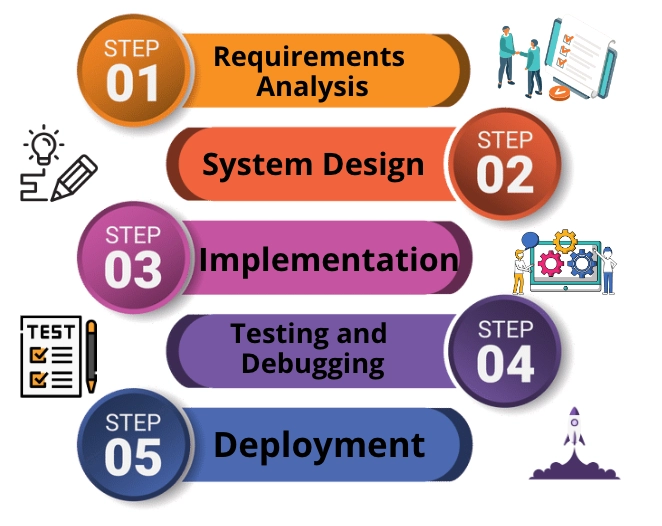
Below we have highlighted the development process of embedded systems:
Requirements Analysis: Defining the system's functional and non-functional requirements.
System Design: Developing the architecture and selecting appropriate hardware and software components.
Implementation: Writing the software code and integrating it with the hardware components.
Testing and Debugging: Ensuring the system meets all requirements and functions correctly.
Deployment: Installing the embedded system into the final application.
Embedded Software Development Tools
Below are some embedded software development tools:
Integrated Development Environments (IDEs): Software that provides a comprehensive environment for writing, compiling, and debugging code.
Compilers and Assemblers: Tools used to convert high-level programming languages into machine code.
Debuggers: Software that helps identify and fix errors in the code during development.
Emulators and Simulators: Tools that mimic the behavior of the embedded system's hardware for testing and debugging purposes.
Future Trends in Embedded Systems
Below are some examples of emerging technologies in embedded systems that are way crucial for you to understand:
Internet of Things (IoT): Embedded systems are at the heart of IoT devices, enabling connectivity and data exchange between various devices and systems.
Artificial Intelligence (AI) and Machine Learning (ML): Integration of AI and ML algorithms in embedded systems allows for more intelligent and adaptive devices.
Edge Computing: Processing data closer to the source reduces latency and network congestion, improving the overall efficiency of connected systems.
Cybersecurity: As embedded systems become more connected, ensuring the security of these devices is of utmost importance.
You can read related articles such as Congestion Control in Computer Networks here.
Challenges in Embedded System Development
Here, we have mentioned some challenges in embedded systems development:
Hardware and Software Co-Design: Designing embedded systems often involves the concurrent development of hardware and software components, which can be complex and time-consuming.
Scalability: Designing embedded systems that can scale to accommodate different hardware configurations or additional functionality can be challenging.
Interoperability: Ensuring that embedded systems can communicate and interact with other systems and devices is crucial, particularly in IoT applications.
Regulatory Compliance: Embedded systems used in safety-critical applications, such as medical devices and automotive systems, must adhere to strict regulatory requirements.
Applications of Embedded Systems
Below are some real-world applications:
Automotive: Engine control units, airbag controllers, and infotainment systems.
Consumer Electronics: Smartphones, digital cameras, and home automation systems.
Medical Devices: Pacemakers, insulin pumps, and medical imaging equipment.
Industrial Control: Programmable logic controllers (PLCs), robotics, and sensor networks. Also read, microprogrammed control unit
Frequently Asked Questions
What is an embedded system?
An embedded system is a specialized computer system designed to perform specific tasks within a larger electronic system.
What are the 4 components of an embedded system?
Common components include a microcontroller or microprocessor, memory, input/output devices, and software.
What are embedded systems in IoT?
Embedded systems in IoT are specialized devices with hardware and software elements developed to link, interact, and execute detailed tasks within the Internet of Things network.
What is embedded system or software?
Embedded software is a program that operates on embedded systems and reliable hardware devices developed to serve precise tasks in different applications like IoT, automotive, and industrial structures.
Conclusion
Embedded systems are integral to the functionality of many electronic devices and have a broad range of applications. Understanding the key components, design considerations, development processes,and tools involved in embedded system development is essential for engineers and developers working in this field.






 1+ registered

