This method accepts a function as an argument. Without altering the source list, apply the function to each element. Scala collections that are both mutable and immutable are also suitable. Let us take an example to understand this.
The flatten function is a member of the GenericTraversableTemplate trait, but there are technical versions of the flatten methods for given collection types.
Let us take an example to understand this.
object codingNinjas{
	def main(args:Array[String]){
    	val list = Seq("two", "three", "four", "six", "eight")
    	println("before" + list)
    	var newList = list.flatten
    	println("aftr" + newList)
	}
}
Output
flatMap in Scala
The flatMap() method is the process of removing the inner grouping of an item. This process generates a sequence. The flatMap method acts as a shorthand to map and instantly flatten a collection. In simple language, it breaks the given string into the characters present in it, separated by a comma.
Users can use this flat map method with mutable and immutable Scala collections. Mutable is something that can be changed. Immutable cannot be changed once set.
There are mainly three methods of using flatMap in Scala.
In this unit, we will learn how to use flatMap in Scala on given Strings.
Syntax
The syntax of flatMap in Scala is as follows:
collection.flatMap(convFunc)
Explanation
The convFunc in the above syntax is a conversion function used for converting elements of the collection. There is a collection under which the flatMap function is located.
Example
object codingNinjas{
    def main(args: Array[String]) {
        val list = List("I", "Love", "Coding", "Ninjas")
        print("Initial collection: " + list)

        val output = list.flatMap(_.toLowerCase)
        print("\nMapped collection with function: " + output)
    }
}
Output
flatMap Using Concatenation
In this unit, we will learn how to use concatenation under flatMap in Scala.
Syntax
The syntax of flatMap using concatenation is given below:
collection.flatMap(x => x + "newString")
Explanation
Here, x is the input given at first while creating the collection. newString is the string given to add in the input string(x). flatMap can also be used to merge the given string into the output string. Let us check an example for more clearance.
Example
object codingNinjas extends App{
	// Creating a collection
	val collection = List("hi", "ninja")
	println(collection.flatMap(x => x + "hello"))
}
In this unit, we will learn how to use the if else statement under flatMap in Scala.
Syntax
The syntax of flatMap using the if-else statement is given below:
collection flatMap { x =>
                if (condition) statement
                else statement
                }
Explanation
Here, x is the given input string. Next, the compiler will check the condition given in the if block. If the condition is true, it will go inside the if block and execute the expression. If not, it will move to the else condition and perform the expression.
Example
object codingNinjas
{
    def main(args:Array[String])
    {
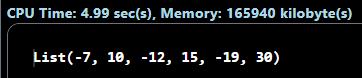
        val seq = Seq(7, 10, 12, 15, 19, 30)
        val result = seq flatMap { str =>
                if (str % 5 == 0) Seq(str)
                else Seq(-str)
        }
        println(result)
    }
}
Output
Advantages of flatMap
Some advantages of flatMap are as follows:
flatMap avoids the use of nested For Loops.
flatMap function is easy and simple to understand as a beginner.
flatMap does not use the callback hell feature.
flatMap functions offer a more readable code flow as compared to others.
The GenericTraversableTemplate traits flatten() method returns a single collection of elements by combining child collections.
What is a map() in Scala?
An Iterable that has pairs of keys and values is known as a map (also named mappings or associations). The Predef object in Scala provides an implicit translation that lets you express the pair (key, value) using key -> value as an alternative syntax.
What is a tuple in Scala?
A tuple is a value in Scala that consists of a certain number of elements, each of which has a unique type. Tuples cannot be changed. When a method returns many values, tuples are extremely useful.
What is a zip in Scala?
The IterableLike trait's zip() method is used to combine a collection with the one that is currently being used. The result is a collection of pairwise tuple elements from the combined collection.
What is a fold in Scala?
Two sets of parameters are required by the fold method. A start value is present in one, while a combining function is present in the other. After that, it traverses the list, recursively applying the function on the next element of the list as well as an accumulated value.
Conclusion
In this article, we discussed the topic of flatMap in Scala. In detail, we have seen the definition of flatMap in Scala. Along with this, we have seen three different methods of using flatMap in Scala. These methods are discussed in three phases that are Syntax, Explanation, and Example. Later we discussed the advantages of flatMap in Scala.
We hope this blog has helped you enhance your knowledge of flatMap in Scala. If you want to learn more, then check out our articles.
But suppose you have just started your learning process and are looking for questions from tech giants like Amazon, Microsoft, Uber, etc. In that case, you must look at the problems, interview experiences, and interview bundles for placement preparations.
However, you may consider our paid courses to give your career an edge over others!










 1+ registered

