Do you think IIT Guwahati certified course can help you in your career?
Introduction
A function is a form of relation in which every domain element is linked with only one range element. As shown in the figure, the pairing of elements is called mapping. It's similar to a flow chart for a function, where the input and output values are shown.
Domain and Co-Domain Of A Function:
For example, we have a function 'f' from A to B. Therefore, set 'A' will be called the Domain of function 'f'.
Similarly, for a function 'f' from A to B, the set 'B' will be called the Co-Domain of function 'f'.
Range Of A Function: Range is nothing but a subset of a function's Co-domain and is donated as f(domain) for a function 'f'.
Representation Of A Function
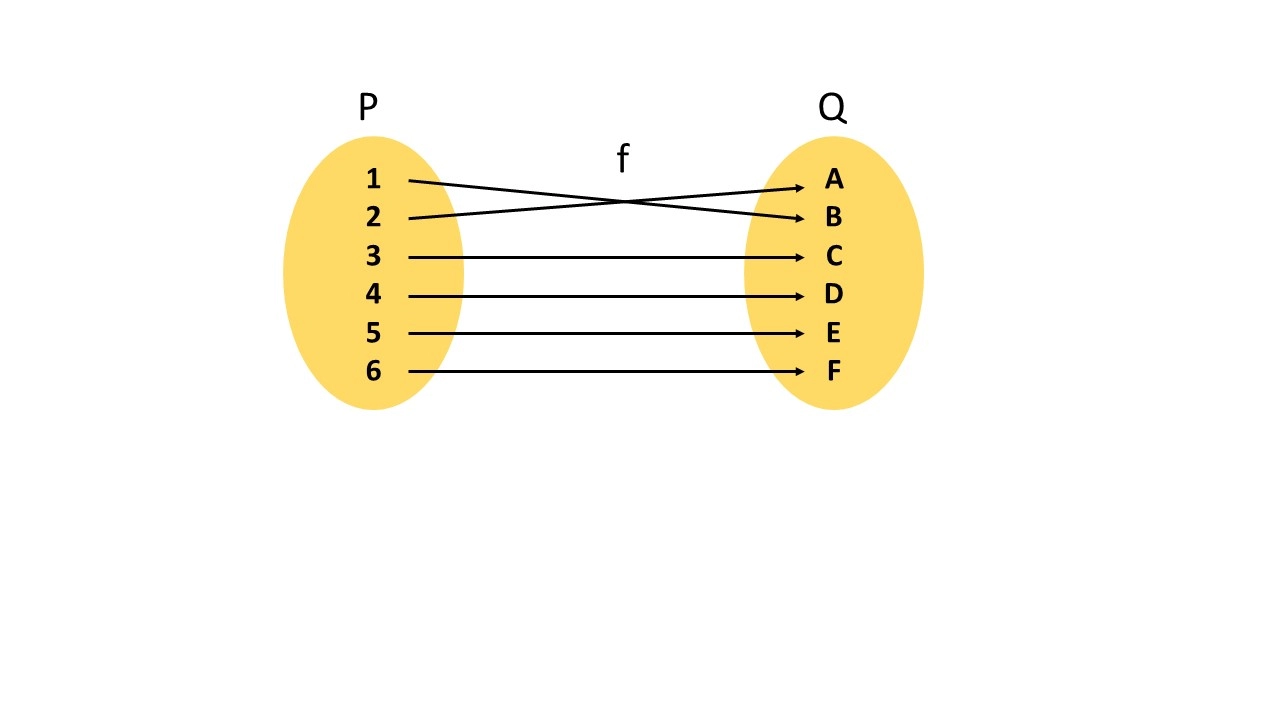
Circles represent the sets of functions. As shown in the figure, The function f: P → Q is represented by a series of arrows connecting points representing elements of P and Q,, respectively.
For Example: Let R = {m, n, o} and S = {r, s, t} and f: R → S such that f= {(m, r), (n, t), (o, r)} The function f can be represented diagrammatically as follows:
Types Of Functions
There are 8 types of Functions In Engineering Mathematics. These are as follows:
Injective (One-to-One) Functions: When one element of Domain Set is associated with one element of Co-Domain Set. It is called an Injective Function.
Surjective (Onto) Functions:
Every element of the Co-Domain Set has one pre-image in this function.
For Example: Consider, A = {A,B,C,D}, B = {12,24,50} and f = {(A,24), (B,12), (C,50), (D,50)}.
It is a Surjective Function, as every element of B is the image of some A.
Bijective (One-to-One Onto) Functions:
A Bijective (One-to-One Onto) Function is a function that is both injective (one to - one) and surjective (onto).
Here, from the figure below, it is pretty clear that f is a one-to-one function, and also it is onto. So it is a bijective function.
Into Functions: A function that requires a co-domain Y element and does not have a pre-image in domain X. For example: Suppose, A = {A,B,C} B = {12,24,50,100} and f: A → B such that f = {(A, 12), (B, 24), (C,50)} In the function f, the range i.e., {12,24,50} ≠ co-domain of Y i.e., {12,24,50,100} So, it is an into function
One-One Into Functions: When different elements of X have different unique images of Y, the function is called one-one into function. For Example:Considering, A = {A,B,C} B = {12, 24, 50, 100} and f: A → B such that f = {(A, 12), (B, 50), (C, 100)} The function f is a one-one into function
Many-One Functions: If there are two or more separate elements in X that have the same image in Y, the function f is said to be a many-one function. For Example:onsider A = {10, 20, 30, 40, 50} B = {A, B, C} and f: A → B such that f = {(10, A), (20, A), (30, A), (40, B), (50, C)} The function f is a many-one function
Many-One Into Functions: For a function f: X → Y. if and only if f is both many one and into the function it is called the many-one Into function. For Example: A = {10, 20, 30} B = {A , B} and f: A →B such that f = {(10, A), (20, A), (30, A)}
Many-One Onto Functions: For a function f: X → Y. if and only if ‘f’ is is both many-one and onto the function is called the Many-One Onto Function. In the example figure given below, The function f is a many-one (as the two elements have the same image in Y) and is onto (as every element of Y is the image of some element X). So, it is many-one onto function.
FAQs:
What do you mean by Invertible Functions? Invertible functions are also known as Inverse Functions. A function f: A → B is inverse if and only if it is a bijective function.
How to denote functions as a set? Considering X and Y as two non-empty sets, then a function ‘f’ from X to Y is a subset of X x Y, with two important constraints:
∀ a ∈ X, (a, b) ∈ f for some b ∈ Y
If (a, b) ∈ f and (a, c) ∈ f then b = c.
Key Takeaways
In this article, we have extensively discussedthe ‘Functions and it’s types in Engineering Mathematics. Check out the next topic Identity Functions.
We hope that this blog has helped you enhance your knowledge regarding Function and it’s types in Engineering Mathematics and if you would like to learn more, check out our articles on Coding Ninjasand visit ourLibrary for more.
Do upvote our blog to help other ninjas grow. Happy Coding!
Live masterclass
Ace Data Analyst Interviews with Amazon SQL Case Studies
by Prerita Agarwal
23 Oct, 2026
11:30 AM
One Prompt, Three AI Agents: Build a Portfolio Project for 25L+ GenAI Roles
by Saurav Prateek
19 Oct, 2026
11:30 AM
AI vs You: Crack a Data Analyst Interview Case with Claude + Excel
by Abhishek Soni
21 Oct, 2026
11:30 AM
Build Your Own Perplexity-Style App: Stand Out in GenAI Job Interviews
by Sumit Shukla
22 Oct, 2026
11:30 AM
Ace Data Analyst Interviews with Amazon SQL Case Studies
by Prerita Agarwal
23 Oct, 2026
11:30 AM
One Prompt, Three AI Agents: Build a Portfolio Project for 25L+ GenAI Roles







 1+ registered

