Importance of HA
HA is of paramount importance for several compelling reasons. Let's explore why HA is important:
-
Business Continuity: HA ensures business connection by minimising system downtime. When systems work during failures, businesses continue to function. They can serve customers, maintain operations, and prevent financial losses. Constant ease of use is crucial for mission-critical applications. It is necessary where service disruptions can have severe effects.
-
Minimised Downtime Costs: Downtime can result in significant financial losses for businesses. The costs linked with downtime include lost capacity and missed business events. They include decreased revenue and damage to brand reputation. By ensuring HA, companies can mitigate these costs. They can maintain steady service delivery via this.
-
Meeting Service Level Agreements (SLAs): Many businesses operate under service-level agreements. These guarantee a certain level of uptime and performance to customers. HA systems help companies meet these SLAs. It ensures customer satisfaction and trust. Delivering reliable services can strengthen businesses' client ties. They can gain a competitive edge in the market.
-
Enhanced Customer Experience: Frequent service disruptions can lead to unsatisfied customers. HA environments reduce the chances of downtime. It is to ensure a seamless user experience. By this, businesses can foster positive customer links. This would help them to retain their customer base.
-
Protection of Critical Data: HA plays a crucial role in data protection and security. By reducing downtime, businesses reduce the risk of unauthorised access. They succeed in data breaches or data loss during critical periods. HA of systems ensures the integrity of sensitive business data.
-
Maintaining Brand Reputation: System availability indicates the quality of delivery. Businesses with a reputation for HA show sureness. By ensuring constant performance, they can build a strong brand reputation. They can attract more customers and gain a competitive advantage.
-
Regulatory Compliance: Specific sectors have strict governing needs for system availability. For example, healthcare systems must adhere to rules for patient safety. HA systems help to meet these compliance requirements, avoiding legal effects.
- Disaster Recovery Preparedness: HA systems work in conjunction with disaster recovery strategies. HA aims to minimise downtime and prevent system failures. Disaster recovery focuses on recovery. By using HA measures, businesses can enhance their overall efficiency.
Principles of High Availability
-
HA systems aim to eliminate single points of failure. These are points that would cause the entire system to collapse. Redundancy is introduced to ensure unity. Backup components can seamlessly take over in case of failure.
-
Failover means switching from a primary to a secondary component. There is no data loss. It avoids performance degradation. Reliable crossover mechanisms are vital to ensure smooth transitions. They are responsible and maintain continual system operation.
-
Failures should be detectable and visible to system controllers. HA systems incorporate automation to handle failures. They reduce the reliance on manual intervention. Mechanisms are in place to avoid common cause failures.
-
To handle high user loads, load balancing is essential in HA systems. Load balancers distribute incoming requests across multiple resources. They ensure that there is no overwhelming of single resource. By using various load balancers, the system can handle varying workloads. They aim at maintaining optimal performance.
-
HA systems employ a clustered and tiered architecture. We make clusters of the servers. If a server within a cluster fails, a replicated one in another cluster takes over. This enables failover with minimal impact on performance. As system complexity increases, maintaining HA becomes challenging. This happens due to an increased number of failure points.
-
HA is the measurement of a percentage of uptime in a given year. The industry standard for HA ranges between 99% and 100%. For instance, "three nines" availability is 8.77 hours of downtime annually. "Four nines" availability reduces downtime to around 52.6 minutes per year. Achieving HA percentages requires additional redundancy measures.
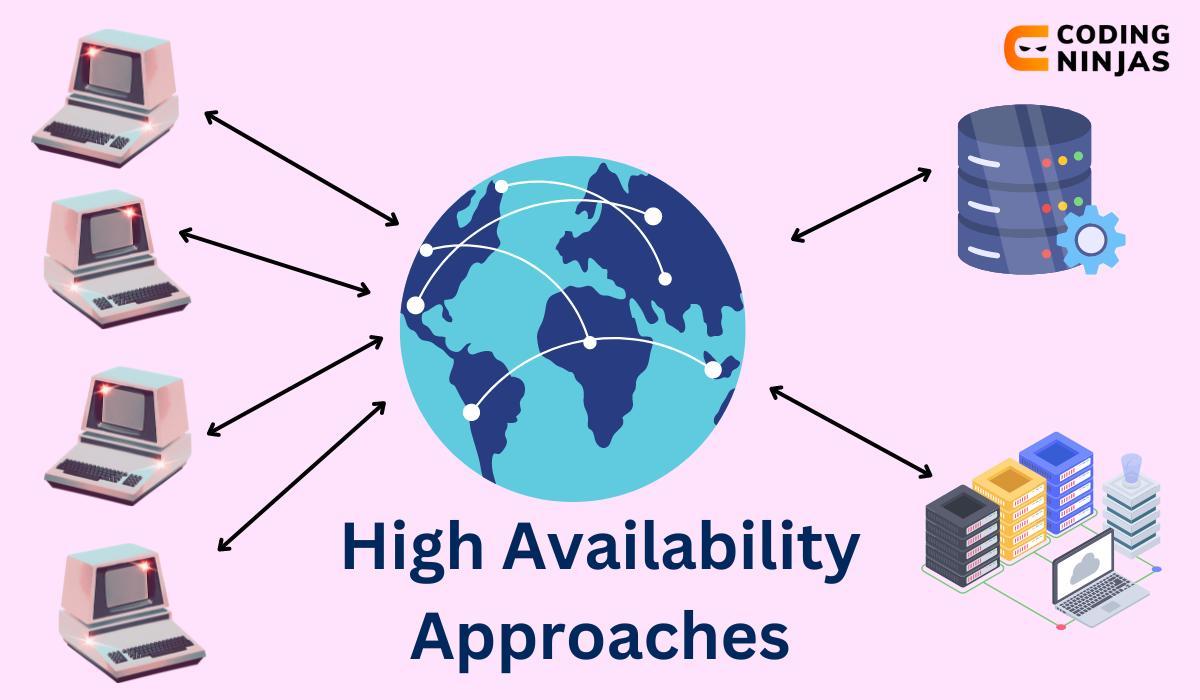
High Availability Approaches
There are several approaches employed to achieve HA in IT systems:
Redundancy and Failover
Redundancy involves deploying duplicate systems. These systems can take over if the primary one fails. This ensures operation in case of hardware/software failures. Failover mechanisms switch from a failed component to a redundant one. There is no interruption of services. Redundancy and failover are fundamental principles of HA design.
Clustering
Clustering involves grouping multiple servers to work as a single unit. In a cluster, if one server fails, another one in the cluster takes over. Clustering gives fault tolerance, ensuring HA by giving loads to nodes. It helps in the load balancing of the systems.
Load Balancing
Load balancing distributes incoming traffic across multiple servers. This is meant to prevent any single component from overworking. Load balancers monitor the performance of servers. They direct traffic to the most suitable and least loaded resource. This approach improves system performance. Vacancy by managing workloads is its target.
Virtualization and Hypervisor Failover
Virtualization allows many VMs to run on one physical server. In HA setups, VMs are present across multiple servers. We use a hypervisor for it. If a server fails, it migrates the affected VMs to available servers. We do all of this while ensuring continuous operation.
Data Replication and Backup
Data replication is maintaining copies of data across systems. There is a synchronisation of the data copies. We can ensure that critical information is accessible. The key point is that it happens even if one storage system fails. Backup mechanisms provide an additional layer of data protection. They facilitate data recovery in case of failures or disasters. For example- Regular data backups and off-site storage.
Geographical Redundancy
Geographical redundancy means resources in distinct locations. This approach provides resilience against localised disasters. They may be natural disasters or power outages. By having redundant systems, we can ensure continual services.
Automated Monitoring and Alerting
HA systems have automated monitoring tools that track system health. These tools generate alerts in case of anomalies or failures. Monitoring enables proactive maintenance and issue detection. It begins prompt remediation to minimise downtime and ensure HA.
Continuous Testing and Maintenance
Regular testing and maintenance are crucial to ensure free systems. This includes conducting periodic tests of failover mechanisms. We set up load balancing frameworks by it. By addressing potential issues in advance, we can prevent disruptions.
Cloud Computing and Multi-Region Deployments
Cloud computing platforms offer built-in HA features. For example- automatic scaling, load balancing, etc. By leveraging cloud services, we can distribute systems across regions. They can benefit from the provider's framework redundancy. This enables them to achieve HA without significant upfront investments.
Best Practices for Maintaining High Availability
-
Achieve geographic redundancy: Deploying multiple servers across locations ensures operation. This connection stays even during catastrophes.
-
Implement strategic redundancy: Prioritise redundancy for critical workloads. Do this to optimise return on investment (ROI). I prefer this over redundantly replicating every workload.
-
Leverage failover solutions: Use failover capacity within systems. It would switch from primary to secondary components. This occurs during failures or planned downtime.
-
Implement network load balancing: Use load balancers to distribute traffic among functional servers.
-
Set data synchronisation for optimal Recovery Point Objective (RPO): Configure data sync mechanisms to minimise data loss. This would ensure recovery within the desired time.
Also see, Mercurial
Frequently Asked Questions
What is the role of load balancing in achieving high availability?
Load balancing distributes incoming traffic across multiple servers. It ensures that no single resource works more than it can. It improves system performance and prevents downtime. Even distribution of workloads enhances fault tolerance.
How does data replication contribute to high availability?
Data replication involves maintaining synchronised copies of data. The copies are across multiple storage systems. This enhances HA by ensuring that critical data is accessible. In a failure, we can retrieve data from the replicated copies. This minimises downtime and provides constant access to crucial data.
What is the difference between active-active and active-passive clustering?
Active-active and active-passive clustering are two common clustering types. In active-active clustering, all nodes in the cluster are processing requests. They are sharing the workload and providing redundancy. In contrast, active-passive clustering involves one node processing requests. The other nodes remain on standby, ready to take over. Both provide HA but differ in terms of resource usage and failover speed.
What is the significance of geographic redundancy in high availability?
Geographic redundancy means deploying systems in distinct locations. It ensures HA by giving resilience against localised disasters. By giving resources to regions, we can minimise the disaster impact. It includes power outages or other localised events. This maintains continual services.
How does virtualization contribute to high availability?
Virtualization creates VMs that can run on one physical server. In terms of HA, virtualization enables the use of hypervisors. They migrate VMs from a failed physical server to an available one. It is done to ensure continuous operation. This failover mechanism reduces downtime. This improves the overall HA of the system.
Conclusion
In this article, we learnt about High Availability Approaches. We got to know about the importance of High Availability, its principles, approaches and techniques, and best practices to maintain it. Now that you have learnt about it, you can also refer to other similar articles.
You may refer to our Guided Path on Code Studios for enhancing your skill set on DSA, Competitive Programming, System Design, etc. Check out essential interview questions, practise our available mock tests, look at the interview bundle for interview preparations, and so much more!
Happy Learning, Ninja!







 5+ registered

