Do you think IIT Guwahati certified course can help you in your career?
Introduction
Today we are going to learn about what is MIS (Management Information System). In today’s business world, MIS plays a vital role in decision-making. In this article, we will delve deeper into what MIS is, its components, characteristics, advantages, and disadvantages.
Let’s begin by learning what is MIS.
What is MIS (Management Information System)?
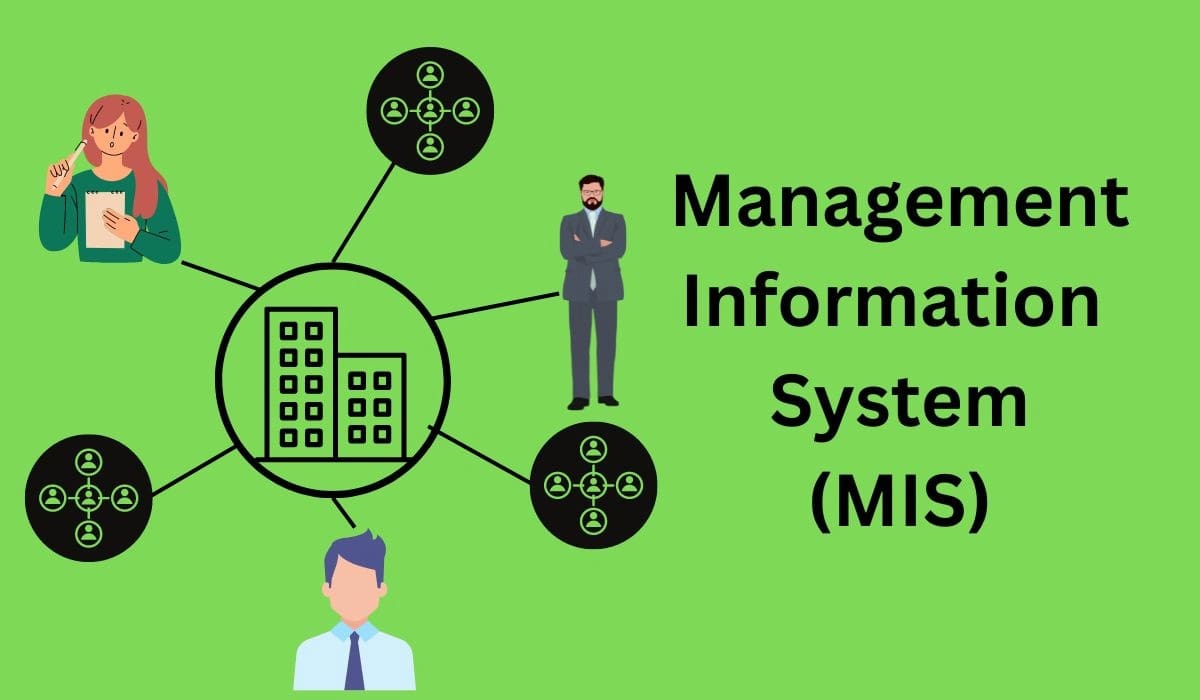
The management information system is a system that collects, analyzes, and then converts the information that has been provided to it in the form of data and then sends the information to the managers of an organization to ease the decision-making process. If any organization has to grow itself, the most vital thing is that it makes the right decision at the correct time. So, for that, the organization must have information about each of its departments. And the system that manages this information is called the management information System.
In MIS, first, the data is collected and then stored in MIS. The data may be related to employees, customers, production sales, etc. MIS then processes the data, i.e., it is transformed into information by manipulating, organizing, and arranging it. Similar data is then classified and presented in the form of graphs or tables. The same can be depicted in the image below:
Importance of MIS for Businesses
Management Information Systems (MIS) play a crucial role in modern businesses by providing accurate, timely, and relevant information to aid decision-making. MIS integrates technology, people, and processes to enhance efficiency, improve productivity, and support strategic planning.
Key Benefits of MIS for Businesses
1. Improved Decision-Making
MIS provides real-time data and reports that help managers make informed decisions.
It enables data-driven strategies, reducing guesswork and uncertainty.
2. Enhanced Efficiency and Productivity
Automates data collection, processing, and reporting, reducing manual effort.
Streamlines business operations by integrating various departments.
3. Better Resource Management
Helps track inventory, financial transactions, and human resources effectively.
Ensures optimal utilization of resources, reducing waste and costs.
4. Competitive Advantage
Businesses using MIS can analyze market trends, customer behavior, and competitor strategies.
This helps them stay ahead in the competitive landscape.
5. Data Security and Compliance
MIS ensures that business data is stored securely with access control mechanisms.
Helps businesses comply with regulations and avoid legal issues.
6. Customer Satisfaction and Relationship Management
MIS helps businesses understand customer needs through data analysis.
Supports Customer Relationship Management (CRM) systems, improving service quality.
Role of MIS (Management Information System)
The role of a Management Information System (MIS) is to assist organizations in efficiently managing and using information for decision-making and business operations. The following are the key roles:
Data Collection: MIS gathers data from various sources, including internal systems and external data feeds, to create a comprehensive information database.
Data Processing: It processes and organizes data into meaningful information, such as reports, charts, and graphs, making it easier for managers to understand.
Storage and Retrieval: MIS stores data securely and provides quick retrieval options, ensuring that information is readily available when needed.
Analysis: MIS analyzes data to identify patterns, trends, and insights, helping organizations make informed decisions.
Reporting: It generates regular and ad-hoc reports, allowing managers to monitor performance and track progress towards organizational goals.
Decision Support: MIS provides tools and information that support strategic and tactical decision-making, aiding in problem-solving and planning.
Evolution of MIS (Management Information System)
The evolution of Management Information Systems (MIS) can be seen through these key phases:
Manual Systems (Pre-1960s): Before computers, businesses relied on manual methods, like paper records and filing systems, for information management. This was slow and error-prone.
Mainframe and Early Computer Systems (1960s-1970s): With the invention of mainframe computers, businesses started automating certain tasks, like payroll and inventory management. These early computer systems were expensive.
Databases and Mini-Computers (1970s-1980s): Businesses began to develop database systems and use mini-computers, expanding the scope of data management. Decision support systems (DSS) also emerged to help with decision-making.
ERP and CRM Systems (1990s-2000s): Enterprise Resource Planning (ERP) and Customer Relationship Management (CRM) systems integrated various business functions and improved data sharing across departments.
Internet and Intranet Technologies (2000s-Present): The Internet and intranet technologies transformed MIS, enabling real-time data access, remote collaboration, and online reporting. Cloud computing further expanded these capabilities.
Big Data and Analytics (2010s-Present): The rise of big data and advanced analytics tools allowed organizations to process and analyze vast amounts of data for insights and decision-making.
Mobile and IoT Integration (2010s-Present): The integration of mobile devices and the Internet of Things (IoT) into MIS expanded data sources and improved accessibility, allowing real-time monitoring and control.
AI and Machine Learning (2010s-Present): AI and machine learning are increasingly being used in MIS to automate tasks, predict trends, and provide intelligent insights.
Career Opportunities for Management Information Systems Include
Business Analyst – Analyzes business needs and recommends technology solutions.
Systems Analyst – Designs and improves IT systems for organizations.
Database Administrator – Manages and secures business databases.
IT Project Manager – Oversees IT projects and ensures successful implementation.
Cybersecurity Analyst – Protects organizational data from cyber threats.
Network Administrator – Maintains and optimizes company networks.
Data Analyst – Interprets business data to support decision-making.
Chief Information Officer (CIO) – Leads the IT strategy and digital transformation of a business.
E-commerce Manager – Handles online business operations and digital strategies.
What Skills do Information System Professionals Need?
Information System (IS) professionals require a blend of technical, analytical, and business skills to excel in their field.
Technical Skills
Knowledge of database management systems (SQL, NoSQL).
Understanding of programming languages (Python, Java, C++, etc.).
Proficiency in network and system administration.
Experience with cloud computing and cybersecurity concepts.
Analytical and Problem-Solving Skills
Ability to analyze large datasets and extract insights.
Critical thinking to solve IT-related issues.
Troubleshooting and debugging skills.
Business and Management Skills
Understanding business processes and requirements.
Project management and leadership skills.
Ability to align IT strategies with business goals.
Communication and Interpersonal Skills
Strong written and verbal communication for reporting and presentations.
Ability to collaborate with teams and stakeholders.
Customer service skills for IT support roles.
Adaptability and Continuous Learning
Staying updated with emerging technologies like AI, blockchain, and IoT.
Ability to learn and adapt to new software and systems quickly.
A combination of these skills helps IS professionals drive business success through technology.
Limitation of MIS
High Implementation Cost – Setting up and maintaining MIS can be expensive.
Complexity in Usage – Requires training and expertise to operate efficiently.
Data Security Risks – Vulnerable to cyberattacks and data breaches.
Dependence on Technology – System failures can disrupt business operations.
Limited Flexibility – Customizing MIS to meet specific business needs can be challenging.
Data Accuracy Issues – Poor data entry can lead to incorrect decision-making.
Resistance to Change – Employees may be reluctant to adopt new systems.
Frequent Maintenance and Upgrades – Requires constant updates to remain effective.
Pillars of MIS (Management Information System)
The pillars of a Management Information System (MIS) are the foundational elements that provide valuable information for decision-making. These pillars are:
Data: Accurate and reliable data is the cornerstone of MIS. It involves collecting, storing, and managing data from various sources within the organization.
Information: Data is processed and transformed into meaningful information through analysis and reporting. This information should be timely, relevant, and easily accessible to support decision-making.
Technology: MIS relies on technology infrastructure, including hardware, software, networks, and databases, to efficiently process and store data and deliver information to users.
People: Skilled personnel are essential for designing, operating, and maintaining MIS. Users should have the necessary training to make the most of the system's capabilities.
Processes: Effective business processes and workflows are integrated into MIS to ensure that data is collected, processed, and used efficiently and consistently.
Security: Ensuring data security and privacy is crucial. MIS should have safeguards in place to protect data from unauthorized access, breaches, and other security threats.
Need of MIS (Management Information System)
The following are the justifications for why we need MIS -
MIS helps in strategic planning as an organization's strategies are based on the data and information from the future prospect.
The organization needs to analyze the present and past situations to anticipate the future. This data is provided by MIS, on behalf of which all the strategies and outcomes are predicted.
MIS helps in developing a system that helps streamline operations.
MIS has a structured database, i.e., any relevant information can be provided within seconds to the organization, saving a lot of time.
MIS provides appropriate and relevant data information to managers at all levels.
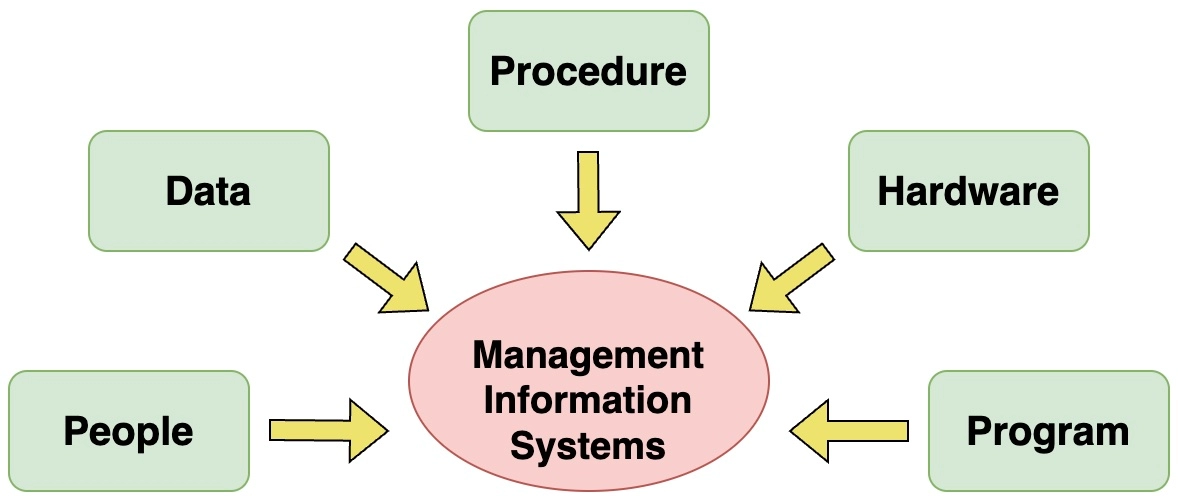
Components of MIS (Management Information System)
The significant components of MIS are -
People - operate and manage this system and use the information.
Data - it is the data that the information system contains.
Procedure - These are the procedures in which these individuals/people are functioning.
Computer Hardware - This includes the hard disks, screens, and servers.
Program - It is a kind of instruction where information gets converted into various parts so that it can be used further.
Characteristics of MIS (Management Information System)
The characteristics of MIS are -
MIS consists of a well-defined system that uses a systematic approach to capturing and processing the data.
MIS works as per the need of the management. As the need changes, MIS can be changed and improved. Therefore, MIS is management oriented.
MIS is already integrated with the sub-systems available. So whatever information it receives, it complements and supplements that information.
MIS follows the long-term planning or future-oriented approach.
MIS has a central database, i.e., the whole system has a shared database; therefore, no data duplication exists.
MIS contains all the organization’s information but makes related information available to associated managers.
Advantages of MIS (Management Information System)
Following are some of the advantages of MIS.
The essential purpose of MIS to be used in any organization is to help managers in better decision-making.
As we use information in MIS, so as information comes from data, therefore data storage is also an advantage of MIS.
As we use the data in MIS for processing further, it becomes an important part. So whenever we use the MIS, just because we use that data as a data bank to process and retrieve data regularly, the data security should be there.
MIS gives us a significant advantage of accessing information even from remote locations.
It helps in fast computation, as the computer has increased the speed of data processing, and hence we use computers in MIS.
MIS gives us immense flexibility in any organization while processing data, as we can alter the data source as per our use or needs.
It is a user-friendly system because it helps managers to make better decisions.
As MIS works on computers, we need not worry about data backup. Even if the data is lost, we can access it easily.
There is no or significantly less data duplication in MIS, as if data is updated in any one department, it would automatically be updated in all the departments.
Disadvantages of MIS (Management Information System)
Let’s discuss the disadvantages of MIS.
MIS just processes the data that we have provided it. It depends on the users and how they utilize or process this data. So MIS is not an information processing system.
MIS always provides the result only as per the query raised by the user. So MIS is entirely impersonal.
If an MIS is poorly designed, it may create various complexities in business.
MIS requires strict quality controls whenever we are using MIS to utilize the input, output, and processing procedures efficiently.
When MIS is developed without streamlining the transaction processes in the organization, it won’t be able to help us effectively. When mixed with the Transaction processing system, MIS can generate more data, and we can seek more relevant information from it.
To make any MIS work, we require skilled handling.
MIS is a fixed design, i.e., its tailoring entirely depends on us that how we use it for our benefit and retrieve relevant information for our use.
MIS is expensive to set up as it requires the hardware and the relevant software to run the information system.
If proper checks are not done, any intruder can manipulate the data.
Objectives of MIS (Management Information System)
Some common objectives of MIS are:
Data Collection: MIS collects data from various sources within and outside the organization. This data can be structured (e.g., sales figures, inventory levels) or unstructured (e.g., customer feedback, social media mentions).
Data Processing: Once data is collected, MIS processes it into meaningful information. This involves data validation, cleaning, and transformation to generate accurate and reliable information.
Information Generation: MIS generates various types of information, including reports, summaries, dashboards, and ad-hoc queries. These outputs are designed to meet the specific needs of different levels of management (strategic, tactical, operational).
Timeliness: One of the primary objectives of MIS is to provide information in a timely manner. Managers rely on up-to-date data to make informed decisions, so MIS systems should ensure that information is current and relevant.
Accuracy and Reliability: Information provided by MIS should be accurate and reliable. Inaccurate data can lead to incorrect decisions and actions, which can be detrimental to the organization.
Frequently Asked Questions
What is the MIS planning process?
The Management Information Systems (MIS) planning process involves identifying information needs, designing systems, acquiring resources, implementing solutions, and continually evaluating to ensure efficient use of technology for organizational goals.
What are the limitations of MIS?
Limitations of Management Information Systems (MIS) include dependence on data accuracy, cost of implementation, potential for data security breaches, lack of flexibility for rapid changes, and the need for skilled personnel.
What is Computerized MIS?
It is a computerized system that refers to a system in which the data is captured, analyzed, and processed with the help of software and hardware.
Conclusion
In this article, we learned what is MIS and its various aspects. We learned how MIS becomes an important tool that can be used to process and distribute data to aid in decision-making. Further, we learned about the need and characteristics of MIS, which helped us to explore more about MIS. Overall, MIS is a robust system that can enhance organizational performance and aid in achieving strategic goals.
To learn more about Information Systems and data, we recommend reading the following articles:








 5+ registered

