Do you think IIT Guwahati certified course can help you in your career?
Introduction
IDaaS, or Identity-as-a-Service, refers to various cloud-hosted identity and access management services (IAM). It refers to cloud-based technical functions that deal with the user identity and cloud services' economic and operational advantage. Well-known and trustworthy third-party companies mainly provide this cloud-based solution. IDaaS providers help verify that users are who they claim to be, preventing cyber thieves and unauthorized access to critical data.
IDaaS assists firms in minimizing risk, lowering IT infrastructure costs, increasing productivity, and speeding up business operations. IDaaS is a SaaS-inspired IAM that allows enterprises to secure access to SaaS applications through single sign-on (SSO), authentication, and access control.
Some well-known IDaas vendors include Google Cloud Identity, Oracle Identity Cloud Service, IBM Identity and Access Management, Microsoft Azure Active Directory(AD), VMware, okta, PingIdentity, etc.
Now we will learn about the concept of identity, the importance, services, advantages, and disadvantages of IDaaS.
Concept of Identity
The term identity refers to attributes connected with something to make it recognizable. Even if all objects have the same attributes, they cannot have the same identities. The unique identification attribute is used to assign a unique identity.
Several identity services are deployed to validate services, such as validating websites, transactions, transaction participants, clients, etc. IDaaS may include the following:
Directory services
Identity and profile management.
Single sign-on services.
Registration.
Authentication services.
Risk and event monitoring.
Identity Attributes
Because of the biometric information recorded in the system, IDaaS can determine whether the physical attributes of the person accessing sensitive data are equivalent. Characteristics that IDaaS systems see for identity recognition include the three factors.
Fingerprint
Face recognition
Irises
Importance of IDaaS
Hackers and other cyber-criminals shouldn't have access to the organization's sensitive and critical data. Although cloud infrastructure is convenient, relying solely on password protection leaves your data vulnerable to cyber-attacks and exposes your company to the risk of fraud. As a result, an IDaaS system is required to keep the user's data secure.
While monitoring the company's identification can be time-consuming, IDaaS providers can help us secure our data and applications in real-time. Identity-as-a-Service allows our company to scale back fraud, implement verification faster, and make a frictionless customer experience.
IDaaS Services
Some of the primary services of IDaaS are:-
Single Sign-On (SSO)
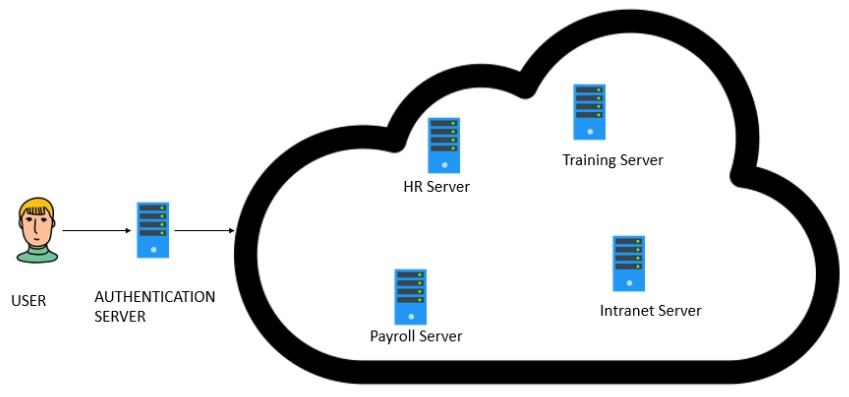
SSO allows users to access all SaaS applications by signing in through a single portal. It also gives corporations a central location to manage their users. SSO services are hosted on the cloud, allowing users to access their SSO login pages from their web pages.
SSO
The working of SSO
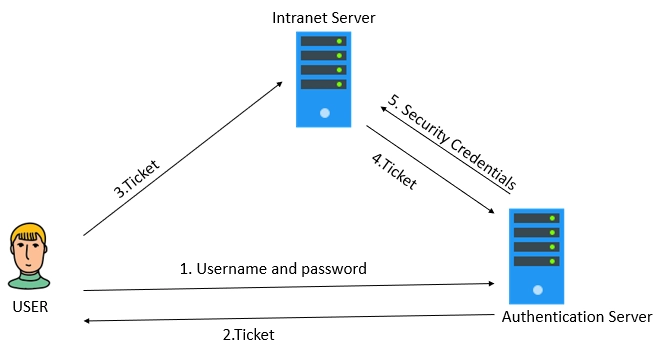
Step by step working of SSO is mentioned below.
The user can log in to the cloud using their devices using their login and password credentials.
When a server is authenticated, the ticket is returned to the user.
The ticket will be transferred to the particular intranet server.
With the help of the intranet server, the ticket is subsequently transported to the authentication server.
The user's security credentials will be returned to the intranet server
Working of SSO
Advantages of SSO
Let's discuss some advantages of SSO.
Along with the desktop flow, manages local and remote applications.
Removes the need for re-authentication and boosts efficiency.
The database is quite user-friendly and versatile, which is advantageous.
Reports on user access in great detail
Disadvantages of SSO
Some of the Disadvantages of SSO are
The user has to buy the hosting fees.
The User needs to monitor the additional turf on-premises for network security.
The user must keep replica data frequently.
SSO is mainly limited to web apps.
Multi-Factor Authentication (MFA)
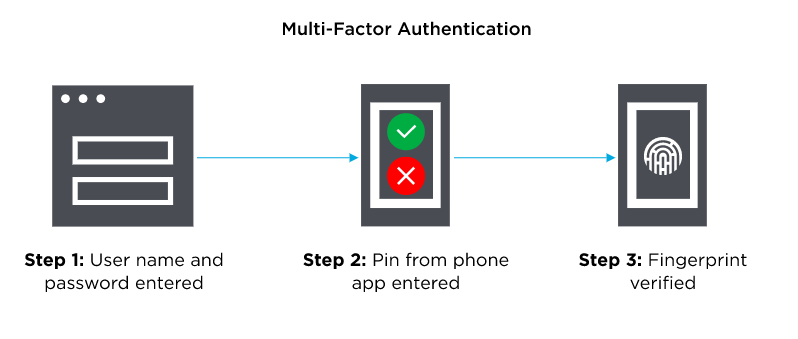
MFA is an authentication mechanism that requires the user to give two or more verification credentials to access a resource such as an application, online account, or a VPN. It is a core component of a strong identity and access management (IAM) policy.
Types of Multi-factor Authentication
There are three types of Multi-factor authentication. They are as follows:-
Knowledge: Things you know E.g.:- Security questions, Passwords, etc.
Possession: Things you have E.g.:- OTPs sent via text or email, Software tokens, badges, USB devices, Smart Cards, security keys.
Inherence: Things you are E.g.:- Fingerprints, facial recognition, voice, retina or iris scanning, or other biometrics.
Identity Management
Access Security is policy build access management. It is for applications and application programming interface (API) to develop security beyond SSO.
Access Security
Access Security is policy build access management. It is for applications and APIs to develop security beyond SSO.
Directory
Most organizations prefer IDaaS along with the users of existing stores or provisions. They can use a cloud directory to help customers and partners.
Provisioning
With the help of SCIM support and integration along with on-premises provisioning. The data of the user gets synchronized with web and enterprise applications.
Functions of IDaaS
Now we are going to learn about some functions of IDaaS; some of them are
Cloud-based and multitenant architecture
A multitenant architecture has several advantages, including the ability for the seller to deliver updates, security features, and improved performance. It also changes the potential for smoothly managing access provision and governance.
Single Sign-On(SSO) and Federation
SSO aids in enhancing the top user's experience while keeping the network's security. The user can use the most secure password combination, which is used to access services regularly, without remembering it.
Analytics and intelligence
Analytics and intelligence capabilities will not report on access privileges in composite relationships. The following relationship is built between users, their roles and responsibilities, job function, and data usage.
Governance, risk, and compliance
IDaaS can assist critical factors like governance, risk, and compliance by modifying the automation and intelligence. It helps define and automate appliance-specific processes that are conversant of access and usage patterns.
Security (management and architecture)
IDaaS provides security features such as multi-factor authentication, digital access cards, and biometrics in the Cloud Computing world. The following features aid in the process of securely retrieving knowledge.
Advantages of IDaaS
Some of the advantages of IDaaS are listed below.
It increased site conversation rates.
Access to more excellent user profile content.
Fewer problems with lost passwords
Ease of content integration into social networking sites.
Disadvantages of IDaaS
Some of the Disadvantages of IDaaS are listed below.
One of the most significant drawbacks of IDaaS that many businesses fear is having to outsource critical functions.
When we transmit our identity management service requirements to the cloud, they leave our company's firewall and expose crucial business functions to the internet.
FAQs
What's the Difference Between MFA and 2FA? MFA (Multi-Factor Authentication) is a type of authentication that requires two or more authentication factors. Two-factor authentication (also known as 2FA) is a type of authentication that requires exactly two authentication factors.
What are the problems associated with IDaaS? Some of the problems associated with the IDaaS are the team should pay hosting fees, keep an eye on the extra turf on-premises for network security, set up and maintain servers, buy, upgrade, install software, and back up data regularly.
How does IDaaS help in businesses? A complete IDaaS solution provides plenty of advantages to the entire company environment. Some of them are freedom to choose, increase in productivity, agility, security, and efficiency.
What is OpenID? OpenID allows users to log in to many websites using a single account. OpenID is supported by businesses like Google, Yahoo!, Flickr, MySpace, and WordPress.com.
What are the types of Multi-factor authentication(MFA)? There are three types of MFA, i.e., knowledge, possession, inherence.
Knowledge refers to passwords, security questions, etc.
Possession refers to OTPs, security tokens, USB drives, etc.
Inheritance refers to biometrics, fingerprints, Irises, etc.
Key Takeaways
In this article, we have extensively discussed the concepts of IDaaS. We started with the introduction of Identity-as-a-Service (IDaaS), the concept of identity, the importance of IDaaS, services, and components of IDaaS, then concluded with pros and cons and FAQs on IDaaS.
We hope that this blog has helped you enhance your knowledge regarding Identity-as-a-Service (IDaaS) and if you would like to learn more, check out our articles on Introduction to Cloud Computing. Do upvote our blog to help other ninjas grow. Happy Coding!
Live masterclass
Ace Data Analyst Interviews with Amazon SQL Case Studies
by Prerita Agarwal
23 Oct, 2026
11:30 AM
One Prompt, Three AI Agents: Build a Portfolio Project for 25L+ GenAI Roles
by Saurav Prateek
19 Oct, 2026
11:30 AM
AI vs You: Crack a Data Analyst Interview Case with Claude + Excel
by Abhishek Soni
21 Oct, 2026
11:30 AM
Build Your Own Perplexity-Style App: Stand Out in GenAI Job Interviews
by Sumit Shukla
22 Oct, 2026
11:30 AM
Ace Data Analyst Interviews with Amazon SQL Case Studies
by Prerita Agarwal
23 Oct, 2026
11:30 AM
One Prompt, Three AI Agents: Build a Portfolio Project for 25L+ GenAI Roles






 1+ registered

