




Introduction
A red-black tree is one type of binary search tree that satisfies the following properties:
- Every node is either red or black.
- The root is black.
- Every leaf (nil) is black.
- If a parent node is red, then both of its children are black.
- All simple paths from the node to descendant leaves contain the same number of black nodes for each node.
In a red-black tree, every new node is inserted with the color red. The insertion in the red-black tree is similar to the insertion operation in a binary search tree. But nodes are inserted with a color property. After insertion operation, we need to check all the properties of the red-black tree. If all the properties are not satisfied, we perform the following operation to make it a red-black tree.
- Recolor
- Rotation followed by recolor.
Algorithm
Step 1: Check if the tree is empty.
Step2: If the tree is empty when inserting the new node as root node with color black an exit from the operation.
Step3: If the tree is not empty, insert the new node as a leaf node with the red color.
Step4: If the parent of the new node is black, then exit from the operation.
Step5: If the new node's parent is red, change the color of the parent node's sibling to the new node.
Step6: If it is colored black or null, then make a suitable rotation and recolor it.
Step7: If it is colored red, then perform a recolor. Repeat the same until the tree becomes a red-black tree.
Let’s visualize this through an example.
- Let the new node be :

- Let y be the leaf (i.e., nil) and x be the root of the tree. The new node will be inserted in the following tree.

- Check if the tree is empty (i.e., whether x is nil). If yes, insert the new node as a root node and color it black.
- Else, repeat steps following steps until a leaf (nil) is reached.
1. Compare the key of the new node with the root's key.
2. If the new key is greater than the root's key, traverse through the right subtree.
3. Else traverse through the left subtree.
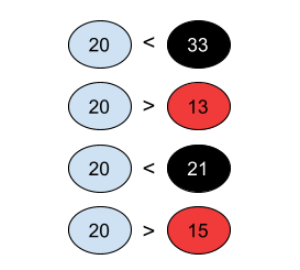
So, the new node can be inserted as the right child of the node with key=15.
- If the leaf node Key is greater than the key of the new node, make the new node as the right child.
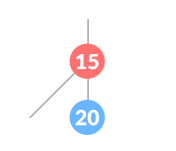
- Assign NULL to the left and right child of the new node and make it red-colored

- Call Insert Fix-algorithm to maintain the property of the red-black tree if violated after insertion.
Insert Fix():
Algorithm to Maintain Red-Black Property After Insertion
- While the parent p of the new node is RED, do the following.
- do the following if p is the left child of grandParent gP of the new node
Case-I
- If the color of the right child of gP(grandparent of the new node) is RED, then make the color of both the children of gP as BLACK and the color of gP as RED.
- Assign gP as newNode.
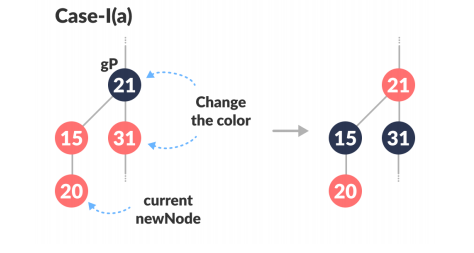

Case-II
- Else if the new node is the right child of p then, assign it as the new node.
- Left-Rotate the new node.


Case-III:
- Set the color of p as BLACK and the color of gP as RED.
- Right-Rotate the gP
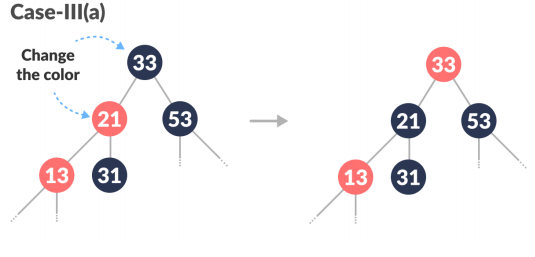

- Else, do the following :
- If the color of the left child of gP of the new node is RED, recolor the color of gP as RED and the color of both the children of gP as BLACK.
- Assign gP as the newNode.
- Else if the new node is the left child of p then, assign p to newNode and Right-Rotate the newNode.
- Recoloring, i.e., the color of p as BLACK and the color of gP as RED.
- Left-Rotate the gP.
- Make the root of the tree as BLACK.

It is the final red-black tree after insertion.
Structure of the red-black tree node
|
struct red_black_node { enum { red, black } colour; void *data; struct red_black_node *left,*right,*parent; } |


 1+ registered

