Do you think IIT Guwahati certified course can help you in your career?
Introduction
Have you ever used any engine to automate IT tools such as application deployment, cloud provisioning, and many more?
This article focuses on one of the automation engines, which is called Ansible. We will also study about the features and its components. Then we will study how it works.
Let's see what it is in more detail.
About Ansible
Ansible can be understood as an open-source information technology (IT) engine that is used for the automation of services like application deployment, provision of the cloud, intra-service orchestration, and many more.
It is used to address a wide range of automation difficulties with significant productivity improvements.
Ansible was developed with multi-tier deployment in mind.
Ansible models IT architecture by specifying how all of your systems are interconnected rather than managing one system at a time.
Because Ansible is entirely agentless, it connects your nodes using SSH to function (by default).
However, Ansible gives you the option of using another connection technique, such as Kerberos.
Due to the lack of agents or specialized security infrastructure, Ansible is simple to deploy.
Why you should use Ansible
Let's check out some significant reasons for using Ansible:
Ansible is open-source, i.e., free to use for everyone.
Ansible is relatively consistent and lightweight and not dependent on the operating system or if the hardware is present or not.
It is secure because of its agentless capabilities and features of open SSH security.
Ansible does not need special system administrator skills for its installation and usage.
Ansible has an easy learning curve because of its thorough documentation and simple structure and setup.
Ansible is the ideal partner for orchestrating big environments due to its modularity regarding plugins, inventories, modules, and playbooks.
Ansible Architecture
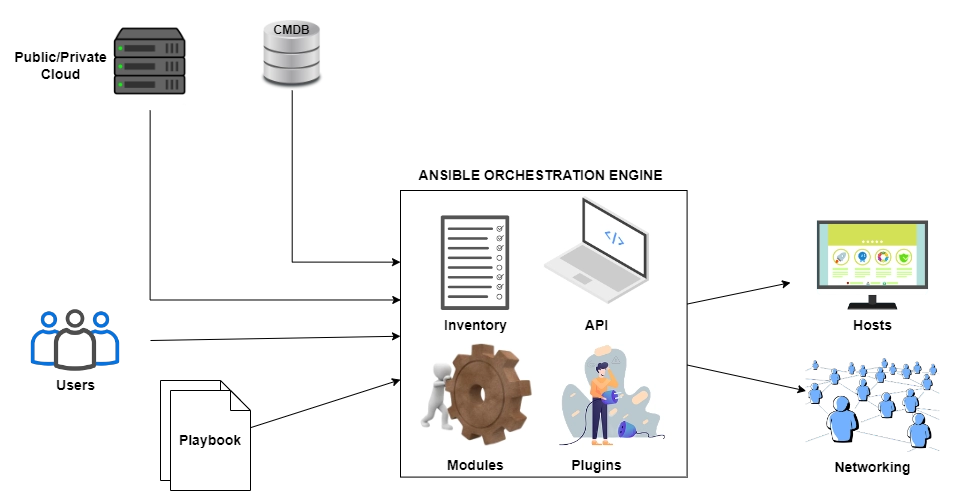
The Ansible orchestration engine communicates with the user creating the Ansible playbook to carry out the orchestration and communicate with the configuration management database and services provided by private or public clouds.You can check out the diagram given below:
Inventory
Inventory can be understood as lists of hosts or nodes that have their IP addresses, servers, databases, etc. which needs management.
API’s
The public or private cloud services can be transported using the Ansible APIs.
Plugins
A piece of code called a plugin extends Ansible's fundamental features. You can also create your own plugins, and there are several that are helpful.
CMDB
CMDB stands for Configuration Management Database. For IT deployments, CMDBs serve as a kind of repository that serves as a data warehouse.
Playbooks
Ansible employs playbooks, which use YAML, a straightforward language that is very easy for people to learn, read, and create to describe automation jobs.
Because of these playbooks, even the IT support people can understand it just by reading it, and debugging can be done as per the requirements.
About YAML
YAML can be understood as a human-readable data serialization language that is generally used for writing configuration files. YAML is an abbreviation that highlights that it is a markup language, not a document, depending on who you ask. It can also stand for yet another markup language or YAML ain't markup language.
There are numerous applications where it could be utilized to store data.
Modules
As soon as it is connected to your nodes, Ansible starts pushing small programs, which are known as Ansible Modules. On your nodes, Ansible executes those modules, then removes them once they are finished.
Hosts File
Ansible also helps in the management of your inventory in simple text files. These simple text files are known as the hosts file. With Ansible's hosts file, one may organize hosts into groups and utilize playbooks to govern specific groups' actions.
How does it work?
Ansible starts by getting connected to your nodes and sending them small programs known as Ansible modules. After these modules had finished running, Ansible deleted them. There are no daemons, servers, or databases necessary; the library of modules can stay on any computer.
The managing node in the image above is the controlling node that oversees how the playbook is carried out in its entirety. It is the node that you are operating the installation from. A list of hosts where Ansible modules need to be run is provided in the inventory file. The management node connects via SSH, runs the tiny modules on the host system, and installs the software or product.
Frequently Asked Questions
Is Ansible free?
Ansible is actually a free and open-source tool. Also, it's pretty straightforward to set up and use.
Is Ansible a programming language?
Ansible is a configuration management tool that employs declarative markup to describe setups. It is implemented in the Python programming language.
Is Ansible easy to learn?
Ansible is quick and straightforward to set up and is effective, dependable, and robust. It runs on Linux, Mac, or BSD.
Should I learn Ansible or Python first?
Despite being developed in Python, Ansible is simple to use; you don't even need to be familiar with the language.
What is Ansible in AWS?
Ansible can be understood as an open-source tool that you can use to automate your AWS deployments.
Conclusion
In this article we studied about one of the automation engines, which is called Ansible. We also discussed the features, and its components. Then we also studied how it works.
We hope that this article has provided you with the help to enhance your knowledge regarding Ansible.

















 1+ registered

