TestNG
TestNG is also a Java based testing framework. It runs tests in classes so as to process them. TestNG is the advanced testing framework which overcomes the flaws of Junit. It's also a versatile tool for running tests because it utilises the same Classes for all tests and handles threads to run procedures, making the whole operation of the checking tests fast.
Characteristics
- It put the test group in Java groups.
- It runs unit tests with arguments passed into the test functions.
- The use of Threads improves testing performance by reducing execution time.
- It allows for parallel testing.
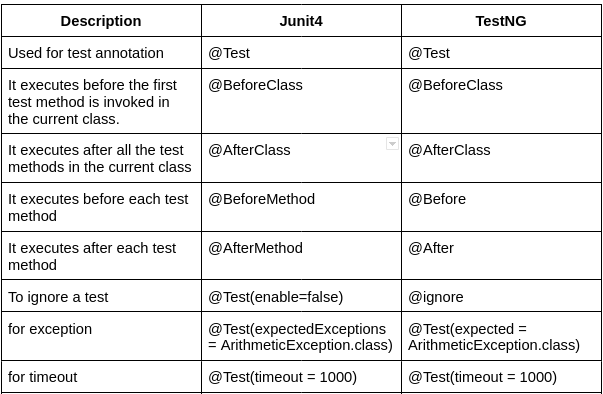
Features Comparison
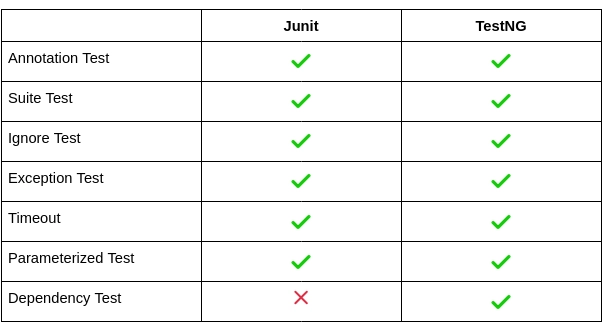
Testing annotation in Junit4 and TestNG

Check out JUnit Interview Questions here.
FAQs
-
Is TestNG better than JUnit?
Both TestNG and Junit frameworks are used for Unit Testing. TestNG has a few extra features that make it more powerful than JUnit.
-
Are unit tests a waste of time?
Not a waste of time. If a function's expected behaviour is explicit, writing a unit test should take seconds to minutes.
-
Can we use JUnit and TestNG together?
Add the JUnit library to the TestNG classpath to discover and utilise JUnit classes, switch your test runner from JUnit to TestNG in Ant, then run TestNG in "mixed" mode. This way, you may start utilising TestNG with all of your tests in the same project, even in the same package.
-
What is the difference between JUnit and unit testing?
JUnit is used for unit testing. And, it is used for other types of testing as well. ... Instead, I view it as a way of running code marked as "runnable by JUnit." That code is marked by @Test annotations and is often called a Test, and those "Tests" are often used for Unit testing, but they don't have to be.
Key Takeaways
Requirements collecting, communication, design, coding, testing, and development are all stages of the SDLC. In order for software to be deployed effectively, testing is essential. It can be done manually or automatically, depending on the needs of the customer and the reason for which it was created. As a result, the article compares and contrasts TestNG and Junit, two popular testing frameworks. The article also covers test annotations which are used in both TestNG and Junit.
Hence never stop your journey of learning.
Learning never stops, and to feed your quest to learn and become more skilled, head over to our practice platform Coding Ninjas Studio to practise top problems, attempt mock tests, read interview experiences, and much more.!
Happy Learning!





 1+ registered

