Do you think IIT Guwahati certified course can help you in your career?
Introduction
Network Functions Virtualization (NFV) represents a transformative approach in the way telecommunication networks and services are designed, deployed, and managed. It decouples network functions from dedicated hardware appliances, allowing them to run in software on standardized hardware platforms. This shift is part of a larger trend towards software-defined networking (SDN) and the virtualization of various computing and network resources.
The concept emerged from the need to increase network agility and flexibility, enabling service providers to respond faster to changing market demands and reduce the reliance on expensive, specialized hardware.
The Need for Network Functions Virtualization
Traditional network infrastructures are often composed of a plethora of specialized hardware devices. Each of these is typically designed for a specific function, such as routing, firewalling, or load balancing. This hardware-centric model poses several challenges:
Cost and Complexity: The procurement and maintenance of specialized hardware are costly. It also adds complexity to network management and scaling.
Inflexibility: Rapidly evolving network demands require quick adaptation, but hardware changes are inherently slow and rigid.
Underutilization: Dedicated hardware often operates well below its capacity, leading to resource underutilization.
Advantages of Network Functions Virtualization
Enhanced Network Flexibility and Scalability
One of the primary advantages of NFV is the increased flexibility and scalability it offers. By virtualizing network functions, service providers can deploy, modify, and scale services much more rapidly than with traditional hardware-based approaches. This agility enables them to adapt quickly to changing market demands and customer needs.
Cost Reduction
NFV can lead to significant cost savings. The shift from proprietary hardware to standard commercial off-the-shelf (COTS) servers, storage, and switches reduces both capital expenses (CAPEX) and operational expenses (OPEX). With NFV, network operators can reduce the costs associated with purchasing, maintaining, and upgrading specialized hardware.
Improved Resource Utilization
Virtualizing network functions allows for more efficient use of physical resources. Network services can be dynamically allocated and adjusted based on real-time demand, leading to better resource utilization and reduced power consumption.
Enhanced Innovation and Service Differentiation
NFV fosters innovation by making it easier to introduce and test new services. Network operators can quickly deploy new applications and services without the need for new hardware, allowing them to differentiate their offerings and stay competitive.
Working of Network Functions Virtualization
Core Principles
The operation of NFV is grounded in a few core principles:
Decoupling of Network Functions: Network functions such as firewalls, load balancers, and routers are decoupled from traditional hardware appliances and are run as software instances.
Leveraging Standard IT Virtualization Technology: NFV utilizes existing virtualization technologies commonly found in data centers, such as virtual machines (VMs) or containers, to host these network functions.
Dynamic and Flexible Network Management: Management and orchestration tools are used to dynamically deploy, manage, and scale network functions as needed.
Step-by-Step Workflow
Virtualization of Network Functions: Network functions are converted into virtual instances, known as Virtualized Network Functions (VNFs).
Deployment on Standard Hardware: These VNFs are deployed on standard servers, storage, and switches instead of dedicated hardware.
Dynamic Orchestration and Management: An NFV management and orchestration system (NFV MANO) oversees the deployment, operation, and lifecycle management of these VNFs.
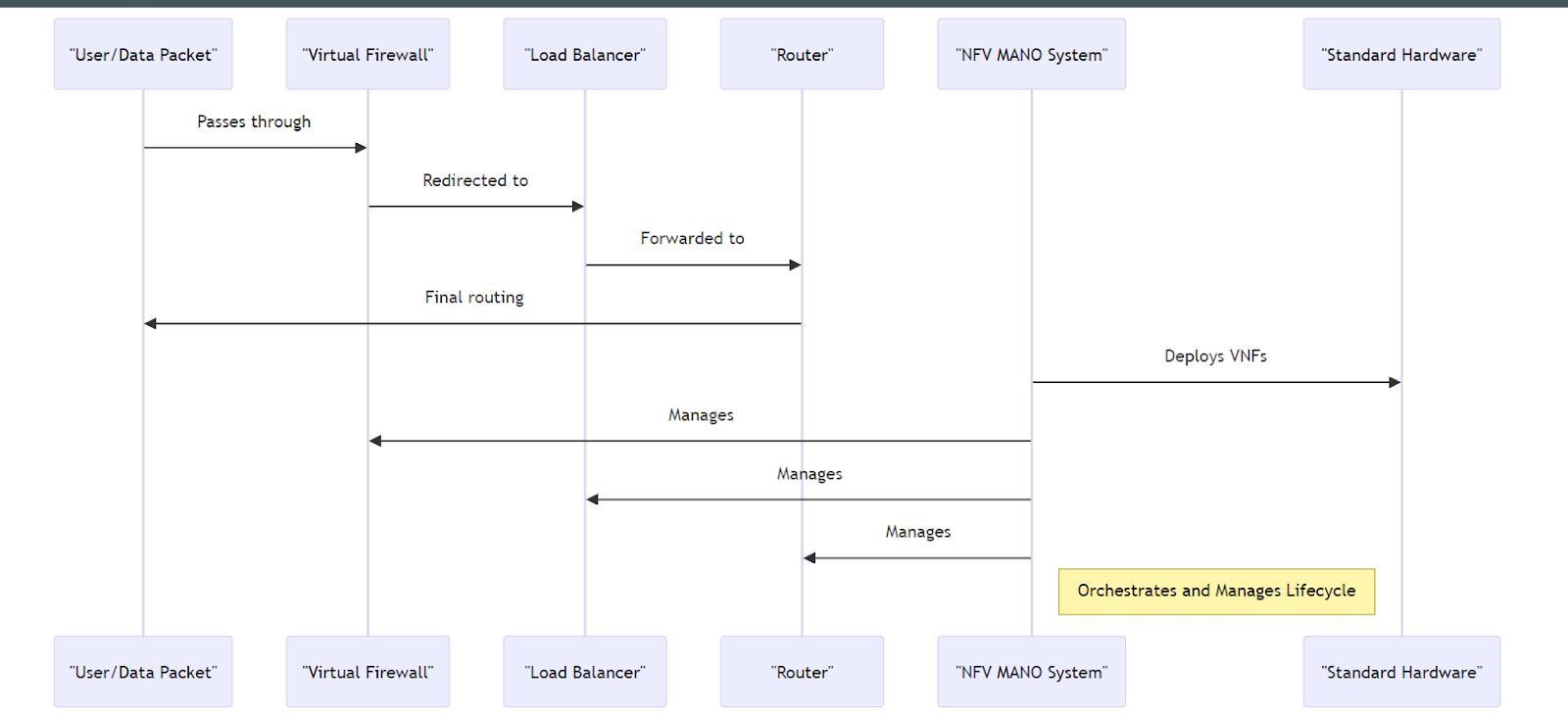
Service Chaining: VNFs can be linked or "chained" together to create complex network services. For instance, a data packet might pass through a virtual firewall, then a load balancer, and finally a router, all implemented as VNFs.
Let’s understand this through the below diagram:
Explanation-
The diagram begins with a User or Data Packet passing through various Virtualized Network Functions (VNFs).
The data packet first goes through a Virtual Firewall (VNF1), then is redirected to a Load Balancer (VNF2), and finally forwarded to a Router (VNF3) for the final routing.
The NFV Management and Orchestration (NFV MANO) system plays a crucial role in deploying these VNFs on standard hardware and managing their lifecycle.
The diagram visually represents the dynamic orchestration and management of network functions in a virtualized environment.
Practical Example
Consider a scenario where a telecom operator wants to deploy a new firewall service. Instead of installing new hardware, the operator can quickly spin up a firewall VNF on their existing infrastructure. This process is faster, more cost-effective, and can be easily scaled or modified as needs change.
Risks of Network Functions Virtualization
While NFV brings numerous benefits, it also introduces certain risks and challenges that must be carefully managed:
1. Complexity in Integration and Management
Integration Challenges: Integrating NFV with existing network infrastructure and operations can be complex, particularly in transitioning from legacy systems.
Skillset Requirements: The shift towards a more software-centric network requires a change in skill sets, necessitating training or hiring personnel with expertise in virtualization and software-defined networking.
2. Security Concerns
Shared Resource Risks: Virtualized environments share physical resources, which can pose security risks if not properly isolated and managed.
New Attack Vectors: The software-based nature of NFV might open up new attack vectors, requiring robust security measures and constant vigilance.
3. Reliability and Performance Issues
Potential for Performance Degradation: Virtualized network functions might not always match the performance of dedicated hardware, especially in high-throughput or low-latency scenarios.
Reliability Concerns: The dependence on software and standard hardware can raise concerns about reliability, particularly in mission-critical applications.
4. Scalability and Elasticity Challenges
Handling Scalability: Efficiently scaling virtualized network functions to meet fluctuating demands can be challenging, requiring advanced orchestration and automation capabilities.
Maintaining Service Quality: Ensuring consistent service quality while dynamically scaling can be difficult, necessitating careful planning and testing.
5. Vendor Lock-in and Interoperability Issues
Risk of Vendor Lock-in: Relying on specific vendors for NFV solutions can lead to lock-in, limiting flexibility and choice.
Interoperability Challenges: Ensuring that NFV solutions from different vendors work seamlessly together can be a significant hurdle.
NFV Architecture
Network Functions Virtualization (NFV) architecture is designed to provide a flexible and scalable framework for deploying and managing virtualized network functions. It consists of three primary components:
1. NFV Infrastructure (NFVI)
NFVI is the foundation of the NFV architecture and encompasses all the hardware and software resources required to deploy and manage virtualized network functions. Key elements include:
Compute Resources: This includes servers, virtualization platforms (e.g., hypervisors), and containers.
Storage Resources: Storage devices and systems that store virtual machine images and data.
Network Resources: Physical and virtual network components such as switches and routers.
The NFV-VIM is responsible for managing and orchestrating the NFVI resources. Its main functions include:
Resource Virtualization: Allocating compute, storage, and network resources to virtualized network functions.
Resource Lifecycle Management: Handling the instantiation, scaling, and termination of virtualized functions.
Resource Monitoring: Continuously monitoring the performance and health of NFVI resources.
3. NFV Orchestrator (NFV-O)
The NFV Orchestrator sits above the NFV-VIM and is responsible for the end-to-end orchestration of virtualized network functions. Its functions include:
Service Orchestration: Managing the entire lifecycle of network services, which may comprise multiple virtualized functions.
Resource Allocation and Optimization: Ensuring efficient resource utilization and scaling based on service requirements.
Interoperability: Ensuring that different VNFs and NFV infrastructure components work seamlessly together.
Interactions within NFV Architecture
In practice, these components interact to enable the deployment and management of virtualized network functions:
Service Providers: Service providers define the network services they want to offer and their requirements.
NFV Orchestrator: The NFV Orchestrator translates the service provider's requirements into resource allocations and instructs the NFV-VIM.
NFV-VIM: The NFV-VIM manages and allocates the necessary resources from the NFVI.
NFV Infrastructure (NFVI): The NFVI hosts the virtualized network functions, ensuring they have the required compute, storage, and network resources.
Virtualized Network Functions (VNFs): These are the actual network functions that run as virtual instances on the NFVI.
Benefits of Network Functions Virtualization
NFV offers numerous benefits that align closely with the evolving needs of modern network environments:
1. Operational Efficiency
Automated Deployments and Upgrades: NFV allows for the automated deployment and scaling of network functions, significantly reducing manual intervention and the potential for human error.
Centralized Management: With NFV, network functions can be managed and monitored from a central location, simplifying network administration.
2. Increased Service Agility
Rapid Service Provisioning: NFV enables the quick rollout of new services and applications, meeting the demands of customers and markets more effectively.
Flexibility in Service Design: Service providers can experiment with and customize services more freely, leading to innovative offerings and enhanced customer satisfaction.
3. Reduced Capital and Operational Expenditures
Lower Hardware Costs: By utilizing standard IT hardware, NFV reduces the need for specialized network equipment, cutting down capital expenses.
Operational Cost Savings: The streamlined management and automation capabilities lead to lower operational costs.
4. Enhanced Disaster Recovery and Business Continuity
Improved Resilience: Virtualized network functions can be quickly replicated and redeployed in different geographical locations, enhancing disaster recovery capabilities.
Easier Backup and Redundancy: The virtual nature of NFV simplifies backup processes and the implementation of redundant systems.
5. Energy Efficiency
Reduced Energy Consumption: By optimizing resource utilization, NFV can lead to lower energy consumption in data centers.
Disadvantages of NFV
1. Complexity and Integration Challenges
Integrating NFV with existing network infrastructure can be complex and may require skillset adjustments.
2. Security Concerns
The virtualized nature of NFV can introduce new security risks, requiring robust security measures.
3. Reliability and Performance
Virtualized functions may not always match the performance of dedicated hardware, raising concerns in mission-critical scenarios.
4. Scalability and Elasticity Challenges
Efficiently scaling virtualized functions while maintaining service quality can be challenging.
5. Vendor Lock-in and Interoperability
Depending on specific vendors for NFV solutions can lead to lock-in, and ensuring interoperability between different vendors' solutions can be a challenge.
While NFV can improve security with features like automated updates, it can also introduce new vulnerabilities if not properly secured. Implementing security best practices is crucial.
Can NFV be applied to small-scale networks?
Yes, NFV can benefit networks of all sizes. Even small-scale networks can take advantage of virtualized network functions for cost savings and agility.
What is the role of NFV in 5G networks?
NFV is a key enabler of 5G networks, allowing for the rapid deployment and scaling of network functions required for the diverse services offered by 5G.
Conclusion
Network Functions Virtualization (NFV) is a revolutionary approach to network infrastructure that offers flexibility, cost savings, and innovation opportunities. However, it also presents challenges related to complexity, security, and performance. By carefully planning deployments, addressing security concerns, and optimizing performance, organizations can fully harness the benefits of NFV and adapt to the evolving landscape of network technologies.






 1+ registered

