Do you think IIT Guwahati certified course can help you in your career?
Introduction
Hello Ninjas! In the digital age, security threats loom in unexpected corners. Cybercriminals are constantly evolving their techniques. They seek to exploit vulnerabilities and compromise our digital identities. In this article, we will learn about Pharming attacks in detail.
Pharming Attack
Imagine innocently typing URL of your banking portal and being redirected to an identical looking fraudulent website. Before you know it, you're a victim of Pharming attack. It's a stealthy cybercriminal technique that has plagued the digital landscape in recent years.
Pharming attacks reported worldwide between 2014 and 2020 have increased by more than 67%, making this insidious form of online fraud on the rise and posing a serious threat to both individuals and organizations. Pharming attacks have gained reputation as a stealthy manipulation of online infrastructure.
In Pharming attack cybercriminals manipulate internet infrastructure. By manipulating the infrastructure they redirect users to fraudulent websites without their knowledge. This attack is aimed at the vulnerability of the Domain Name System (DNS). This attack can also be executed by tampering host files on the client machine.
Types of Pharming Attack
There are 2 major types of Pharming attacks:
DNS based Pharming Attack
Host File Pharming Attack (also known as Pharming Malware Attack)
Now we will discuss both in detail.
DNS based Pharming Attack
In DNS-based pharming attacks, attackers manipulate DNS records to redirect users to fraudulent websites.
The attack targets the Domain Name System (DNS). An infrastructure that translates domain names into IP addresses.
Attackers control DNS settings and associate legitimate domain names with malicious IP addresses.
When a user attempts to visit their legitimate website, the DNS query is spoofed and redirected to an attacker-controlled malicious website.
Host File Pharming Attack
In a hosts file farming attack, the attacker manipulates the hosts file on the target system to redirect DNS resolution.
A hosts file is a local file that maps a domain name to it's IP address on an individual computer.
An attacker gains administrative access of the target system and modifies entries in the hosts file.
They associate a legitimate domain name with it's IP address on a malicious website.
When a user tries to access it's legitimate website, the system checks for a compromised hosts file and redirects to the attacker's malicious website. This operation is done locally on the target system and only affects DNS resolution on that particular device.
Working of Pharming Attack
Now we will look into details of working of pharming attacks
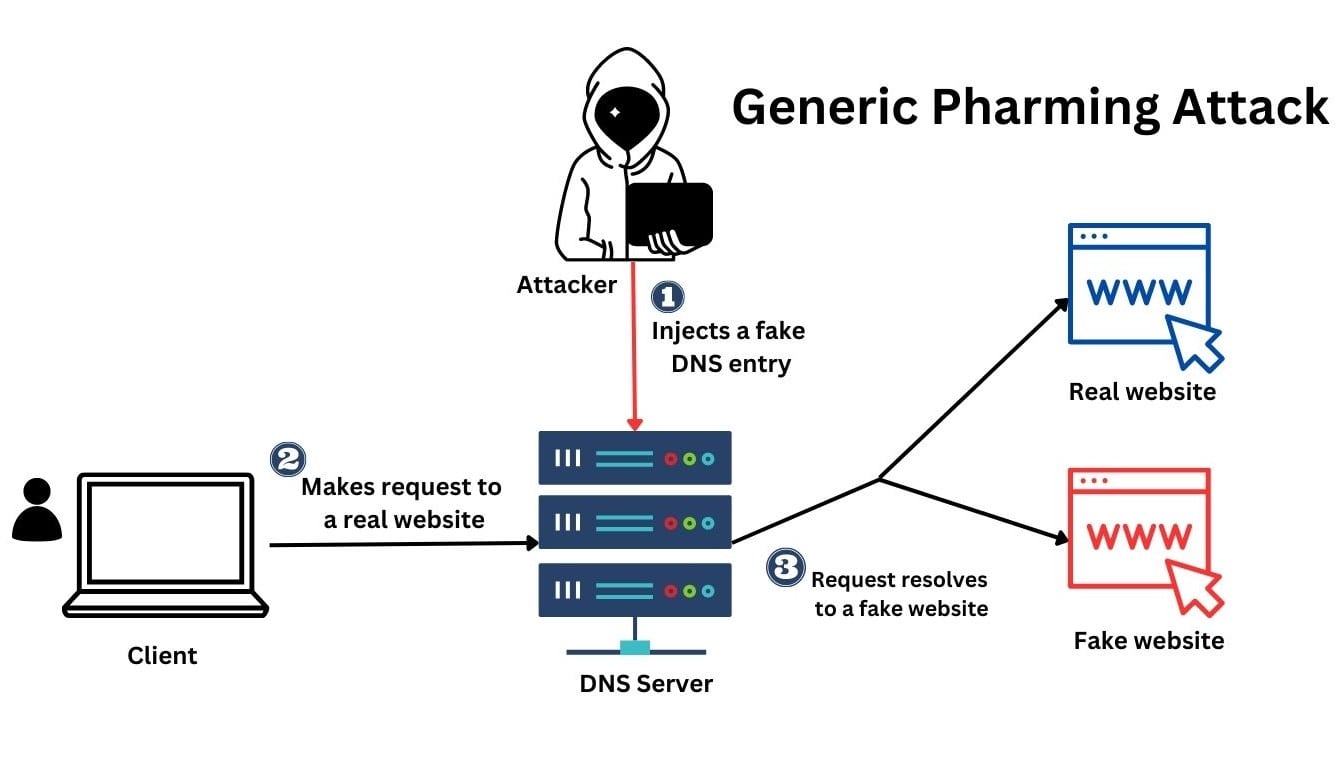
Here’s a detailed explanation of the above diagram.
Manipulate DNS Settings
Attackers first compromise DNS (Domain Name System) settings as shown in step 1. They exploit vulnerabilities in routers and DNS servers, and compromise DNS records.
Redirect DNS Resolution
Once the attacker gains control over the DNS settings, he manipulates the settings to redirect the DNS resolution process. They change the IP address associated with a legitimate domain name to the IP address of a malicious website under their control.
DNS Cache Targeting
The attacker's goal is to exploit the caching mechanisms of DNS servers or individual computers. DNS information is cached to affect multiple users.
DNS Resolution
A DNS server looks up the IP address associated with the requested domain name. In a pharming attack, a manipulated DNS configuration gives the user the IP address of a malicious website .
The user receives the manipulated IP address through the DNS resolution process. As a result, the user's browser connects to a malicious website.
User Actions on Malicious Websites
Users unknowingly navigate rogue websites that are designed to appear legitimate as shown in step 2 & 3. Attackers can use a variety of techniques, including phishing, to trick users into providing sensitive information.
Possible Results
Results may vary, depending on the attacker's intent. This may include identity theft, financial fraud or further exploitation of compromised users or systems.
Implications of Pharming Attack
Pharming attacks have significant implications for society, organizations and individuals as a whole. Let's look at the implications of pharming attacks in depth:
Legal and Regulatory Consequences
If organizations fail to protect against attacks, they may face legal and regulatory repercussions. Data protection regulations like GDPR(General Data Protection Regulation) set rules for safeguarding personal data. Compliance with data protection regulations is crucial to mitigate legal and financial consequences.
Interruption of Online Service
Pharming attacks can affect the availability of legitimate online services. By redirecting users to deceptive websites, attackers can cause confusion and frustration. Thus, leading to decreased user engagement and trust. This can be harmful to businesses that rely heavily on online platforms.
Reputation Damage
Companies that fall victim to pharming attacks suffer significant reputational damage. Users may lose confidence in the ability of affected organizations to protect their data. Users may be reluctant to conduct future transactions or share sensitive information. A damaged reputation can have long-term effects and impact customer loyalty, partnerships, and overall business success.
Financial Loss
Pharming attacks can result in financial loss for individuals and organizations. An attacker could trick a user into entering credit card information on a fake website to steal funds. Additionally, businesses may face financial consequences through legal obligations, customer compensation, or reputational damage.
Data Breach and Privacy Risks
Pharming attacks can lead to data breaches. Suppose a user unknowingly enters login credentials into a fraudulent website. An attacker could collect and misuse this sensitive information. Personal information can be sold on the black market or used for a variety of malicious purposes, including identity theft and fraud.
Detecting Pharming attacks
To uncover a pharming attack, you must look for signs of suspicious activity or unauthorized changes. Here are some important methods for detecting pharming attacks.
Monitor your DNS Settings
Regularly check your DNS settings for unexpected or unauthorized changes. This includes checking DNS records, IP addresses, and domain configurations. Look for discrepancies or changes that could indicate a pharming attack.
Analyze Website Behavior
Be aware of unusual behavior when visiting websites. Unexpected redirects, website content changes, or a sudden increase in pop-ups can be signs of a pharming attack.
Check the Authenticity of the Site
Double-check your website's URL for mismatches or unknown domain names that could indicate a deceptive website. Check the legitimacy of the URL by comparing it to a trusted source or official channel.
Be Aware of SSL Certificate Issues
Check for SSL certificate errors or warnings when accessing secure websites. If you encounter an SSL certificate mismatch or receive a warning about an untrusted certificate, it may indicate a pharming attack. Monitor network traffic.
Use network monitoring tools to analyze incoming and outgoing network traffic. Look for unusual patterns or connections to suspicious IP addresses or domains that may be associated with pharming attacks.
Preventing Pharming Attacks
Here are some important points to be considered by users about preventing pharming attacks.
Understanding Pharming Attacks
Pharming attacks redirect users to fake her websites without their knowledge or consent.
Attackers manipulate DNS servers and hosts files to trick users. Further, they exploit vulnerabilities in the Internet infrastructure.
Detect Suspicious URLs
Be careful when clicking on links from email, social media, or unknown sources.
Check the actual URL by hovering over the link before clicking and avoid suspicious or unverified links.
Keep your software up to date.
Enable Two Factor Authentication
Enable 2FA whenever available to add an extra layer of security to your online accounts.
Even if your login credentials are compromised, 2FA provides an additional authentication step.
Using Secure DNS
For better protection, DNS services such as DNSSEC or DNS are better over HTTPS.
These services verify the authenticity of websites and help prevent pharming attacks.
Safe Online Habits
Users should practice safe online habits such as :
Users should not share sensitive information through insecure channels.
Using strong and unique passwords.
Users should enable two-factor authentication (2FA) whenever possible.
Being cautious when downloading files or clicking on attachments.
Frequently Asked Questions
Can two-factor authentication (2FA) protect against pharming attacks?
Yes, 2FA can protect against pharming attacks. It provides an extra layer of security and helps protect against various other attacks too. It can mitigate the attack impact and minimize the risk of unauthorized access.
Are there any legal implications for perpetrators of pharming attacks?
Yes, there can be legal repercussions for perpetrators of pharming attacks. Conducting a pharming attack is a criminal offense. It is subject to various laws and regulations related to cybercrime and fraud.
How can users differentiate between legitimate and fraudulent websites to avoid pharming attacks?
There are many ways users can distinguish between legitimate and fraudulent websites. Some of the methods are checking URL, looking for safety indicators, checking website reputation, and using safe browsing tools.
What steps can individuals and organizations take to protect themselves against pharming attacks?
To protect yourself and organization users can take various steps such as: keeping software updated, using secure DNS services, implementing strong network security and enabling 2 factor authentication.
How do attackers manipulate host files in host file pharming attacks?
An attacker gains administrative access to a target system and modifies the hosts file to add or modify entries that redirect DNS resolution. This operation makes it possible to redirect users to her deceptive website without their knowledge.
Conclusion
Pharming attacks pose a significant threat to individuals and organizations. Implementing robust security measures such as secure DNS configuration, can greatly reduce the risk of pharming attack. However, it is important to stay vigilant, stay informed about new threats. You should continually adapt security practices to counter the evolving nature of attacks.






 6+ registered

