Introduction
Hey, Ninjas! Welcome to another cloud computing article. The concept of cloud computing is to provide an on-demand IT infrastructure and services to enhance the capabilities of organisations. The aim is to provide services as per the business needs and help the organisations manage and scale their IT operations.

This article will discuss the relationship between an organisation’s work model and the cloud. We will also talk about the roles and features of the cloud.
Relationship between Organisation’s Work Model and Cloud
Nowadays, it is seen that most organisations are transforming their work model to the cloud. Cloud provides a fantastic set of features that help organisations grow faster and helps in the management and security of their IT operations and services.
But moving from the traditional work model to the cloud takes work. Most organisations need more resources to shift their work model to the cloud. They aim to maintain a good balance between their traditional work model and the emerging cloud model.
Let us first understand how an organisation design the cloud model.
How is the Cloud Model Designed?
The cloud model defines a high-level representation of how the organisation will adopt the cloud services in its existing business model. It is a guide for structuring a team in a way that will produce the results and capabilities needed to offer value through cloud services. First, we build a Cloud Strategy which governs the management of resources in a multi-cloud world.

The cloud strategy defines the “What” and “Why” of cloud services, and the cloud model defines the “how” and “who” for the implementation of cloud services. In other words, the cloud strategy acts as a bridge between the business strategy and the cloud model.
It is not ideal to move to the cloud model all at once. Organisations usually take small steps and combine the new cloud features slowly with their existing models. There is no hardcode method to design the cloud model for an organisation, but there are three main components that need to be addressed when building a cloud model.
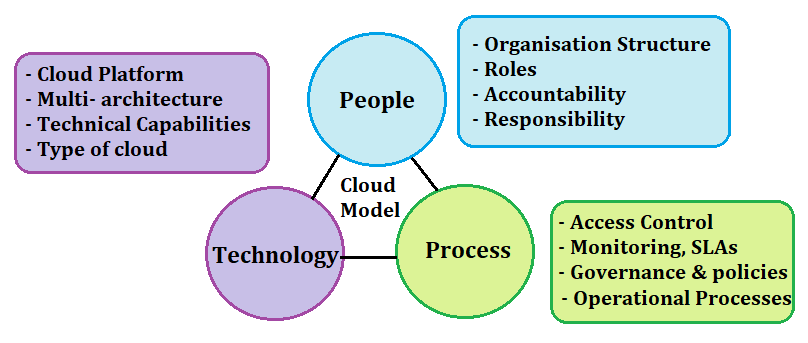
The three main components of designing the cloud model include -
- People
- Process
- Technology
People
The people or teams working in an organisation are the significant factors in designing the cloud model. People need to be skilled with the functionalities of cloud computing and be aware of how everything works within the cloud. The security measures, operations, and management of the cloud model differ from the traditional model. So, it can be challenging for people to adapt to the new cloud infrastructure.

Organisations build a structure to define the roles and accountability of different teams to work effectively. New roles may be required to define responsibilities specific to the cloud. Organisations may require to recruit new skillsets or upskill the existing employees.
Process
The next vital step to keep in mind is the management of the processes. Over the past years, a defined set of processes have been developed and is managed by organisations. But by adopting the cloud, many such processes may be automated or aren’t required anymore. Understanding these processes and how to execute and manage them efficiently is necessary.

Some of these processes or services are
- Governance and policy enforcement processes.
- Workload placement policy and process.
- Responsibility and Accountability.
- Access Control.
- License management.
- Data protection and classification.
Technology
After people and process, the next most important component is technology when designing the cloud model. Technology decisions can either make success much easier or much more difficult. There are many cloud service providers and platforms, and it is essential to understand your needs and requirements to decide the best fit for your organisation.
The cloud platform to be used, the cloud capabilities, the type of cloud model to be implemented, the architecture to be used, all these decisions are to be taken by the organisation to implement the cloud model effectively.
Why is it essential for organisations to make a strong commitment to the cloud at scale?
Organisations need to make a strong commitment to the cloud at scale for the following reasons.
-
Cloud services provide many functionalities, and the more an organisation adopts the cloud facilities, the higher the outcomes are achieved.
-
Cloud provides security measures to organisations, and moving to the cloud would ensure the security of sensitive information.
- With the cloud services and flexibility of infrastructure and resources, the capabilities of the cloud are enormous. Small organisations with less investment can also easily move to the cloud and grow.
Roles of cloud
Cloud computing plays an essential role in an organisation. Organisations can automate repetitive processes and scale up the infrastructure as and when required. There are many reasons why an organisation should move to the cloud.
The top roles of the cloud are mentioned below.
-
Reducing Overhead: Cloud offers the capability to pay only for the resources used by your organisation; this reduces the costs significantly. Organisations do not have to purchase all the resources and infrastructure, but they can use the on-rent facility of cloud services to fulfill their needs. It is found that by adopting cloud services, the IT overhead cost reduces by 30-40%.
-
Security: Big companies such as Zscaler provides security-as-a-service to small organisations and businesses to ensure a secure and reliable network over the cloud. The sensitive data is protected using authentication, authorization, and encryption services. These services provide the software implementation of firewalls to prevent intrusions and threats to the organisation's data.
-
Efficient Delivery of Services: It is easier for organisations to deliver services digitally with the help of the cloud. By using the cloud, organisations can reach a much wider range of customers and elevate their total outcome. Cloud providers also ensure that the downtime is as low as possible to provide uninterrupted delivery of services.
-
Collaborative Management: The data and processes are available anywhere, anytime when using cloud services. The progress is synchronized, and this eases collaboration between the IT department and the other teams. The resources can be shared and, at the same time, synchronized. The system updates and installation is also easier with data sharing over the cloud.
- Scalability: When working with cloud services, you do not have to care about scalability. By adopting cloud computing, you can use the facility of pay-as-you-go; it means that the resources and infrastructure are available at all times, and you can pay for the resources your organization uses. You can scale up or down the resources at any time and pay only for the number of resources you actually use. This reduces the need to purchase more resources when your organization's requirements are at their peak.
Features of Cloud
There are certain features or characteristics that are to be considered by all cloud providers. These works in favor of cloud consumers and help organisations and businesses grow efficiently using cloud services. The features of cloud computing are defined by five main points. They are mentioned below.
-
On-demand Self-Service: The services like emails, applications, networks, or servers are provided without requiring interaction with each service provider. All these services are made available on one platform, making it easier to use them in an integrated manner.
-
Broad Network Access: The cloud services should be compatible to work on heterogeneous clients like mobile phones, laptops, computer systems, etc. Cloud services need to be compatible with different interfaces or operating systems.
-
Resource Pooling: A vast pool of resources should be maintained and made available at all times. The resources include computing resources, RAM, memory, storage, processors, or network bandwidth. The actual physical location of these resources is not known to the customers, but a higher level can be specified by the organisations like the country or state.
-
Rapid Elasticity: The resources should be available in any quantity and at any time. The organisations using cloud services should be capable of scaling up and down the resources on demand. The resources must appear unlimited for the users.
- Measured/Metered Services: Metering and billing of resources used by the organisations must be done in order to implement the pay-as-you-go model. The organisations have to pay only for the services/ resources they use. It is essential to maintain transparency in resource usage for both the providers and the consumers.

 9+ registered