




Introduction
According to the REST design, a RESTful Web Service shouldn't keep a client state on the server. This restriction is called Statelessness. The client must pass its setting to the server; afterward, the server can store this setting to deal with the client's further solicitation. For instance, the meeting kept up with my server is distinguished by the meeting identifier passed by the client.
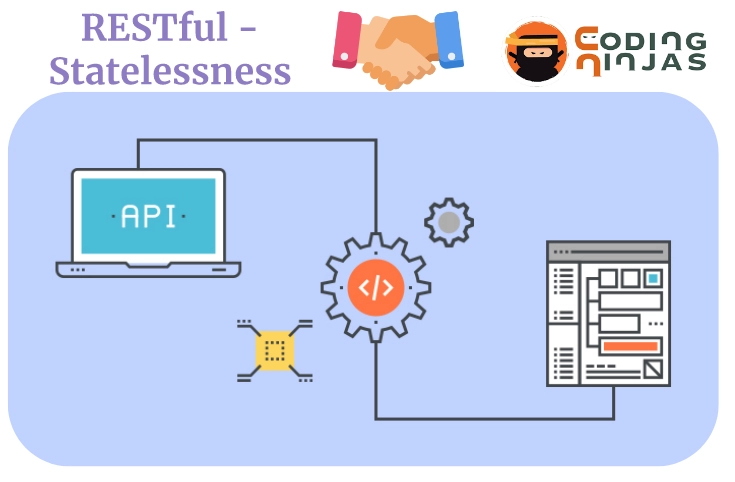
RESTful - Statelessness
REST is an abbreviation for Illustrative State Move and an engineering style for conveyed hypermedia frameworks.
The six core values of REST are:
🔅Uniform Connection point
🔅Client-Server
🔅Stateless
🔅Cacheable
🔅Layered design
🔅Code on request (discretionary).
This article will discuss the Stateless imperative of REST top to bottom.
⚠️NOTE: According to the REST{Representational "State" Move } design, the server stores no data about the client-side on the server-side.
Each solicitation from the client to the server should contain all the data expected to deal with that solicitation. That data can't be stored on the server side for future reference. This restriction is called Statelessness.
The client is answerable for putting away and dealing with the meeting-related data on its side. Assuming that any data is expected from the past solicitation, the client will share it in the ongoing solicitation.
"Statelessness implies that each HTTP demand occurs in complete disengagement."
The application state is the data put away at the server side to distinguish approaching solicitations and past connections; REST statelessness implies being liberated from the application state.

Statelessness
According to the REST (Authentic "State" Move) engineering, the server stores no state about the client meeting on the server side. This restriction is called Statelessness.
Each solicitation from the client to the server should contain all vital data to grasp the solicitation. The server can't exploit any put away setting on the server.
The application's meeting state is like this, kept totally on the client. The client is liable for putting away and dealing with the meeting-related data on its side.
To empower clients to get to these stateless APIs, it is vital that servers additionally ought to incorporate each snippet of data that the client might have to make/keep up with the state on its side.
Don't store the client's validation/approval subtleties for becoming stateless. Furnish validation accreditations with each solicitation.
Accordingly, each solicitation should remain solitary and not be impacted by past discussions with a similar client.
Resource State VS Application State ⚡
It is critical to comprehend the between the application state and the asset state. Both are various things.

Application state
Servers store server-side information to recognize approaching client demands, past communication subtleties, and current setting data.
Resource state
This is the present status of an asset on a server anytime - and it doesn't have anything to do with the communication between client and server. It is what we get as a reaction from the server as the Programming interface reaction. We allude to it as asset portrayal.
Advantages
1️⃣Statelessness helps scale the APIs to many simultaneous clients by sending them to various servers. Any server can deal with any solicitation since there is no meeting-related reliance.
2️⃣Being stateless makes REST APIs less intricate - by eliminating all server-side state synchronization rationale.
3️⃣A stateless Programming interface is not difficult to store too. Explicit virtual products can choose whether or not to reserve the aftereffect of an HTTP demand by simply checking that one solicitation out. There's no irritating vulnerability that state from a past solicitation could influence the cacheability of this one. It works on the presentation of uses.
4️⃣The server never forgets about "where" every client is in the application because the client sends all fundamental data with each solicitation.
Disadvantages
Web services need to get additional data in each solicitation and decipher the client's state if the client associations are to be dealt with.

Take the accompanying URL 🔗−
https://localhost:8080/UserManagement/rest/UserService/clients/1
On the off chance that you hit the above URL utilizing your program or a java based client or Mailman, the result will constantly be the Client XML whose Id is one because the server stores no data about the client. 🧑💻
<user>
   <id>1</id>
   <name>mahesh</name>
   <profession>1</profession>
</user>

 7+ registered

