




Introduction
In this article, we will look into tcs codevita previous year's questions of Sudo Kube. You must put a lot of effort into improving your competitive coding abilities if you hope to pass all three rounds of tcs codevita. Take up any language you want to learn. You may go through tcs codevita previous year's questions.
We will start with the TCS codevita questions or TCS codevita previous year questions.
Codevita problems with solutions
Researcher, professor, and puzzle solver John is looking for your assistance to publish his work on SudoKube on his website blog for his readers and students.
A SudoKube combines Sudoku and the Rubrics cube. While the Rubrics cube has six different colors, every digit from 1 to 9 appears exactly six times on a SudoKube.
Note: It is essential tcs codevita the previous year's questions.
John is worried about how he would illustrate the step-by-step rotation process in 2D form because he wants to publish his work in a text or document format (no video). The ideas and principles John adheres to are as follows:
- The cube's six faces are referred to by their respective names: FRONT, BACK, UP, DOWN, LEFT, and RIGHT.
- The SudoKube can rotate through 90 and 180 degrees in clockwise and counterclockwise directions, just like a Rubrics cube.
- Each cube face is a 3x3 square matrix, and its indices range from (0,0) to (2,2). The diagram below demonstrates this.
-
The following method is used to indicate an elementary move.
- The move is identified by the first letter of the face's name if a given face is rotated 90 degrees clockwise about the axis running from the face's centre to the cube's centre.
- The letter is followed by an apostrophe (') if the rotation is 90 degrees counterclockwise.
- The letter is followed by a two if the process is 180 degrees.
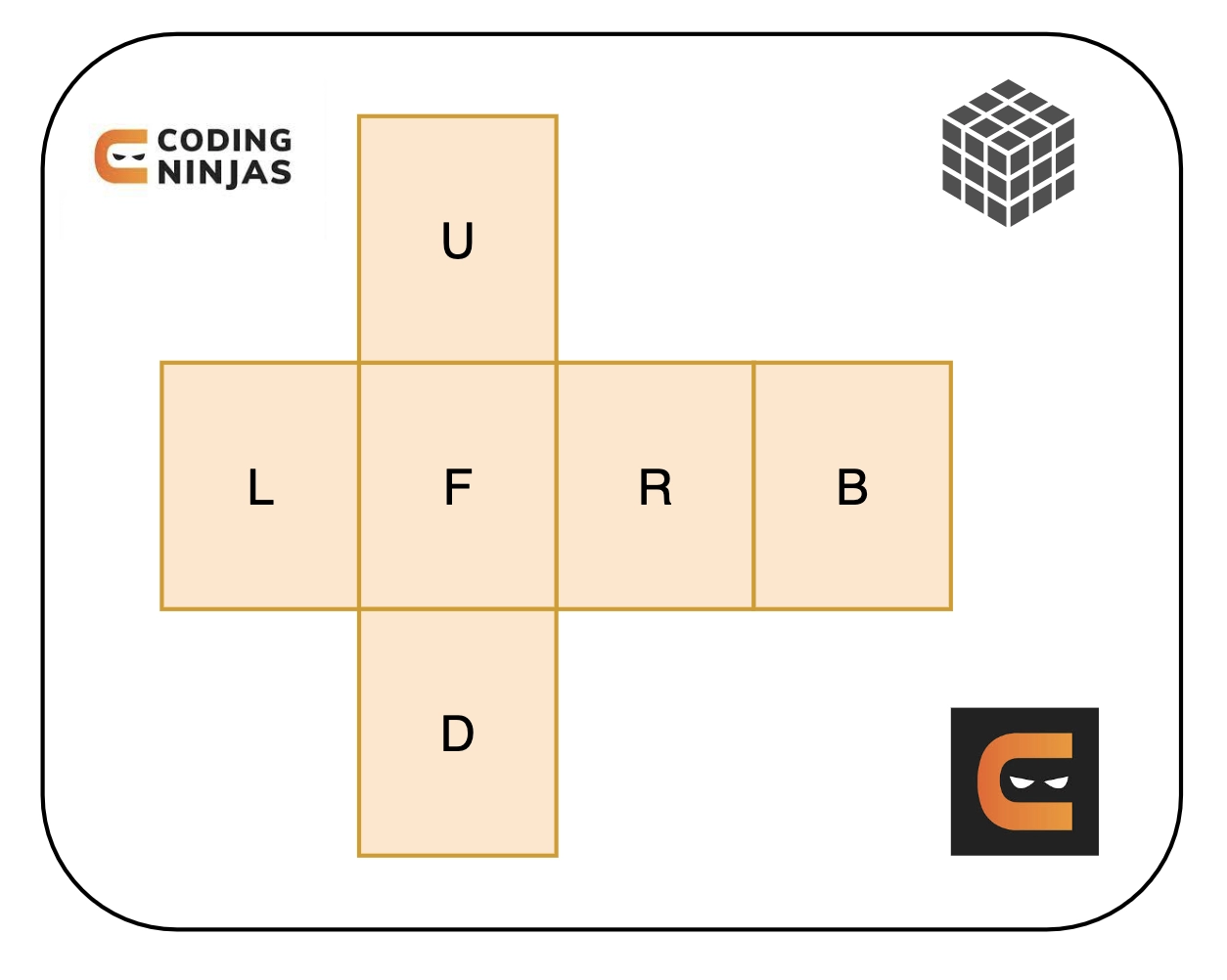
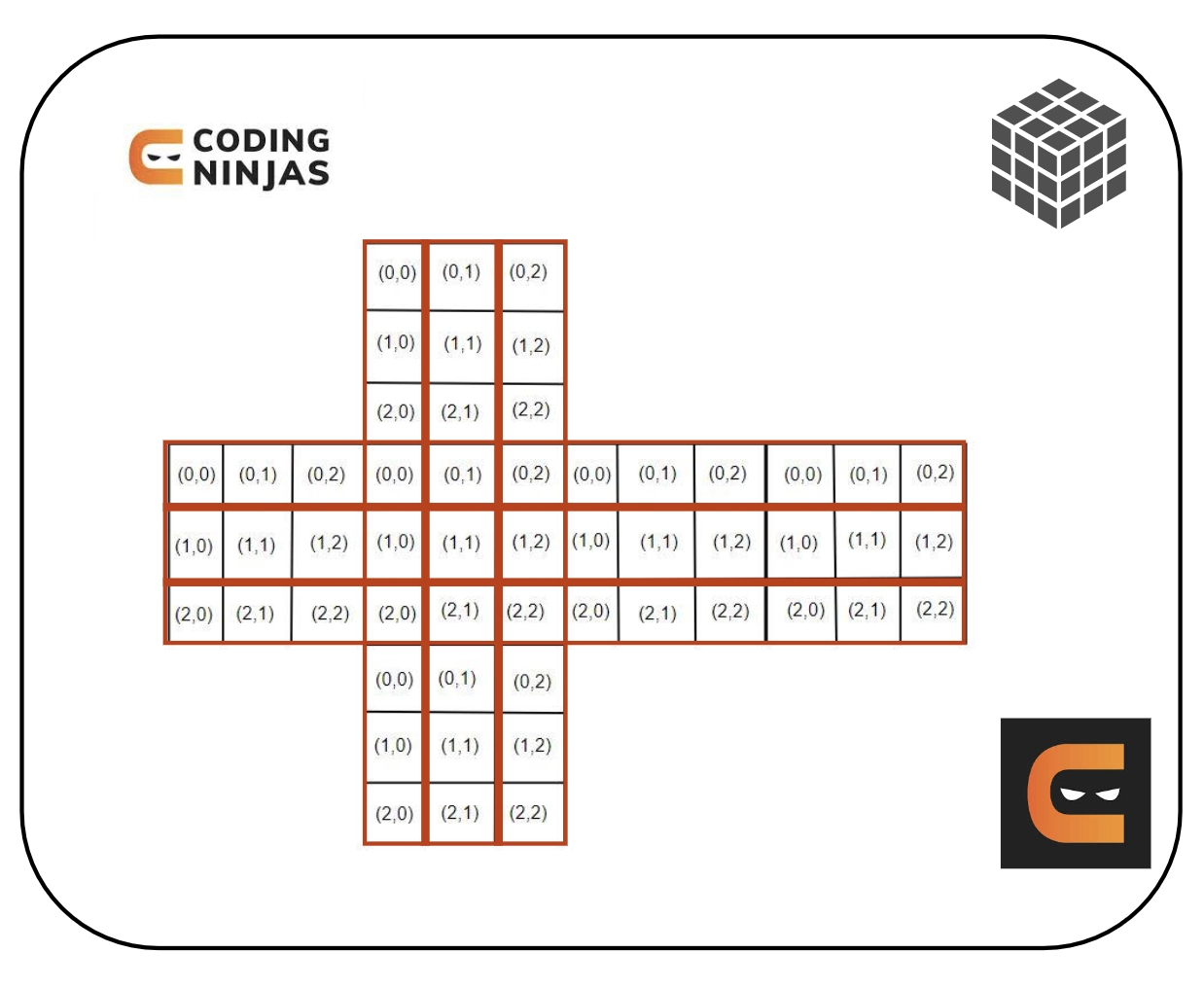
Understand the diagram of tcs codevita previous year questions.
The matrix indices are shown on the faces of the above diagram.
John wants to put your notes to the test. You have given the SudoKube's starting position and a list of operations that must use his notation. The final SudoKube state should match what John anticipates after all operations have applied. Applying the operations and printing the ultimate SudoKube state is your responsibility.
Constraints
SudoKube values range from 0 to 9.
15 moves total
Note: It is important tcs codevita previous year questions.
Input
4 7 1

2 8 7

6 3 5

5 8 3

3 1 6

9 4 2

5 2 4

3 7 8

5 1 9

6 1 4

9 4 8

2 5 7

7 9 1

1 9 6

6 2 8

8 6 3

7 2 5

3 9 4

F
Output
6 1 7

2 8 7

6 3 5

5 8 3

3 1 6

9 8 4

5 2 4

3 7 7

5 1 1

2 9 6

5 4 1

7 8 4

9 9 1

4 9 6

2 2 8

8 6 3

7 2 5

3 9 4
Note
It is important tcs codevita previous year questions.
The values of the faces on SudoKube are contained in the first eighteen lines in the following order: (Input)
D D D

D D D

D D D

U U U

U U U

U U U

L L L

L L L

L L L

F F F

F F F

F F F

R R R

R R R

R R R

B B B

B B B

B B B
D stands for the Down face.
U stands for the upper face.
L for Left face
Front face: F
R stands for Right face.
Back face: B.
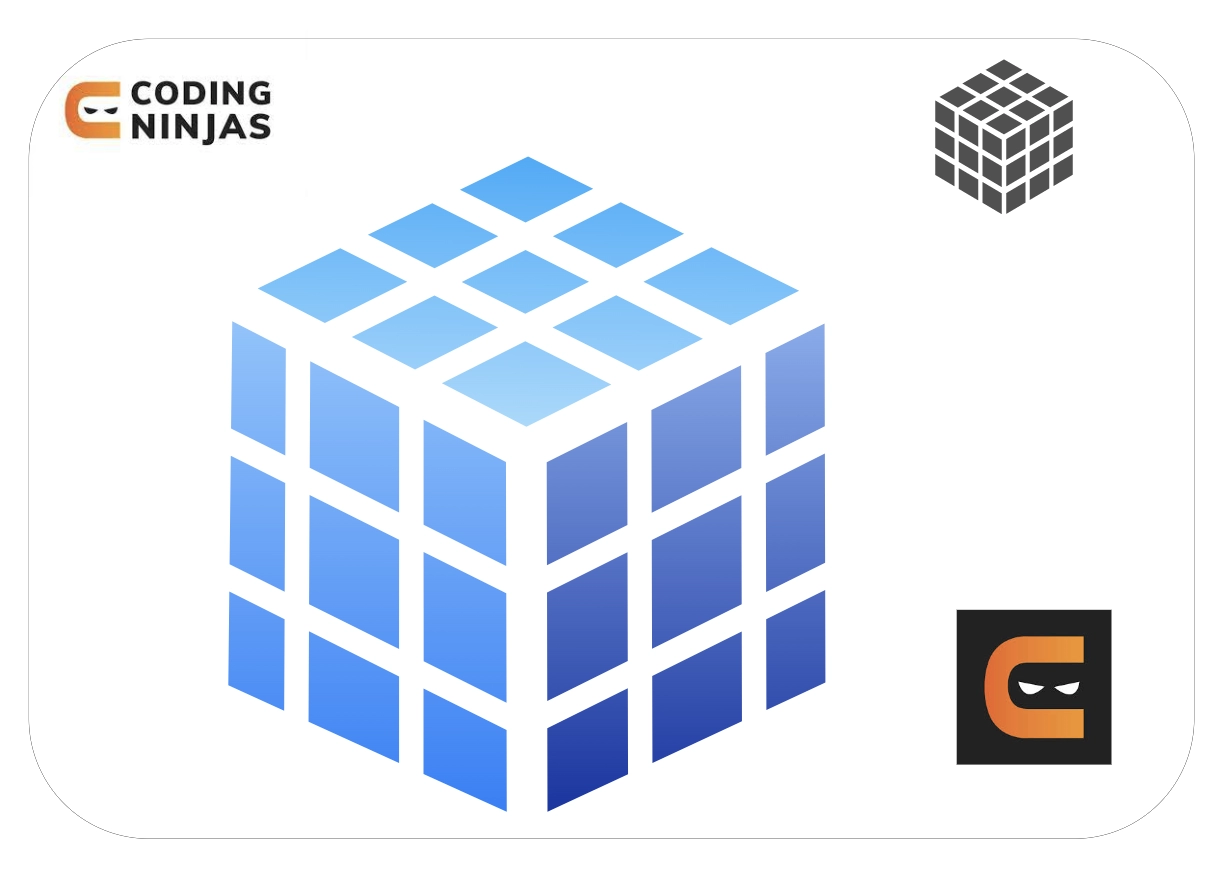
Explanation
The cube's state following the D F2 R' U operation, is printed in the above output. Here
D signifies turning the Downside 90 degrees clockwise.
F2 stands for 180-degree rotation of the front side.
To rotate the right side 90 degrees counterclockwise, use the letter R.
U stands for turning the Upside 90 degrees clockwise.
Note: It is essential tcs codevita the previous year's questions.



 1+ registered

