Get a skill gap analysis, personalised roadmap, and AI-powered resume optimisation.
Introduction
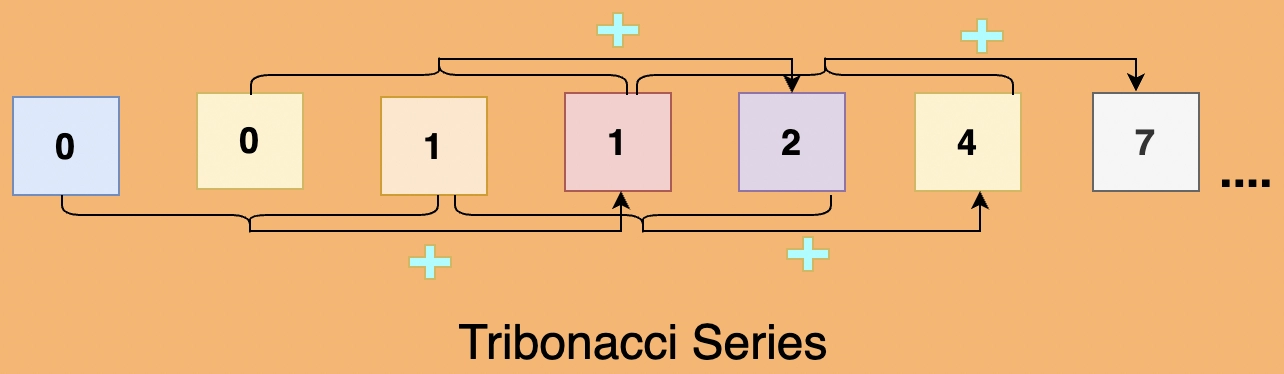
Tribonacci series consists of numbers defined by the recurrence F(N) = F(N-1)+F(N-2)+F(N-3), which is similar to the Fibonacci sequence in which the previous two terms determine the following number; however, the Tribonacci series requires the preceding three terms.
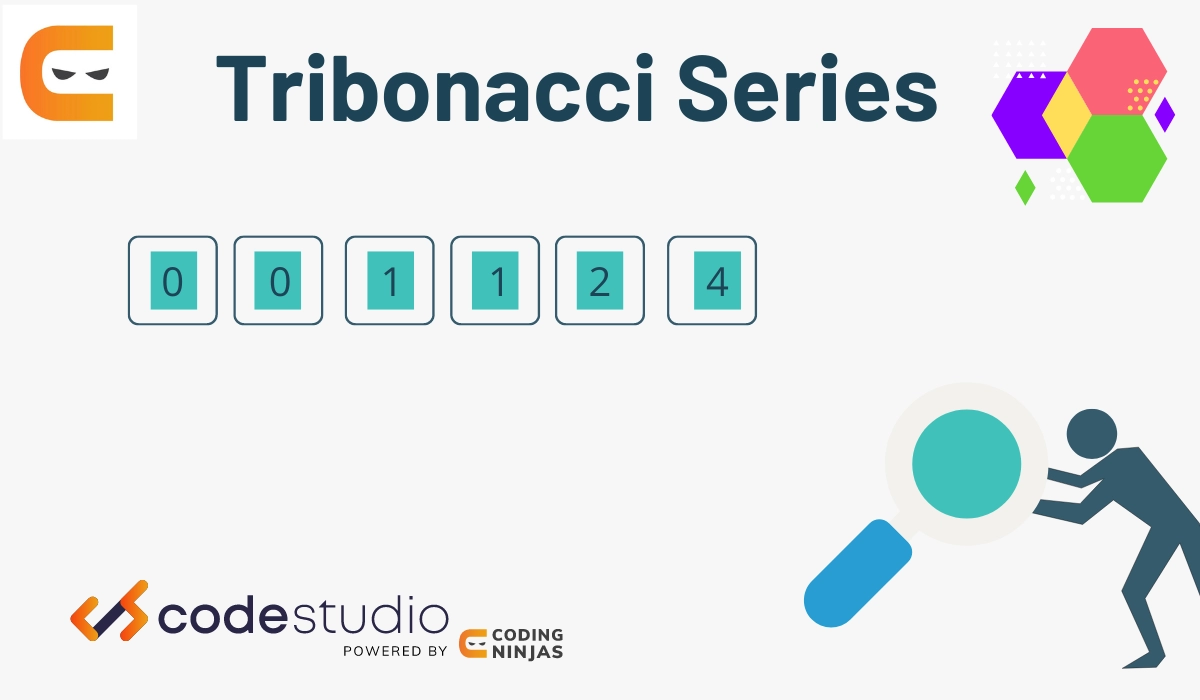
The first three terms of the Tribonacci Series are 0, 0, and 1.
Some of terms from the Tribonacci Series is given below:-
Given a value N, your task is to print the Nth Tribonacci Number.
Examples:
Input: N = 4
Output: 2
Input: N = 8
Output: 24
Explanation: The Nth Tribonacci number can be calculated by using the recursive formula, for N = 4 it will give 2, and for N = 8 it will give 24 as output.
Solution
There can be multiple approaches to solve this problem. At first, we will see the Brute Force solution, and then move on to the optimized solution.
Method 1
The most naive way to solve this problem is to Solve using Recursion with the help of the given recurrence relation.
Let’s see the Code Implementation for Tribonacci Series in python.
# Tribonacci Series in python
# nth tribonacci number

def nthTribonacci(n):
    if(n==0 or n==1):
        return 0
    if(n==2):
        return 1

    return nthTribonacci(n-1)+nthTribonacci(n-2)+nthTribonacci(n-3)

n = 15
nthTribonacciNumber = nthTribonacci(n)
print(f'The {n}th Tribonacci Number is:',nthTribonacciNumber)
You can also try this code with Online Python Compiler
You can practice by yourself with the help of online python compiler for better understanding. Time Complexity: O(N). Since we are storing the previous results into a list at max N recursive calls will happen.
Space Complexity: O(N), as we have declared a list of size N.
Also, O(N) is auxiliary space complexity. A maximum of N elements can be present in the Recursive Stack Space at a time.
Method 3
This method will help in reducing the Auxilary Space complexity used in Method 2.
Bottom Up DP - Tabulation
We will initialize our dp list with 0. dp[n]
Let’s see the Code Implementation for Tribonacci Series in python.
# Tribonacci Series in python
# nth tribonacci number

def nthTribonacci(n):
    dp = [0 for i in range(n + 1)]
    dp[0] = dp[1] = 0
    dp[2] = 1

    for i in range(3,n+1):
        dp[i] = dp[i - 1] + dp[i - 2] + dp[i - 3]
    return dp[n]

n = 18
nthTribonacciNumber = nthTribonacci(n)
print(f'The {n}th Tribonacci Number is:',nthTribonacciNumber)
You can also try this code with Online Python Compiler
Time Complexity: O(N). Since we are running a for loop up to N times.
Space Complexity: O(N), as we have declared a list of size N.
Method 4
This method will solve this problem in O(1) Space Complexity.
Instead of taking a list of size N, we will take three variables to store the previous three results as our current result is completely dependent only on the previous three elements.
Space Optimization
Taking three variables, prev1=1, prev2=0, prev3=0.
Let’s see the Code Implementation for Tribonacci Series in python.
# Tribonacci Series in python
# nth tribonacci number

def nthTribonacci(n):
    prev3=0
    prev2=0
    prev1 = 1
    for i in range(3,n+1):
        curr = prev1+prev2+prev3
        prev3 = prev2
        prev2 = prev1
        prev1 = curr
    return prev1

n = 18
nthTribonacciNumber = nthTribonacci(n)
print(f'The {n}th Tribonacci Number is:',nthTribonacciNumber)
You can also try this code with Online Python Compiler
Fibonacci Series is a series of numbers in which each number (Fibonacci number) is the sum of the two preceding numbers. It is defined by the recurrence F(N) = F(N-1)+F(N-2).
What is Tribonacci Series?
Tribonacci series consists of numbers defined by the recurrence F(N) = F(N-1)+F(N-2)+F(N-3), which is similar to the Fibonacci sequence in which the previous two terms determine the following number; however, the Tribonacci series requires the preceding three terms.
What are the values of the first three Tribonacci Numbers?
The first three Tribonacci Number values are 0, 0, and 1, respectively.
What is a list in Python?
Lists in Python is a data structure used to store multiple items in a single variable.
What is a String in Python?
A string in Python is a sequence of characters.
Conclusion
In this article, we have extensively discussed Tribonacci Series in Python and its recurrence relation, and also we have implemented it in Python using different Methods.











 1+ registered

