Table of contents
1.
Introduction
2.
The Architecture of Biometric System
3.
Biometric System Phases
4.
Biometric System Types
5.
Why do we need biometrics?
5.1.
Authentication (Identification)
5.2.
Verification
5.3.
Authorization
5.4.
Traditional Security Aids Have Flaws
6.
Basic Biometric System Components
6.1.
Input Interface (Sensors)
6.2.
Processing Unit
6.3.
Database Store
6.4.
Output Interface
7.
Performance of the Biometric System
8.
FAQs
9.
Key Takeaways
Last Updated: Mar 27, 2024

What is Biometric System

Author Aditya Kumar
0 upvote
Career growth poll
Do you think IIT Guwahati certified course can help you in your career?

Introduction

Biometric Systems are computer-assisted techniques of validating or detecting a live person's identification based on physiological traits such as a fingerprint or facial pattern or behavioural characteristics such as handwriting or keyboard patterns. The image below depicts some of the most commonly utilised biometric characteristics. Even if the latter may be easier to incorporate inside some specialised applications, a biometric system based on physiological parameters is more dependable than behavioural variables.
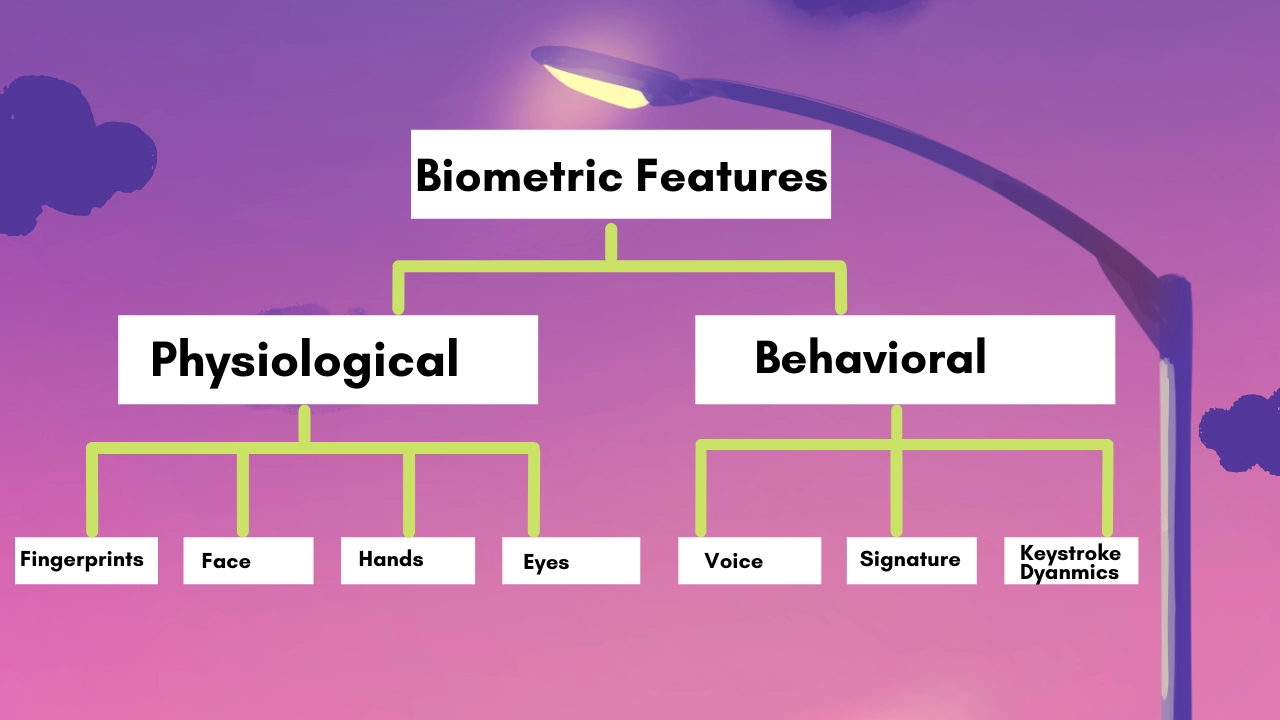
The only option to ensure the owner's presence during a transaction is to use biometric traits. Fingerprint-based solutions are successful in securing information and resources across a wide range of applications. The number of apps that use biometric technology to safeguard transactions is still somewhat restricted. On the one hand, certain hurdles are defined by people's lack of familiarity (and, in some cases, acceptance). Still, the expense of the requisite hardware/software and insufficient performance was arguably the most crucial factors for biometrics' underdevelopment in the past. Today's technology allows for the creation of low-cost systems with high performance that are suitable for a wide range of applications.

In the subject of biometric systems, there are two types of issues to consider:

  • Identity verification (or simply verification) needs a person to declare their identity, for example, through the use of a PIN (Personal Identification Number); the system then compares (1:1) the person's current biometric characteristic to a previously obtained one retrieved via the PIN.
  • The system must scan a list of candidates and determine if one fits the individual who needs to be identified. This is a more challenging operation because it necessitates a (1:N) match, which may be computationally expensive on massive databases.
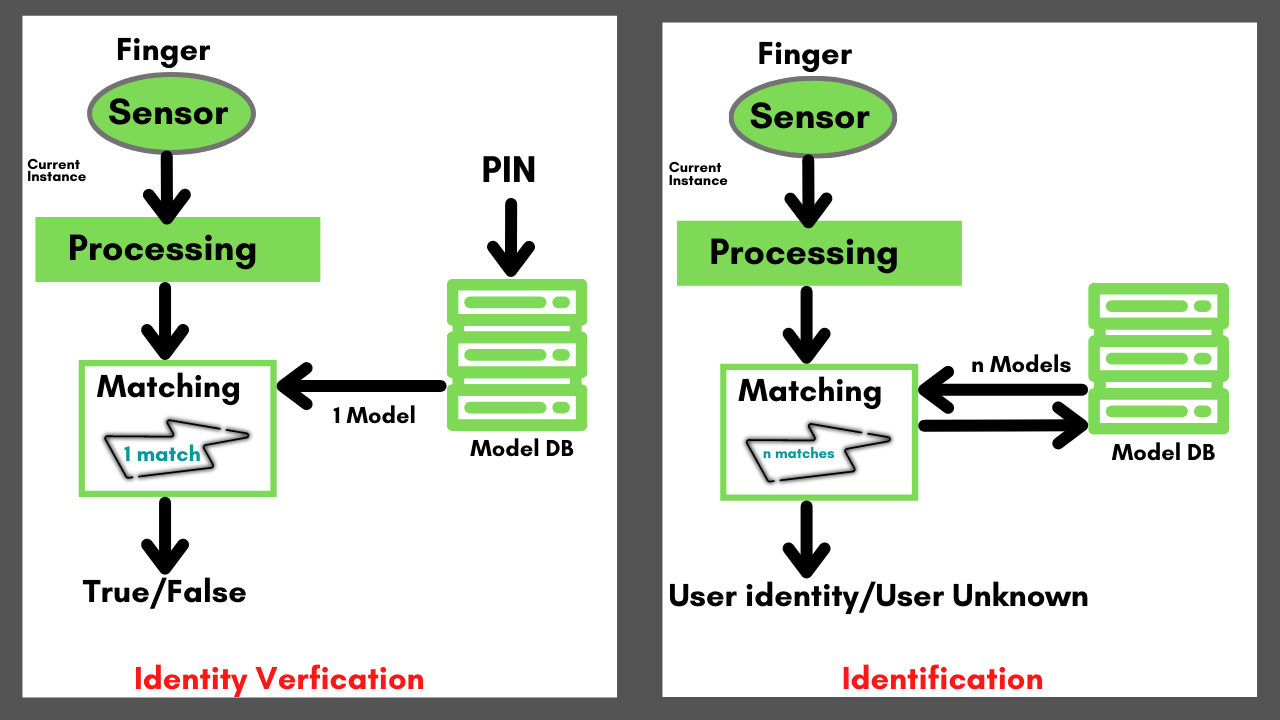
All users must be enrolled before a biometric system will be utilised for verification or identification. During enrollment, the individual provides a sample of their biometric characteristic, which the system uses to create a compact model (or template) that summarises the discriminant characteristics. Models can be kept in a centralised database, disseminated across a network, or embedded in badges delivered to users, depending on the application. When an individual demands verification/identification, they provide a new sample of their fingerprint, which the system compares to the previously stored model(s).
Recommended Topic, 8085 Microprocessor Pin Diagram

The Architecture of Biometric System

Biometrics are automated techniques of determining a person's identity based on physiological and observable characteristics. Biometric technologies have changed the way people identify and verify themselves all across the world. Biometric methods measure different traits such as the face, fingerprints, handwriting, palmprints, hand geometry, gait, iris, retinal, and voice.

The following are the major components of a biometric system's architecture:
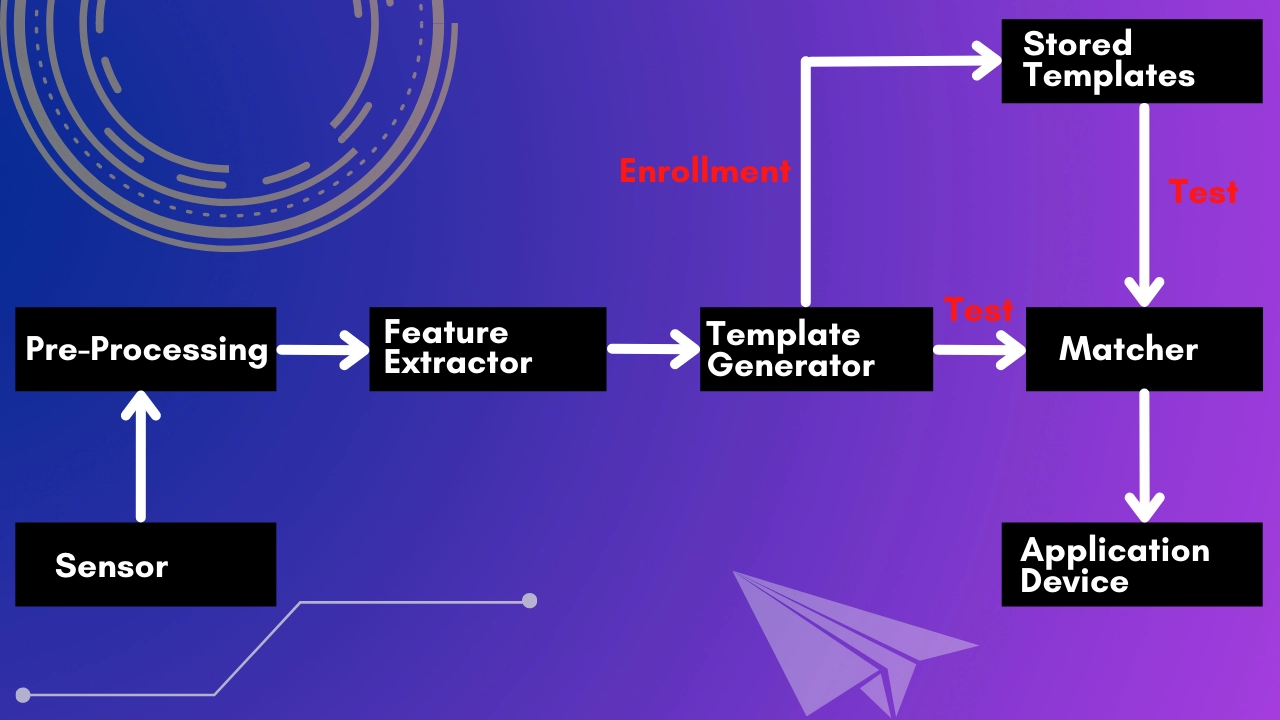
Sensor: The sensor is the initial component of a biometric system, and it collects all of the necessary biometric data. It serves as a link between the system and the outside world. Typically, it is an image capture system, but whether it has to be replaced or not depends on the features or qualities required.

Pre-processing: The second block is where all of the pre-processing takes place. Its purpose is to improve the input by removing sensor artefacts, background noise, and other factors. It normalises the data in some way.

Feature extractor: The third and most crucial phase in the biometric system is the feature extractor. Features must be extracted in order to be identified at a later stage. A feature extractor's purpose is to describe an item so that measurements may be used to recognise it.

Template generator: Using the extracted characteristics, the template generator creates the templates that are used for authentication. A template is a numeric vector or a picture divided into discrete tracts. The source groups' characteristics are combined to create a template. Templates are saved in the database for comparison purposes and as input for the match.

Matcher: A matcher is used to complete the matching step. The acquired template is provided to a matcher, who compares it to the stored templates using various methods like Hamming distance. The results will be generated when the inputs have been matched.

Application device: This is a gadget that employs biometric system results. Some examples of application devices are the iris recognition system and the facial recognition system.


Biometric System Phases

A Biometric System is divided into two phases:

  • Enrollment Phase: The user's or person's biometric information is stored in a database during the enrollment phase. It's a one-time thing. In this step, the appropriate information is often measured quite precisely.
  • Recognition Phase: The biometric system's second step is the recognition phase. This happens when the detection phase starts depending on the first step of the user's authentication. This step must be rapid, accurate, and capable of quickly identifying the authentication issue.

Biometric System Types

The biometric characteristics of a person are divided into three categories:

  • Biological
  • Physiological
  • Behavioural


A physiological attribute is a biological pattern that may be discovered on or in the human body, such as the face, fingerprints, iris pattern, DNA, hand geometry, etc. Behavioural patterns, such as handwriting, voice, stride, and typing rhythm, develop through time and become common traits. The kind of biometric system is determined by the biometric feature that is used to identify an individual. Individual biological and behavioural characteristics may be recognised, and distinct, repeatable biometric information can be derived from them to automate recognition.

The following are types of biometric systems:

  1. System for Fingerprints Recognition
  2. System for Facial Recognition
  3. System for Recognizing Iris
  4. System for Recognizing Handwriting
  5. System for Recognizing Retinas
  6. System for Recognizing Gaits
  7. System for Recognizing Lip Motion

Why do we need biometrics?

With the growing use of information technology in finance, research, and medicine, there is a pressing need to safeguard systems and data against illegal access.

Biometrics is a technique for verifying and approving a person's identity. Even though these phrases are frequently used together, they have separate meanings.

Authentication (Identification)

This procedure aims to answer the questions "Are you the same person you claim to be?" and "Do I recognise you?" This is a one-to-many comparison of a person's biometrics against the whole database.

Verification

This is a one-to-one matching procedure in which the candidate's live sample is matched to a previously stored template in the database. The verification is successful if they match more than 70% acceptable similarity.

Authorization

It is the process of granting access credentials to verified or authorised users. It seeks to answer the question, "Are you qualified to have particular access permissions to this resource?"

Traditional Security Aids Have Flaws

ID cards, passwords, Personal Identification Numbers (PINs), and other traditional techniques of information system security were employed. The following are some of their drawbacks:

  • They all refer to identifying a code linked with a person rather than the person who created it.
  • They are easily forgotten, misplaced, or stolen.
  • They can be readily circumvented or hacked.
  • They aren't exact.


In such instances, the system's security is jeopardised. When plans require a high level of dependable protection, biometrics can assist by tying the identity to the individual.

Basic Biometric System Components

A biometric system may be separated into four essential components in general. Let us take a quick look at them.

Input Interface (Sensors)

A biometrics system's sensing component turns human biological data into digital form.

As an example,

  • Face recognition, handprint recognition, and iris/retinal recognition systems use a Metal Oxide Semiconductor (CMOS) imager or a Charge Coupled Device (CCD).
  • In the case of fingerprint systems, an optical sensor is used.
  • In the case of speech recognition systems, a microphone is required.

Processing Unit

A microprocessor, Digital Signal Processor (DSP), or computer processes the data gathered by the sensors as part of the processing component.

The biometric sample is processed in several ways as following:

  • Illustration of picture enhancement
  • Normalization of a sample picture
  • Extraction of features
  • The biometric sample is compared to all other instances in the database.

Database Store

The enrolled sample is saved in the database and is recalled upon authentication to perform a match. Any memory, such as Random Access Memory (RAM), flash EPROM (Erasable programmable read-only memory), or a data server, can be used for identification. A detachable storage device, such as a contact or contactless smart card, is utilised for verification.

Output Interface

The biometric system's decision to provide access to the user is communicated through the output interface. This might be a basic serial communication protocol like RS232 or a higher-bandwidth standard like USB. TCP/IP protocol, Radio Frequency Identification (RFID), Bluetooth, or one of the several cellular protocols are all possibilities.

Performance of the Biometric System

Since it is impossible for two samples of the same biometric characteristic acquired in different sessions to exactly coincide due to differences in positioning on the acquiring sensor, environmental changes, deformations, and noise, the matching is done by an algorithm that computes a similarity score and compares it to an acceptance threshold. If the similarity is greater than the threshold, the system claims that the two samples coincide. Unlike password matching, a biometric system's output might be erroneous at times: the most common system mistakes are quantified in terms of:

  • False Acceptance Rate (FAR) is the probability that a biometric system would mistakenly identify an illegal user as a legitimate user.

           FAR = Number of false acceptance / Number of Attempts at Identification

           A biometric system ensures high security with a low FAR.

  • False Reject Rate (FRR) is the probability that a biometric system would mistakenly reject a valid user as an invalid user.

           FRR = Number of False Rejections / Number of Attempts at Identification

FAQs

1. What do you mean by a biometric system?

Ans: A biometric system is a system that uses mathematical algorithms and biometric data to recognise a specific trait of a person. Biometric systems may be used for a variety of purposes. Several methods need users to enrol upstream. Other techniques of identification do not need this step.

2. Why do we use a biometric system?

Ans: Biometric systems and devices are primarily used for identification and authentication. Security, banking, mobile access and authentication, law enforcement, public transportation, schools, home helpers, and building access are among the most popular applications for biometric equipment.

3. What are the types of biometric systems?

Ans: The following are types of biometric systems:

  1. System for Fingerprints Recognition
  2. System for Facial Recognition
  3. System for Recognizing Iris
  4. System for Recognizing Handwriting
  5. System for Recognizing Retinas
  6. System for Recognizing Gaits
  7. System for Recognizing Lip Motion


4. What do you mean by authorization in a biometric system?

Ans: It is the process of granting access credentials to verified or authorised users. It seeks to answer the question, "Are you qualified to have particular access permissions to this resource?"

5. What is the recognition phase in the biometric system?

Ans: The second step in the biometric system is the recognition phase. This happens when the detection phase starts depending on the first step of the user's authentication. This step must be rapid, accurate, and capable of quickly identifying the authentication issue.

Key Takeaways

In this article, we have discussed the biometric system. We have discussed why we need this and its uses. We have also discussed its various types. So basically, a biometric system is a system that uses mathematical algorithms and biometric data to recognise a particular trait of a person. Biometric systems may be used for a variety of purposes.

We hope that this blog has helped you enhance your knowledge regarding the Biometric system. If you would like to learn more, check out our article on Types of Biometrics and the Advantages and disadvantages of biometric systems. Do upvote our blog to help other ninjas grow. 

Happy Coding!

Live masterclass