Do you think IIT Guwahati certified course can help you in your career?
Introduction
A DevOps toolchain consists of various tools that help software teams collaborate effectively. These tools support codedevelopment, testing, automation, continuous integration and deployment, monitoring, and more. They streamline(efficiency) the software development and delivery process, promoting teamwork and ensuring high-quality outcomes.
In this article, we look closely at all these tools. Let’s start with the “What is DevOps Toolchain.”
What is DevOps Toolchain?
A DevOps toolchain identifies the various tools, technologies, and techniques used to support and enable DevOpspractices in software development and delivery. It includes many tools that enable and simplify various stages of the Software Development Lifecycle (SDLC). , from code development to deployment and operations.
The DevOps toolchain supports businesses in achieving the promise of DevOps by maintaining a healthy software development pipeline. Toolchains enable team members to complete and simplify more complex development process tasks. Implementing a DevOps toolchain represents the next iteration of the new industry standard.
There are many open-source DevOps tools available. Clubbing them together based on your needs makes a DevOps toolchain.
Alright!! Let’s move on to some essential components of DevOps.
Components of a DevOps Toolchain
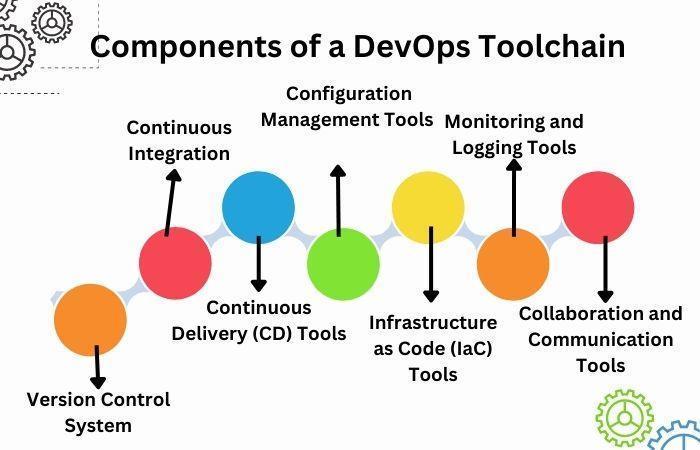
A DevOps toolchain is a set of tools that helps automate and streamline the processes involved in software development and operations. Let's break down the components of a DevOps toolchain.
Version Control System (VCS)
Let’s say you're a member of a team working on a collective project. You'll all need a way to stay organized and track changes to the project files. A version control system comes in very handy here. It functions as a smart system, assisting you in successfully managing and tracking these changes. It enables several team members to work on the same codebase without disagreement and assists you in keeping track of different versions of your project. In other words, it's a useful tool that maintains everything in order and ensures easy team collaboration.
Continuous Integration (CI) Tools
You might have been aware while developing the software, it is very important to test the code continuously. Make changes produced by different team members. Here, Continuous Integration (CI) tools do the work by compiling, building, and testing your code. An you know the changes you will made will be done auto sent to the version control. It's like having a security guard taking care of all versions of code. Ensuring sure everything fits together well and detecting any errors as soon as they appear. This lets you detect and resolve issues early, improving cooperation and higher code quality.
Continuous Delivery (CD) Tools
Whenever you have done with all the development, you will put the software for the deployed and released smoothly. CD tools help you to automate the process of deploying or you can say, hosting for your software to various environments, such as development, testing, staging, and production. It basically helps you whenever you want changes in the deployed code you do not have to repeat all the process, you just need to push the code, and the updated code will merge to the deployed software.
Configuration Management Tools
Think in this way you have a car, and you drive a fixed path. Every time, you want it to drive the same path so every time it turns out exactly the same every time you drive. Similarly, Configuration management tools work in this way. They help us to manage and automate the setup and configuration of our software environments. These tools make sure that all components, settings, and dependencies are properly configured across different environments.
Infrastructure as Code (IaC) Tools
When managing a large-scale application, you need a way to define and provision your infrastructure consistently and repeatedly. IaC tools allow you to describe your infrastructure requirements using code.
Monitoring and Logging Tools
Once your software is deployed, you want to monitor its performance and ensure everything runs smoothly. Monitoring and logging tools help you track important metrics, detect issues, and collect log data from your applications and infrastructure. They provide insights into the health and performance of your systems, helping you identify and resolve problems quickly.
Collaboration and Communication Tools
It is very important of collaboration and communication among team members in a DevOps environment. Collaboration tools enable teams to work together in very effective ways and fast, share knowledge, and manage tasks. They provide features like chat, project management boards, and document sharing, helping teams stay organized and aligned.
Why do we Need a DevOps Toolchain?
Following are some points to prove why we need DevOps Toolchain:
Improved collaboration: DevOps toolchains provide a centralized platform where team members can collaborate effectively. They offer features like shared repositories, issue tracking, communication channels, etc.
Faster time-to-market: The toolchains in the DevOps help in staging the software development lifecycle; you can say these are building, testing, and deployment. So as these tools help to automate things so it helps the team is reducing time and perform tasks very quickly. Also, this allows the team to respond quickly to market demands and stay ahead of the competition.
Greater efficiency: DevOps toolchains eliminate manual and repetitive tasks, freeing up valuable time for developers and operations teams. Automated processes, such as code compilation, testing, and deployment, ensure consistent and reliable results. This reduces the risk of human errors, increases efficiency, and allows teams to focus on higher-value activities, such as innovation and problem-solving.
Continuous feedback: DevOps toolchains facilitate continuous integration and delivery (CI/CD) practices. They automatically trigger build and test processes whenever changes are made to the codebase. This provides immediate feedback on the impact of changes, enabling teams to detect and address issues early in the development cycle.
Better quality: DevOps toolchains incorporate automated testing and quality assurance processes into the development workflow. They enable teams to run automated tests, perform code reviews, and enforce coding standards.
Scalability: DevOps toolchains support managing multiple projects, environments, and teams. They provide features for version control, environment provisioning, and deployment automation, allowing teams to scale their development efforts effectively.
Flexibility: DevOps toolchains offer flexibility regarding tool selection and process customization. Teams can choose the tools that best fit their requirements and integrate them seamlessly within the toolchain.
Main aspects of creating a DevOps Toolchain
Acceptance: It's crucial to define and agree upon the acceptance criteria or the definition of done for each stage of the software development lifecycle. This ensures that the DevOps toolchain meets the requirements of the project stakeholders and delivers value.
Inspiration: Constant innovation and improvement are key in the DevOps toolchain. It's important to continuously explore new tools and practices to stay ahead of the competition and deliver high-quality software products.
Analysis: Data analysis and feedback loops are vital in the DevOps toolchain. Teams need to continuously monitor and analyze data to identify areas for improvement and enhance the performance of their software products and infrastructure.
Build: Building and deploying software artifacts is a fundamental aspect of the DevOps toolchain. This involves utilizing tools for continuous integration and continuous delivery (CI/CD) and adopting containerization and automation techniques.
Strategy: Taking a strategic approach to the DevOps toolchain is essential. This includes setting goals, defining key performance indicators (KPIs), and aligning the DevOps toolchain with the overall business strategy and objectives.
Frequently Asked Questions
What is DevOps pipeline vs. toolchain?
A DevOps pipeline is a series of automated steps that enable the continuous integration, delivery, and deployment of software. On the other hand, a DevOps toolchain encompasses all the tools and technologies used throughout the software development lifecycle.
What is the benefit of the DevOps toolchain?
A DevOps toolchain brings efficiency, collaboration, and automation to software development processes. It improves productivity, accelerates delivery, ensures quality, and enables faster response to market demands.
What is the core component of a DevOps toolchain?
The core component of a DevOps toolchain is automation. Automation tools streamline processes, enable seamless integration between different stages, facilitate collaboration, and eliminate manual tasks, enhancing efficiency and productivity in software development.
Conclusion
The DevOps toolchain is a critical enabler of efficient software delivery, fostering collaboration, automation, and continuous improvement. In this article, we have learned about the components, needs, and main aspects of the DevOps toolchain.
So now that you have learned about "What is DevOps Toolchain," you can refer to similar articles.








 1+ registered

