Do you think IIT Guwahati certified course can help you in your career?
Introduction
The DevOps methodology places a strong emphasis on cooperation and communication between the development and operations teams in order to generate quicker, more often, and more reliable software releases. In the Scaled Agile Framework (SAFe) environment, DevOps is integrated into the Continuous Delivery Pipeline, a crucial component of the SAFe DevOps capabilities.
SAFe enables enterprises to achieve a quicker time-to-market, better quality, and greater customer happiness by embracing DevOps principles and techniques. In this article, we will discuss what DevOps is in SAFe, its benefits, and how is DevOps Incorporated in SAFe.
What is the Scaled Agile Framework (SAFe)?
SAFe, or Scaled Agile Framework, is an agile framework designed for development teams. Most crucially, SAFe is built on three metaphorical pillars: team, program, and portfolio. Furthermore, SAFe allows a product team to be flexible. In addition, it helps in the management of some of the issues that larger organizations have while implementing Agile. SAFe is a large knowledge foundation of established best practices. SAFe is also used by product teams to produce successful software products.
DevOps in SAFe
DevOps is a set of technological processes, a culture, and a mindset, according to the Scaled Agile Framework (SAFe). It facilitates intimate collaboration, automation, integration, and communication. These things will occur among all people involved in the maintenance, release, deployment, testing, development, and planning of a system. DevOps will be part of the Agile Product Delivery skill in a Lean Enterprise.
The goal of DevOps SAFe is to provide value anytime a business requires it. This is something that is doable. According to one study, teams who excel at DevOps deploy with 7 times fewer failures, 106 times faster, and 208 times more frequently on average. The survey also found that they recover from incidents at a 2604 times faster rate than low-performing teams.
Why is DevOps Required?
Prior to the emergence of DevOps, firms' operations and development teams operated in full isolation. Deployment and testing were also independent tasks. As a result, they took a long time compared to actual building cycles. Without DevOps, your teams will spend more time testing, deploying, and planning rather than producing projects.
Furthermore, utilizing handwritten coding to deploy the software program can result in human errors during the production process. Without DevOps, operation and coding teams will operate on their own timetables. There will be additional delays because they run independently. According to studies, there is a requirement to increase the rate at which software packages are provided. DevOps may be the best option for meeting this demand.
Benefits of DevOps
DevOps can be advantageous in a variety of ways:
It will help in increasing efficiency through automation.
It boosts the stability and speed of software development and deployment. As a result, the entire business can be optimized.
The most essential reason for incorporating DevOps into SAFe is that it will allow you to focus more on what is vital.
The advantage of DevOps over traditional SDLC is that it helps in addressing the long-standing separation of development and operations.
DevOps gives you complete control over setup and deployment. It is an essential component of SAFe, and many SAFe concepts and principles apply to the DevOps concept as well. Fast feedback, brief iterations, and small batch sizes are some examples.
How Is DevOps Incorporated in SAFe?
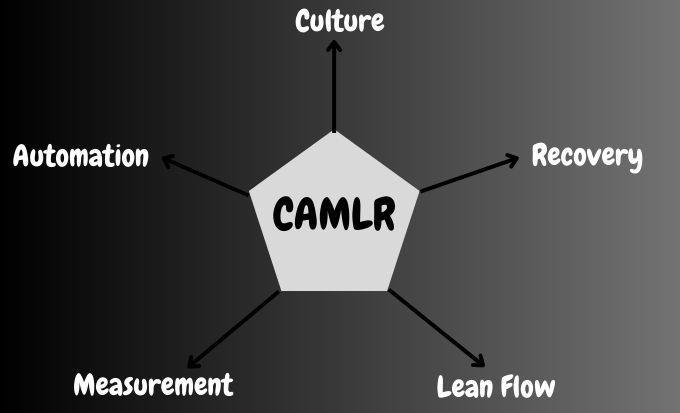
Organizations can use the CAMLR technique to integrate DevOps into SAFe. Continuous integration, deployment, and release on demand will be available with SAFe. The CAMLR strategy is as follows:
Culture: Culture involves a shared responsibility for operations and development.
Automation: It involves dynamically rotating and breaking down the development environment. The goal is to simulate deployment, test, and production automation.
Lean Flow: This term refers to the general trend for smaller batch sizes for software delivery. It requires restricting work in progress and providing real-time visibility of software. It also includes cutting costs and boosting the frequency of release. Reducing rework, speeding up feedback, and boosting predictability are also included.
Measurement: It involves evaluating the flow and optimizing delivery. For example, you can utilize Karban to map out the entire delivery pipeline. You may assess lead time and cycle time and use telemetry for all servers and applications here.
Recovery: It offers real-time scalability monitoring. It monitors redundancy to provide a faster recovery.
SAFe DevOps Integration
In order to improve the effectiveness and efficiency of the software development process, DevOps SAFe integration makes use of the advantages of both methodologies. Organizations are now able to integrate SAFe's strategic planning and alignment capabilities with DevOps' continual feedback and improvement philosophy.
With a focus on alignment, cooperation, and visibility, SAFe provides a framework for coordinating the efforts of several teams in the direction of a common goal. It offers a methodical planning process with clearly stated roles, responsibilities, and success criteria. DevOps, on the other hand, places a strong emphasis on feedback, automation, and collaboration in order to quickly produce value and continually improve processes and outcomes.
It is possible to combine SAFe and DevOps to improve the software development process.
Key integration strategies and technologies include value stream mapping, agile release trains (ARTs), continuous feedback and improvement, and continuous integration and delivery.
SAFe's planning and alignment are combined with DevOps' emphasis on delivering value quickly and continuously improving procedures and outcomes.
It necessitates a willingness to adapt and integrate methods from both systems, as well as a dedication to collaboration, communication, and continual progress.
What is DevSecOps?
DevSecOps is an essential component of the Continuous Delivery Pipeline, as well as a major component of the Scaled Agile Framework's (SAFe) DevOps competency. It is a phrase used in SAFe to emphasize the necessity of good information security procedures. It is done in order to achieve continuous delivery. The reason for using this notion is that the origins of DevOps do not inherently include security as a top-priority concern. Businesses will be able to lessen the likelihood of security risk becoming an afterthought with DevSecOps.
Security testing was a separate step from the SDLC in traditional software development approaches. Only after the software was constructed did the security team identify security problems. The SDLC is improved by the DevSecOps framework, which detects vulnerabilities throughout the software development and delivery process.
Frequently Asked Questions
What is a Value Stream in SAFe?
The phrase "value stream" refers to the entire process from the point at which a client places an order to the point at which it is delivered. It covers the people who create new technologies and solutions as well as the ongoing flow of materials or information to the client.
What does SAFe's iteration review mean?
Every team analyzes the increment at the end of each iteration (the typical fixed-length time window) and, depending on feedback from stakeholders and the product owner, changes the team's backlog as necessary.
What is the role of a Release Train Engineer (RTE)?
A coach for an Agile Release Train (ART) is an RTE. They are mostly in charge of quickening the ART events and helping with value delivery. RTEs are the ones who typically contact stakeholders. Thus, they must be effective communicators.
What is a feature, and what is a capability?
The SAFe-defined artifact hierarchy lists both a feature and a capability. A feature is a service that meets the needs of a stakeholder. Benefit hypotheses and acceptance criteria are the two ideas that make up a feature.
Conclusion
The benefits of DevOps can be realized considerably more effectively in a SAFe system. It will help with every element of a company, beginning with faster deployment. Stabilizing the work environment is a good example. You can ensure a significant improvement in product quality. In this tutorial, we discussed what is DevOps in SAFe, its benefits, SAFe DevOps Integration, and how is DevOps incorporated in SAFe.








 1+ registered

