Do you think IIT Guwahati certified course can help you in your career?
Introduction
The observability of a system is based on three important pillars: logs, metrics, and traces. These pillars help engineers to identify and fix errors.
In this article, we will learn about the concept of observability in detail and explore all the 3 Pillars of Observability.
Understanding Observability
Observability is the ability to monitor and gain important information to understand the working of complex systems. It checks the performance of the system, identifies errors, analyses them, etc. Observability is using a combination of Blackbox and Whiteboxmonitoring tools.
Observability is mainly Whitebox testing as it helps taking a closer look at the system's internals to better understand how it works. It involves different tools like logging, metrics, and tracing. Hence the 3 Pillars of Observability are Logs, Metrics, and Traces.
The 3 Pillars of Observability
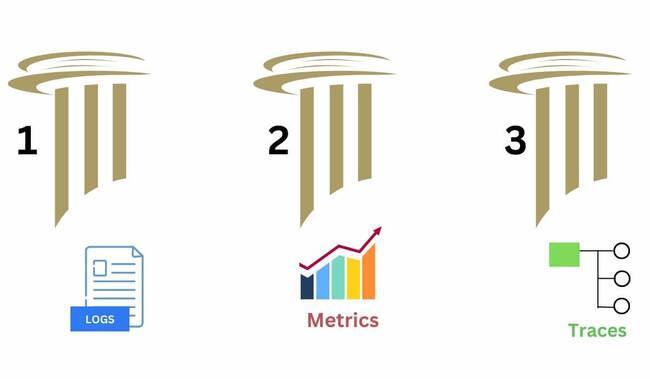
The 3 Pillars of Observability consist of logging, metrics, and tracing.
Let us look at each of them one by one.
Logs - Capturing and Analyzing Event Data
Logs consist of important information about system events, actions, and errors. It provides all the records of activities, thus helping to find the root cause of the problem and improving the performance of the system. By gathering and analyzing the logs, we can understand the internal working of the systems.
Advantages of Logs
The advantages of Logs are:
The logging data provides a detailed record of events and errors, which is used in identifying and debugging issues within the software system.
Logs provide a detailed view of system events and activities. Thus it becomes easier to analyze the root cause of any error or system failure.
Since logs can be monitored in real-time, the responsible teams can receive alerts and notifications if any unexpected event occurs.
Disadvantages of Logs
The disadvantages of logs are:
With the increase in logging data, managing them becomes difficult. Large amounts of logging data can result in information overload, which might, in turn, lead to certain events being missed.
Logs contain important information which might become a target for attackers. Hence security is another challenging factor here.
Logs record only those events and errors which have already been configured in the logging software. That is, the information that is not configured will not appear in the log files. This limits the visibility of the recorded data.
Metrics - Collecting and Presenting Performance Data
Metrics give the numbers that show how well a system is performing. They measure how well a system responds to requests, how many resources are used, and how many errors are found in the system in real-time. Metrics help in monitoring the behavior of the system closely.
We can find any unusual problems in the system by fixing the base values. Metrics can be of different types depending on what you have to measure, like the transaction rates or resource usage.
There are two popular methods by which metrics can be defined, the RED method, which focuses on rates, errors, and request duration, and the Google Golden Signals, which measure latency, traffic, errors, etc.
Advantages of Metrics
The advantages of metrics are:
Metrics provide real-time data on the performance of the system. Thus we can monitor and set alerts to keep a check on the health of the systems.
Metrics play a key role in identifying problems and analyzing them.
Since metrics provide information on the performance of the system, data-driven decision-making becomes easier.
Disadvantages of Metrics
The disadvantages of metrics are:
Similar to logs, metrics keep track of the data only, which they are designed to record, thus offering a limited scope.
Metrics do not provide the root cause or factors contributing to a metric value.
Traces - Transaction Flows and Dependencies
A distributed trace is like a map that follows a request as it moves through different parts of an application. It tracks how long each part takes to process the request and passes it to the next part. Traces also tell us which parts might be causing any delays or errors.
Traces give us a picture of how requests flow through the system and interact with different components. It helps us understand and improve the overall performance of the system.
Advantages of Traces
The advantages of traces are:
Distributed traces are used to find the root cause of performance issues.
Traces give a detailed and distributed view of the system transactions and workflows. They allow users to understand how requests from different services flow within the system.
Disadvantages of Traces
The disadvantages of traces are:
Traces capture only a portion of application requests due to limited time and resources.
Implementing tracing tools in a system can increase the complexity of the system.
Traces can produce a large amount of data which can be difficult to store and process.
Tools Used to Achieve the 3 Pillars of Observability
There are many tools that can be used to achieve observability in complex systems.
For example, tools like Prometheus and Nagios are used as monitoring and alerting tools that keep a real-time check of the health and performance of the system.
We have tools like Elasticsearch, Logstash, and Splunk for logging data. These tools collect, store, and analyze the log data from various sources.
Tools like Jaeger and AWS X-Ray are used as tracing tools.
You can also use software like Kibana and Grafana to present and visualize the data from logs, metrics, and traces. These tools provide interactive dashboards to analyze the data.
Frequently Asked Questions
What is Observability?
Observability is the ability to monitor and gain important information to understand the working of complex systems. Observability is using both Blackbox and Whitebox monitoring tools to check the performance of the system, identify bugs, analyze them, etc.
What are the 3 Pillars of Observability?
Observability involves different tools like logging, metrics, and tracing. Hence the 3 Pillars of Observability are Logs, Metrics, and Traces. With these pillars, organizations can detect issues and fix them, thus improving the performance and reliability of the system.
What do you understand about Metrics?
Metrics give the numbers that represent the performance of the system. They measure how well a system responds to requests, how much of the resources are used, and how many issues are found in the system in real-time. Metrics help in monitoring the behavior of the system closely.
Mention some tools for logging data.
We have tools like Elasticsearch, Logstash, Graylog, and Splunk for logging data. These tools collect, store, and analyze the log data from various sources. The choice of these tools depends on factors like scalability requirements, budget, etc.
Conclusion
Kudos, Ninja, on finishing this article! We have discussed the 3 Pillars of Observability and their advantages and disadvantages in detail.
We hope this blog has helped you enhance your knowledge of the 3 Pillars of Observability.
Keep learning! We suggest you read some of our other articles related to Observability:
But suppose you are just a beginner and are looking for questions from tech giants like Amazon, Microsoft, Uber, etc. For placement preparations, you must look at the problems, interview experiences, and interview bundles.







 1+ registered

