




Introduction
Amplitude Shift Keying or ASK is a digital modulation technique that is used in digital communication systems to transmit digital data over a carrier wave. In ASK, the carrier signal's amplitude changes according to the transmitted digital data. It's one of the simplest types of digital modulation and is commonly used for low data rate applications.

This article will teach you about amplitude shift keying in digital signal processing.
What is the Amplitude Shift keying?
Amplitude-shift keying (ASK) entails modulating the amplitude of a carrier wave to encode digital information. Within an ASK setup, symbols representing binary data are conveyed by adjusting the amplitude of a constant-frequency carrier wave over a defined period.
For example, it can use full amplitude for binary 1 and reduced amplitude for binary 0.
ASK is linear, which makes it sensitive to atmospheric noise, distortions, and propagation conditions, but the processes of demodulation and modulation are relatively inexpensive, making it viable for use in low to moderate data rate applications.
Now, let’s understand the amplitude shift keying with the help of the Matlab example. You can use Matlab online to learn about the waves like sine, cosine.
close all; // it is used to close all the programs.
F1=input('Enter the carrier wave frequency'); // taking input from the user
Enter the carrier wave frequency
10
F2=input('Enter the frequency of pulse');
Enter the frequency of pulse
20
A=3; // amplitude for the wave.
t=0:0.001:1;
x=A.*sin(2*pi*F1*t);
u=A/2.*square(2*pi*F2*t)+(A/2);
v=x.*u;
subplot(4,2,2); // It determines the size of the graph.
plot(t,x);
xlabel('Time');
ylabel('Amplitude');
title('Carrier');
grid on; // holding the system and printing the values.
subplot(4,1,2);
plot(t,u);
xlabel('Time');
ylabel('Amplitude');
title('Square Pulses');
grid on;
subplot(4,1,3);
plot(t,v);
xlabel('Time');
ylabel('Amplitude');
title('ASK Signal');
grid on;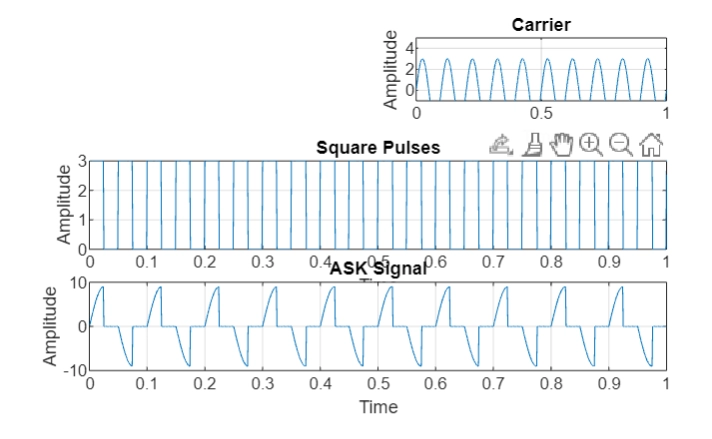
Explanation
In the output, you can see there are three signal carrier, square pulse and ASK modulated signal. The modulation is performed on the carrier signal, and square pulses is used to change the carrier signal to produce an ASK output wave.
ASK is performed on the carrier signal to modulate the sinusoidal signal and demodulate the sinusoidal signal. We will discuss the ASK modulation and demodulation in the further article.
Amplitude Shift Keying (ASK) Modulator
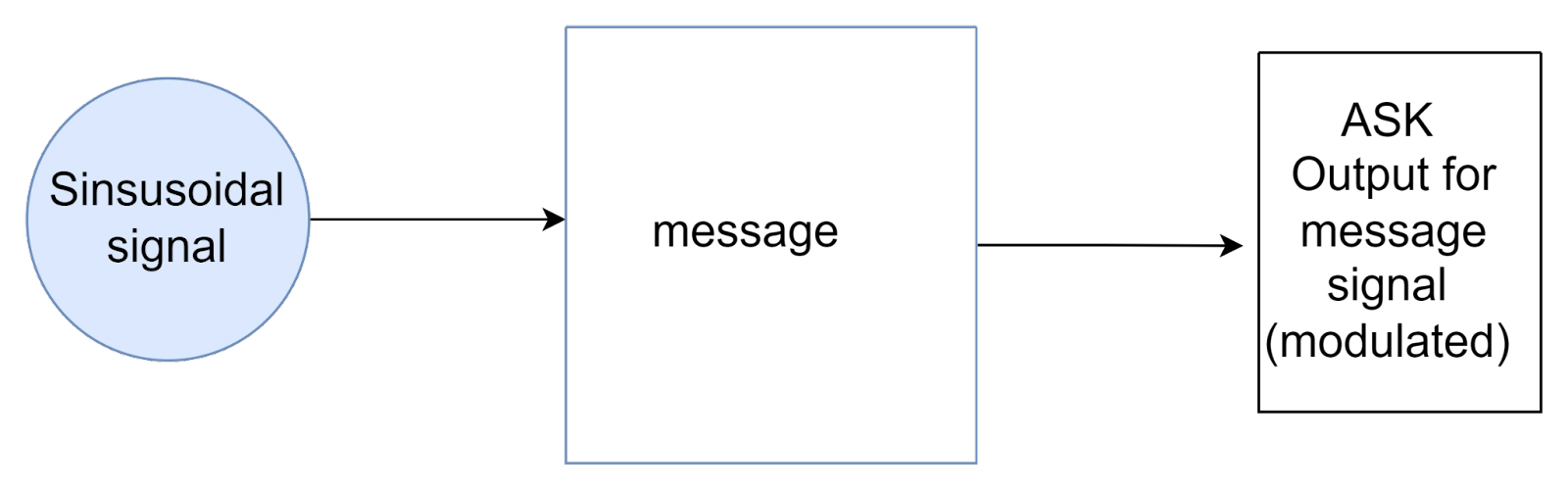
ASK modulator generates a continuous high-frequency carrier signal. The binary message signal determines whether the input is at a Low or High state. When the input is High, a switch is closed, allowing the carrier wave to pass through, resulting in a high-amplitude output. Similarly, the switch remains open when the input is Low, resulting in a low-amplitude output. The band-limiting or pulse-shaping filter determines the final pulse shape, which adjusts the pulse based on amplitude and phase parameters.




 1+ registered

