Do you think IIT Guwahati certified course can help you in your career?
Introduction
As technology improves, computers are getting more complicated in how they're built. One cool thing that has come from this progress is the creation of multicore and multiprocessor systems. These are special types of computer setups that make things run faster and better.
In this article, we will discuss the differences between these two types of setups to help you understand how they work.
Multicore System
A multi-core processor is a single unit that holds different independent processing cores. These cores work inside a single CPU system. Each core can handle computer instructions on its own, like separate processors. Even though they're not separate processors, they make it seem like there are many processors in the computer. These cores can do regular processor tasks, such as adding numbers, moving data, and making choices.
Advantages of Multicore System
The main advantages of multicore systems are:
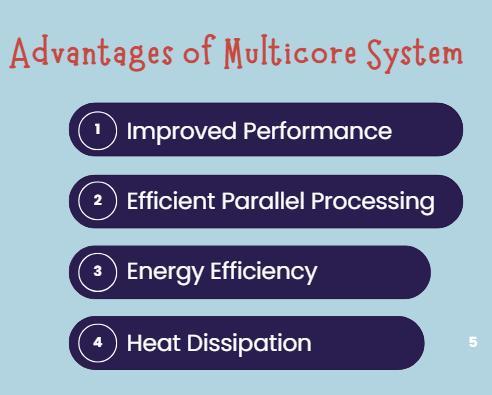
Improved Performance: Multicore processors can execute multiple tasks at the same time, leading to enhanced overall performance. It also has a faster execution of programs. This is mainly helpful for tasks that can be divided into parallel threads.
Efficient Parallel Processing: It is designed for multiple cores. It can take advantage of parallel processing. It also leads to quicker data processing and better utilization of system resources.
Energy Efficiency: Multicore processors are generally more power-efficient compared to single-core processors. The overall power consumption can be optimized by distributing the workload among multiple cores.
Heat Dissipation: Since the processing load is distributed across multiple cores, each core operates at a lower workload, resulting in reduced heat generation and better temperature management.
Disadvantages of Multicore System
The main disadvantages of multicore systems are:
Software Compatibility: Not all software is designed to take full advantage of multiple cores, which can lead to underutilization of available processing power. Legacy applications and poorly parallelized software may not experience significant performance gains on multicore systems.
Complex Programming: Developing software that effectively utilizes multiple cores can be challenging. Parallel programming requires careful synchronization and coordination to avoid data conflicts and race conditions.
Diminishing Returns: As the number of cores increases, the performance gains may not scale linearly. There comes a point where adding more cores doesn't necessarily lead to proportional performance improvements due to overhead and diminishing returns.
Characteristics of Multicore Systems
More than One Core: In a multicore system, there are multiple cores or "brains" inside a single chip.
Working Together: These cores can work on different tasks at the exact same time, which makes everything faster.
Better Performance: Because they can work together, multicore systems can do tasks quicker and more efficiently.
Less Energy Used: Even though they work harder, multicore systems use less power than having multiple separate chips.
Multiprocessor System
A multiprocessor system is a kind of computer system that holds multiple separate processors. It is also called central processing units or CPUs. It collaborates to do tasks and handle information. Unlike multicore processors, where different cores are put together on one CPU chip, multiprocessor systems use separate physical CPUs that can work at the same time and on their own. These CPUs are linked through different interconnect technologies to make communication and sharing of data easier.
The main advantages of multiprocessor systems are:
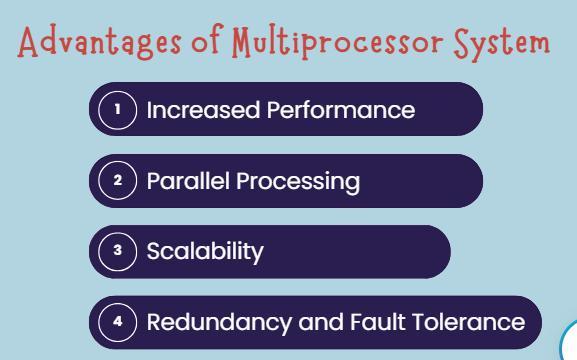
Increased Performance: Multiprocessor systems can achieve higher performance levels by distributing tasks among multiple processors. This leads to faster execution of programs and improved system responsiveness.
Parallel Processing: Tasks can be divided into smaller units and processed in parallel by multiple CPUs, enabling efficient utilization of resources and quicker data processing.
Scalability: Multiprocessor systems can be designed to scale by adding more processors, allowing for flexibility in handling varying workloads.
Redundancy and Fault Tolerance: Some multiprocessor configurations can provide redundancy and fault tolerance. If one processor fails, other processors can continue to operate, minimizing system downtime.
Disadvantages of Multiprocessor Systems
The main disadvantages of multiprocessor systems are:
Complexity: Designing, configuring, and programming multiprocessor systems can be complex due to the need for efficient task scheduling, synchronization, and communication mechanisms.
Software Challenges: Developing software that effectively utilizes multiple processors can be challenging. Parallel programming requires careful management of shared resources and synchronization to avoid conflicts.
Cost: Multiprocessor systems can be more expensive to design, manufacture, and maintain due to multiple CPUs and associated hardware.
Scalability Limits: While multiprocessor systems offer scalability, there are practical limits to the number of processors that can be effectively integrated due to issues like communication overhead and diminishing returns.
Characteristics of Multiprocessor Systems
Many Computers Working Together: A multiprocessor system is like having a bunch of computers that can work together on different tasks.
Sharing Memory: These computers can share information by using a common memory space.
Growing the Team: If more work needs to be done, you can add more computers to the team to handle it.
Faster Together: Working together makes the team finish tasks quicker like everyone working together on a big project.
Difference Between Multicore and Multiprocessor Systems
Parameters
Multicore System
Multiprocessor System
Number of Processors
One chip with multiple cores
Many separate computers work together
Communication
Cores share memory
Processors may communicate through shared memory or interconnect
Design Complexity
Lower complexity due to integrated design
Higher complexity due to separate processors and memory
Scalability
Limited scalability in terms of cores
Highly scalable by adding more processors
Resource Sharing
Cores share cache and memory resources
Processors may have dedicated resources
Application Suitability
Good for tasks that can be split into pieces
Useful for tasks that need a lot of teamwork and speed
Multicore systems allow different cores to work on separate tasks at the same time, making things run faster and more efficiently.
Can you give me an example of multicore vs. multiprocessor in real life?
Think of a multicore system as having a team of friends working on different parts of a project. In a multiprocessor system, it's like having different people with their own tools working together to finish a task faster.
Are multicore systems and multiprocessor systems used in the same types of devices?
They're used in similar devices like computers, smartphones, and tablets. Multicore systems are standard in most modern devices, while multiprocessor systems are used in more complex tasks that require teamwork.
Conclusion
Multicore and multiprocessor systems are two ways we're achieving that. These setups have their strengths and differences, which help us choose the best way to set up computers for different needs. We hope this article helped you in a better way. You may refer to our Guided Path on Code Studios for enhancing your skill set on DSA, Competitive Programming, System Design, etc. Check out essential interview questions, practice our available mock tests, look at the interview bundle for interview preparations, and so much more!







 7+ registered

