Primary Types of Hibernate Mapping
There are mainly three different kinds of mapping. As follows:
1. One to one: One property is mapped to another attribute in this form of relationship in a way that only one-to-one mapping is maintained. An illustration will help you comprehend this better. Suppose, for instance, that only one employee works for one department.
When a worker cannot work for another department at the same time, the mapping is known as one-to-one.
2. One to many: One property is mapped to many other characteristics in this form of relationship by being mapped to another attribute in a specific way. An illustration will help you comprehend this better. as in the case of a student who belongs to multiple groups, like a simultaneous cultural organization, sports team, and robotics team.
The student and group relationship in this scenario is referred to be a many-to-one relationship.
3. Many to many: One attribute is mapped to another attribute in this type of connection so that any number of attributes can be linked to other attributes without a limit on the quantity. An example will help you better comprehend this. For instance, in the library, one individual may check out a number of books, and one book may be issued to a number of other books.
Many to many partnerships are what this form of relationship is known as. Before implementation, there must be a thorough knowledge of the business use case for this complex relationship.
Types of Mapping
The primary fundamental forms of Hibernate mapping types are:
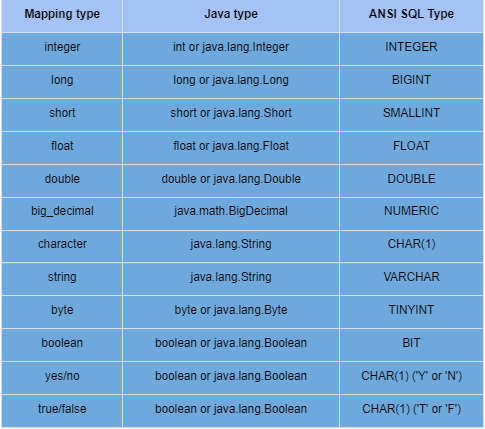
1. Primitive Types: Data types such as "integer," "character," "float," "string," "double," "Boolean," "short," "long," etc., are defined for this type of mapping. These can be found in the hibernate framework to map java data types to RDBMS data types.
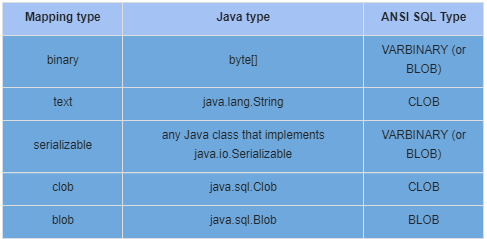
2. Binary and Large Object Types: They include "clob," "blob," "binary," "text," etc. To maintain the data type mapping of big things like images and videos, blob and clob data types are present.
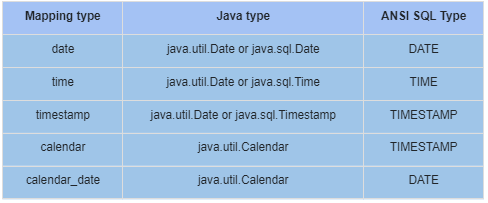
3. Date and Time Types: "Date," "time," "calendar," "timestamp," etc. are some examples. We have data type mappings for dates and times that are similar to primitive.
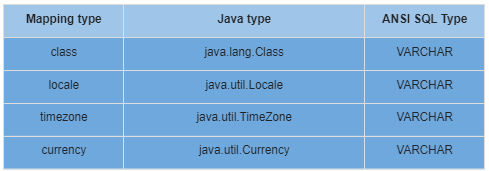
4. JDK-related Types: This category includes some mappings for things outside the scope of the previous kind of mappings. "Class," "locale," "currency," and "timezone" are among them.
Let's now go into greater depth about each of the four mapping types stated above:
Primitive Types
Some of the primitive forms of Hibernate mapping types:
Binary and Large Object Types
Binary and Large object types are one of the hibernate mapping types.
Date and Time Types
Hibernate mapping types also contain the Date and Time types.
JDK-related Types
The fourth category of Hibernate mapping types is JDK-related types.
Frequently Asked Questions
How is mapping accomplished in Hibernate?
One of the main components of Hibernate is association mappings. Similar linkages to those in the relational database model are supported. As follows:
- One-to-one relationships
- many-to-one relationships
- many-to-many relationships
What is HQL?
The abbreviation for Hibernate Query Language is HQL. It is a database-independent, object-oriented query language.
What does Hibernate's One-to-One association mean?
This kind of mapping requires you to model the system for the entity you want to use as a query or domain model to navigate the connection. To represent the association, you need an entity attribute; mark it with the annotation @OneToOne.
What is the One-to-Many association in Hibernate?
In this kind of linkage, a single thing may be connected to numerous other objects. In terms of the mapping, a Set Java collection without any unnecessary elements is used to implement the One-to-Many mapping. The set's One-to-Many element describes the relationship between a single object and many other things.
Conclusion
Hibernate mapping can therefore be implemented by creating the mappings using XML files. These mappings serve as the framework for a database created to meet the demands of the business model. This aids in figuring out the connections between the database's persistent items. Since the front-end application relies on this mapping for performance, accuracy, and speed, it is crucial for database architecture.
In this blog, we discuss Hibernate Mapping types with detailed explanations. If you want to explore more blogs on this topic, please follow these blogs especially curated for readers like you - Java Framework, JDBC Connection, Guide to ORM, Introduction to Spring Boot.
Please refer to our guided pathways on Code studio to learn more about DSA, Competitive Programming, JavaScript, System Design, etc. Enroll in our courses, and use the accessible sample exams and questions as a guide. For placement preparations, look at the interview experiences and interview package.
Please do upvote our blogs if you find them helpful and informative!
Happy learning!





 7+ registered

