Get a skill gap analysis, personalised roadmap, and AI-powered resume optimisation.
Introduction
MySQL is a relational database management system (RDMS) based on SQL, which is highly popular for accessing and managing the relational database. MySQL is free and open-source software supported by Oracle Company. MySQL is scalable, fast, and easy to use compared to Oracle Database and Microsoft SQL Server.
MySQL defined the database relationships in tabular form (collection or rows and columns). It consists of various queries which help in managing the database and manipulating data. In this article, we are only going to focus on MySQL UNIX_TIMESTAMP() Function.
MySQL UNIX_TIMESTAMP() Function
The MySQL UNIX_TIMESTAMP() is an inbuilt MySQL function that accepts only one argument: DATETIME or DATE data types and returns an unsigned integer. This unsigned integer is the number of seconds passed since 1970-01-01 00:00:00 UTC.
If the Function UNIX_TIMESTAMP() is called with no argument, it will simply return the number of seconds passed from 1970-01-01 00:00:00 UTC until now. If we want to use different timezones, we can convert them using CONVERT_TZ() function.
Syntax
The syntax for the function UNIX_TIMESTAMP() in MySQL is as follows:
MYSQL
MYSQL
UNIX_PARAMETER(parameter);
You can also try this code with Online MySQL Compiler
The parameters that we can pass to the MySQL UNIX_TIMESTAMP() Function are as follows:
DATETIME or TIMESTAMP
DATE
The parameter of the UNIX_TIMESTAMP() Function is optional. If no argument is passed to the Function, it will return the time passed since 1970-01-01 00:00:00 UTC.
Let’s look at both the parameters one by one in detail.
DATETIME or TIMESTAMP
The data types DATETIME or TIMESTAMP are used to store data with time instances. In MySQL, the format of data types is YYYY-MM-DD hh:mm:ss. In MySQL, The DATETIME or TIMESTAMP data types range between “1000-01-01 00:00:00” to “9999-12-31 23:59:59”.
DATE
In MySQL, this data type is used to store a date only. The format of this data type is YYYY-MM-DD. In MySQL, the DATE datatype ranges between “1000-01-01” to “9999-12-31”.
Examples of MySQL UNIX_TIMESTAMP() Function
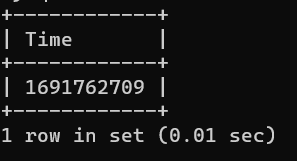
Case1: When no parameter is passed to the timestamp function
MYSQL
MYSQL
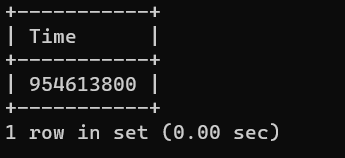
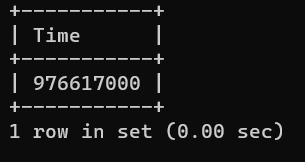
SELECT UNIX_TIMESTAMP() as Time;
You can also try this code with Online MySQL Compiler
Other than the YYYY-MM-DD hh:mm:ss format, no other formats are supported in UNIX_TIMESTAMP() Function. If provided, an error will be thrown.
NULL is returned if the given input parameter is NULL.
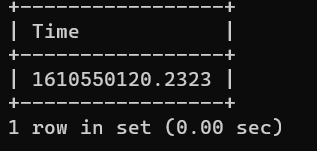
If fractional seconds are given to UNIX_TIMESTAMP() Function, it calculates the time passed from the Unix epoch and adds the fractional part to the return value.
If we give input as a string, MySQL tries to convert it into a datetime or date value with the help of internal parsing rules. Though, the Function will return NULL.
Frequently Asked Questions
What is the function of UNIX_TIMESTAMP?
The UNIX_TIMESATMP() function in MySQL helps to return a UNIX timestamp. We can define a Unix timestamp as the no. of seconds elapsed since ‘1970-01-01 00:00:00’ UTC.
What is the function of a timestamp in MySQL?
The TIMESTAMP() function in MySQL converts the datetime or date expression as a datetime value and returns the result in the form of a string.
How to check timestamp in MySQL?
To check the timestamp in MySQL, we can use the CURRENT_TIMESTAMP() function, which returns the current date and time.
Conclusion
In this article, we have discussed MySQL UNIX_TIMESTAMP() Function. We started with the introduction of MySQL, then we saw the syntax of MySQL UNIX_TIMESTAMP() Function, the we saw some examples.We hope this blog has helped you enhance your knowledge on MYSQL UNIX_TIMESTAMP() FUNCTION. If you want to learn more, then check out our articles:










 7+ registered

