




Simple Network Management Protocol
- SNMP is a protocol for managing internet-connected devices. SNMP mainly stands for Simple Network Management protocol.
- It uses TCP/IP protocol suite to connect the internet-connected devices.
- In order to monitor and manage the Internet, SNMP provides a set of basic activities.
- It is an application layer protocol that uses a UDP port number 161/162.
- The Internet engineering task force designated it as an application layer protocol.
Use of Simple Network Management Protocol
If a business has 1000 devices, checking each one individually every day to see if it is working properly or not is a time-consuming operation. Simple Network Management Protocol (SNMP) is used to help with this.
Working of Simple Network Management Protocol
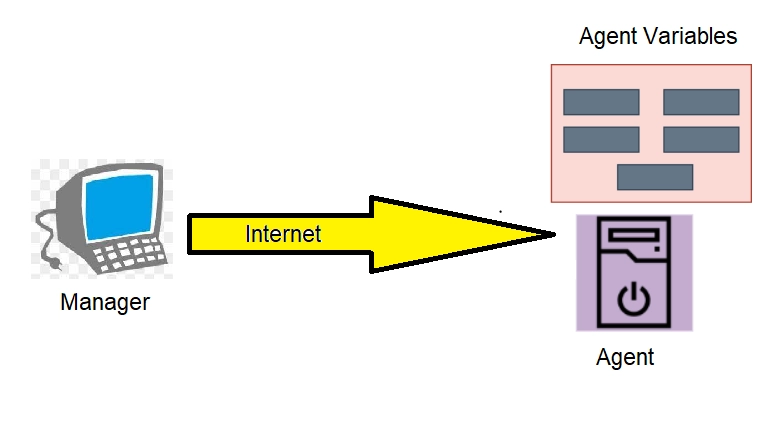
The SNMP protocol uses the Manager and Agent concepts, with the manager often being a host that supervises and monitors a group of agents. The SNMP protocol is an application-level protocol that is made up of a few manager stations that control a group of agents. This protocol is primarily intended for use at the application level to monitor devices made by a variety of manufacturers and installed on a variety of physical networks.
Components of Simple Network Management Protocol
- SNMP Manager
- SNMP Agent
- Management Information Base
SNMP Manager: It is basically a centralised system that is primarily used to monitor and manage network-connected devices. A machine called an SNMP manager is used to run one or more network management systems.
SNMP Agent: The SNMP Agent is a piece of software that is included with the network element. It is mostly installed on a managed device, which can include switches, servers, routers, PCs, and so on.
Management Components: Management is accomplished not only through the use of the SNMP protocol but also through the use of other protocols that can work in conjunction with the SNMP protocol. The other two protocols, SMI (Structure of Management Information) and MIB (Management Information Base), are used to achieve management (Management Information Base).

SMI: The SMI (Structure of Management Information) is a network management component. Its primary purpose is to define the types of data that can be kept in an object and to demonstrate how to encode that data for network transmission. The SMI does not specify how many objects an entity should be able to manage.
MIB: This protocol is mostly used to define the number of objects, name them according to the SMI's rules, and then assign a type to each named object in order to manage each entity.
The Management Information Base (MIB) is primarily used to define a set of objects for each entity that is similar to a database. As a result, MIB primarily builds a collection of named items, as well as their types.
SNMP: GetRequest, GetNextRequest, SetRequest, GetResponse, and Trap are the five types of messages defined by SNMP. It performs some specific roles in Network Management. It mostly specifies the packet format to be transferred from the management to the agent or vice versa. The result is also interpreted, and statistics are generated via SNMP. The name of the object (variable) and its state are included in the packets sent between the manager and the agent (values). The SNMP is in charge of reading and modifying these parameters as well.
Pros and Cons of Simple Network Management Protocol
| Pros | Cons |
|---|---|
| This protocol's functional design is portable. | The bandwidth of the network is reduced as a result of this protocol. |
| The SNMP protocol is a widely used protocol. | SNMP deals with data that isn't particularly detailed or well-organised. |
| This protocol allows for management access to be spread. |
Access control, authentication, and data privacy are some of the most serious security concerns.
|
| The operating system and programming language have no bearing on this protocol. | |
| It's the industry standard for network management. |


 1+ registered

