Introduction
The requirement can be defined as a high-level abstract statement or a detailed mathematical functional specification of a system's services, functions, and constraints. They are depictions of the characteristics and functionalities of the target system. Requirements denote the expectations of users from the software product.
The requirement should be open to interpretation and detailed enough to understand. It is essential to know about software requirements because it minimizes the developer's time and effort and the development cost. We have also discussed requirement engineering and the process in one of our articles.
In this article, we will learn the concept of Software Engineering and types of software requirements, functional and non-functional requirements, domain requirements.
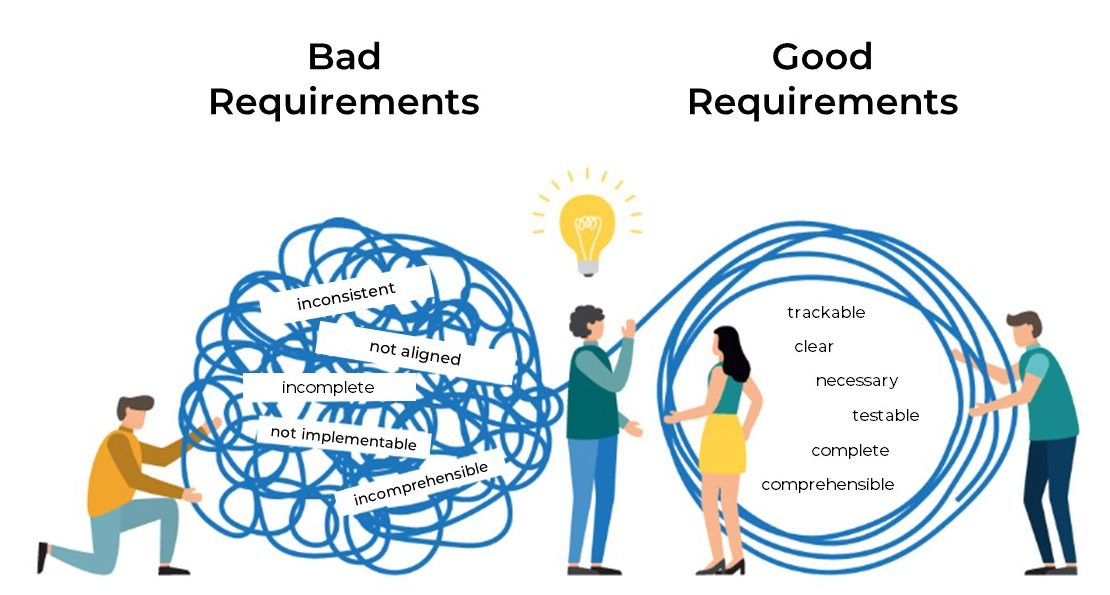
Bad requirements and Good requirements
Source-https://www.softwareone.com/
Types of Software Requirement
There are three types of Software requirements as follows:
- Functional requirements
- Non-Functional requirements
- Domain requirements
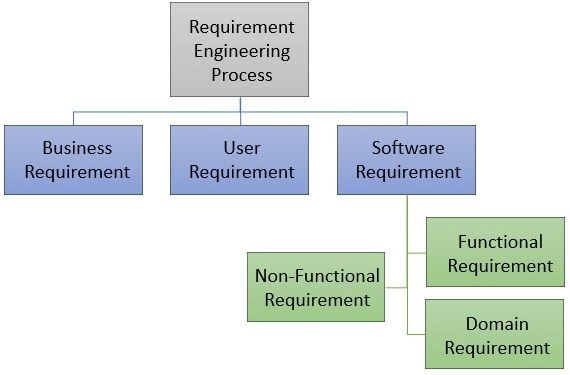
Requirement engineering process
Source- https://binaryterms.com/requirement-engineering.html
Functional Requirements
Functional requirements are such software requirements that are demanded explicitly as basic facilities of the system by the end-users. So, these requirements for functionalities should be necessarily incorporated into the system as a part of the contract. They describe system behavior under specific conditions. In other words, they are the functions that one can see directly in the final product, and it was the requirements of the users as well. It describes a software system or its components.
These are represented as inputs to the software system, its behavior, and its output. It can be a calculation, data manipulation, business process, user interaction, or any other specific functionality which defines what function a system is likely to perform.
A functional requirement can range from the high-level abstract statement of the sender's necessity to detailed mathematical functional requirement specifications. Functional software requirements help us to capture the intended behavior of the system.
Functional requirements can be incorporated into the system in many ways as
1. Natural language
2. A structured or formatted language with no rigorous syntax and formal specification language with proper syntax.
Examples of functional requirements
1. Whenever a user logs into the system, their authentication is done.
2. In case of a cyber attack, the whole system is shut down
3. Whenever a user registers on some software system the first time, a verification email is sent to the user.
Non-functional Requirements(NFRs)
These requirements are defined as the quality constraints that the system must satisfy to complete the project contract. But, the extent may vary to which implementation of these factors is done or get relaxed according to one project to another.
They are also called non-behavioral requirements or quality requirements/attributes.
Non-functional requirements are more abstract. They deal with issues like-
- Performance
- Reusability
- Flexibility
- Reliability
- Maintainability
- Security
- Portability
Non-Functional Requirements are classified into many types. Some of them are as:
- Interface Constraints
- Economic Constraints
- Operating Constraints
- Performance constraints: storage space, response time, security, etc.
- Life Cycle constraints: portability, maintainability, etc.
To perform the process of specification of non-functional requirements, we require knowledge of the context within which the system will operate and an understanding of the system's functionality.
Domain Requirements
Domain requirements are the requirements related to a particular category like software, purpose or industry, or other domain of projects. Domain requirements can be functional or non-functional. These are essential functions that a system of specific domains must necessarily exhibit.
The common factor for domain requirements is that they meet established standards or widely accepted feature sets for that category of the software project. Domain requirements typically arise in military, medical, and financial industry sectors. They are identified from that specific domain and are not user-specific.
Examples of domain requirements are- medical equipment or educational software.
Software in medical equipment
- In medical equipment, software must be developed per IEC 60601 regarding medical electrical equipment's basic safety and performance.
- The software can be functional and usable but not acceptable for production because it fails to meet domain requirements.
An Academic Software
- Such software must be developed to maintain records of an institute efficiently.
-
Domain requirement of such software is the functionality of being able to access the list of faculty and list of students of each grade.
Also read, V Model in Software Engineering
Click here to read more about Cloud Computing here.

 9+ registered