Phases of Spiral Model
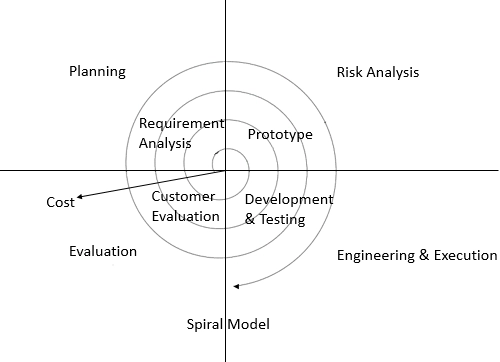
The Spiral model has four phases in the software development process. They are:
- Planning: The baseline spiral collects the business needs at this phase. This phase is followed by identifying system requirements, subsystem requirements, and unit requirements as the product grows.
- This phase also includes continual contact between the client and the system analyst to understand the system requirements. The product is launched in the specified market after the spiral.
- Risk Analysis: In the second quadrant, all viable solutions are reviewed to choose the optimal one. The risks connected with that solution are then identified, and the risks are mitigated using the best technique feasible. The prototype is made at the end of this quadrant for the most satisfactory potential solution.
- Execution: At each spiral, the execution phase relates to developing the authentic software product. A POC (Proof of Concept) is produced in this phase of the baseline spiral when the idea is merely being thought of, and the design is being developed to collect user input.
- Then, when the requirements and design specifics become more precise, a functioning model of the program known as a build is created with a version number. These prototypes are submitted to the buyer for review.
- Evaluation: Technical feasibility and management risks, such as schedule slippage and cost overrun, are identified, estimated, and monitored through risk analysis. At the end of the first iteration, the client analyses the program and comments after testing it.
Risk Handling in the Spiral Model
The Spiral Model is renowned for its robust approach to managing project risks throughout the software development lifecycle. Unlike traditional models that follow a linear path, such as the Waterfall Model, the Spiral Model iteratively progresses through phases: planning, risk analysis, engineering, and evaluation. Each iteration allows for continuous risk assessment and mitigation, ensuring that potential issues are identified early and addressed promptly. This iterative nature makes the Spiral Model superior in risk management after development starts because it integrates risk handling directly into the process rather than treating it as a separate phase. By revisiting and refining the product in successive spirals, teams can adapt to changing requirements and mitigate emerging risks effectively.
Why Spiral Model is Called a Meta Model?
In the context of SDLC, a Meta-Model is a model that encompasses and organizes other models, guiding their use based on the project’s needs. The Spiral Model is called a Meta-Model because it integrates the principles of multiple SDLC models into a single framework, offering flexibility and adaptability.
It incorporates the Waterfall Model by following a stepwise progression through planning, design, development, and testing phases in each loop. It adopts the Prototyping Model by emphasizing the creation of prototypes during early iterations to mitigate risks and gather user feedback. It reflects the Evolutionary Model through its iterative loops, where each spiral represents a refined version of the system.
Each loop in the Spiral Model can mimic another SDLC model—such as a mini Waterfall or an incremental prototype—making it highly versatile. This integration of models and its risk-driven nature make the Spiral Model a true Meta-Model in software development.
Advantages of Spiral Model
The spiral model has the following advantages:
- Requirements may be captured with more precision.
- Users get a first look at the system.
- Development may be broken down into smaller chunks, with the hazardous elements first, allowing for better risk management.
- It's excellent for big, mission-critical projects.
Disadvantages of Spiral Model
The spiral model has the following disadvantages:
- Smaller tasks are not well served by this method.
- The procedure is intricate.
- Spiral might continue endlessly.
- A large number of intermediate phases demands a mountain of paperwork.
When to use Spiral Model?
The spiral model is best suited for implementation where:
- There is a budget constraint, risk assessment is critical.
- For projects with a medium to a high level of risk.
- Long-term project commitment due to the possibility of shifting economic priorities as requirements change over time.
- The customer is unsure about their needs, which is typical.
- Conditions are difficult to understand and must be evaluated.
Also check out - Phases of Compiler and V Model in Software Engineering
Frequently Asked Questions
What is the Meta Model?
As Spiral Model encompasses all other SDLC models, it is also referred to as a Meta-Model. The Iterative Waterfall Model, for example, is represented by a single loop spiral. The spiral model integrates the Classical Waterfall Model's progressive technique. The spiral model employs the Prototyping Model's risk-handling strategy of developing a prototype at the start of each step
How is risk handled differently in the Spiral Model compared to the prototyping model?
The Prototyping Model also enables risk management, although risks must be fully recognized before the project's development activity begins. However, project hazards may arise in real life after development work has already started; in this instance, the prototyping model cannot be employed. The spiral model addresses these unknown risks after the project has begun. The development of a prototype makes such risk solutions easier. The spiral model facilitates risk management by creating a prototype at each stage of software development.
What is the most critical feature of the Spiral Model?
Risk Analysis and management is the most critical feature of the Spiral Model. Due to risk analysis and risk management at each level, the Spiral Paradigm is the ideal development model to follow.
What is the difference between the Spiral model and the waterfall model?
The main distinction between the waterfall and spiral models is that the waterfall model is used for smaller projects with defined needs. In contrast, the spiral approach is utilized for large, complicated projects with ongoing risk analysis.
Conclusion
This article extensively discussed the Spiral Model used in the software development life cycle and its advantages and disadvantages.
We hope this blog has helped you enhance your knowledge of the Spiral Model and other software development processes. For learning more about software project management or other models like Waterfall Model, Big Bang Model, and Iterative Model, check out Code Studio's blog site.
Also check out - Strong Number Phases of Compiler






 1+ registered

