Do you think IIT Guwahati certified course can help you in your career?
Introduction
Hello Ninja, Hope you are doing well. In this article, we will be going to study Table Per Concrete. We will talk about its advantages and disadvantages. Also, we will implement it through coding and make it easier to understand.
Let’s learn about Hibernate now. Hibernate, a java framework makes it easier to create Java applications that communicate with databases. It is an Object Relational Mapping (ORM) tool that is open-source and portable. Hibernate implements the JPA (Java Persistence API) requirements for data persistence. An ORM tool makes creating, manipulating and accessing data easier. It is a programming method that associates the object with the database data.
Table Per Concrete
According to the "Table per Concrete Class" technique, a table in the inheritance tree is defined for each concrete class to contain all of the class's attributes and superclasses. While querying root or branch classes can be challenging and time-consuming, it is an optional strategy in ORM technologies (like JPA).
We will understand this with an example in the coming section.
Benefits and Drawbacks
The benefits and drawbacks of Table per Concrete Class Mapping are listed below.
Benefits
This inheritance mapping approach is very easy to use.
It makes the program very clear and easy to understand.
Drawbacks
A parent class's data is dispersed throughout several subclass tables representing concrete classes.
A significant number of tables reflect changes a/c to the parent class.
Example
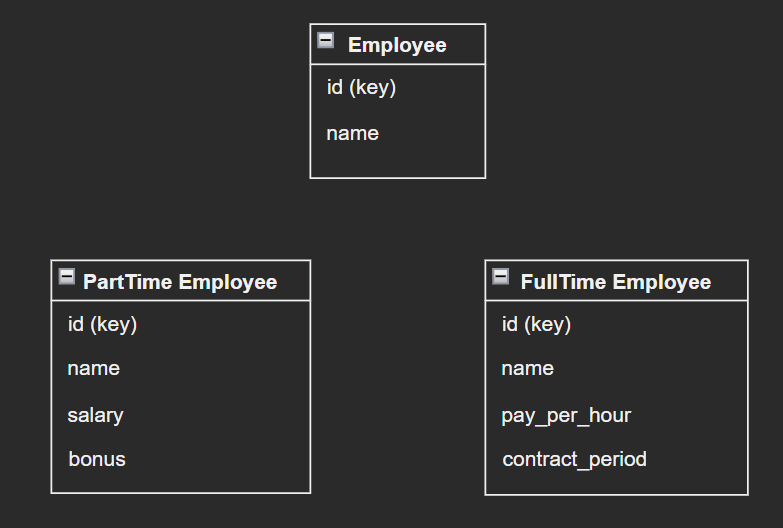
Assume for a moment that you want to convert the entire hierarchy shown below into a meaningful relational database schema. Both the PartTime_Employee and FullTime_Employee classes are subclasses of the Employee class.
The DB schema illustrated in the following diagram is the result of using the pattern just described:
that(one on top) turns to this(image below):
This hierarchy's corresponding mapping file should be:
If the DB has relationships with multi-levels of inheritance, you must reflect them in the ORM file by recursively nesting each definition.
Frequently Asked Questions
What is the Table per concrete class in hibernate?
Hibernate maintains each derived class object of the hierarchy in a different database table using the Table per Concrete Class technique. A parent class's data is dispersed throughout several subclass tables, which stand in for actual courses.
When a Table per concrete class is used, will three tables be present?
I am using an XML file, one Table per concrete class. Three tables with no relationships to one another will be present in the Table Per Concrete class database. The Table with Table per concrete class technique may be mapped in two different ways.
What is the Table per subclass in hibernate?
A main key column that connects two different tables by acting as a foreign key is specified by this annotation. In the JOINED mapping approach, it is used to link the primary Table of an entity subclass to the primary Table of its superclass.
What is the Table per concrete class mapping?
In the inheritance hierarchy, for each concrete class, a table is established in the "Table Per Concrete Class" approach, containing all of the attributes of the course and its superclasses. This tactic is optional in certain ORM technologies (like JPA), and querying root or branch classes might be time-consuming and ineffective.
What is dirty checking in hibernate?
Hibernate tracks all permanent objects. It is aware of which items have undergone modification after a work unit. The update statement is then executed on all updated things. In hibernation, this procedure of keeping track of and updating only modified items is known as automated dirty checking.
Conclusion
So that's the end of the article. Table Per Concrete
After reading about Table Per Concrete, Are you interested in reading/exploring more themes on Table? Don't worry; Coding Ninjas has you covered.
However, if you want to give your work an edge over the competition, you might choose to enroll in one of our premium courses.
With our Coding Ninjas StudioGuided Path, you may learn about Data Structures & Algorithms, Competitive Programming, JavaScript, System Design, and more! If you want to put your coding skills to the test, check out the mock test series on Coding Ninjas Studio and participate in the contests! But if you've only recently started your schooling and are looking for answers to issues presented by digital titans like Amazon, Microsoft, Uber, and others. In this situation, you must consider the obstacles, interview experiences, and interview package as part of your placement preparations. If you find our blogs valuable and fascinating, please vote them up!







 7+ registered

