Do you think IIT Guwahati certified course can help you in your career?
Introduction
The travelling salesman problem is one of the most searched optimization problems. Many optimization methods use the travelling salesman problem as a benchmark. Despite the problem's computational difficulty, various algorithms exist. These algorithms allow instances with tens of thousands of cities to be solved completely.
In this article, we’ll be looking at a basic version of this problem. We’ll understand the problem statement and various approaches to solve it.
So, Let’s get started!
What is the Travelling Salesman Problem (TSP)?
The Travelling Salesman Problem (TSP) is a well-known optimization problem in computer science and operations research. The problem is defined as follows: given a set of cities and the distances between them, find the shortest possible route that visits each city exactly once and returns to the starting city.
In other words, the TSP asks for the shortest possible Hamiltonian cycle in a complete weighted graph, where each vertex represents a city and each edge represents the distance between two cities.
The TSP is a famous NP-hard problem, meaning that there is no known algorithm that can solve all instances of the problem in polynomial time. However, there are several approximation algorithms and heuristics that can provide good solutions for many practical instances of the problem. The TSP has many applications in logistics, transportation, and circuit design, among other fields.
Problem Statement
The problem states that "What is the shortest possible route that helps the salesman visits each city precisely once and returns to the origin city, provided the distances between each pair of cities given?"
Let’s understand this with the help of an example.
Example
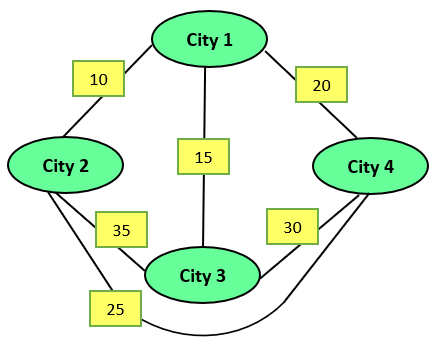
Given, City1, City2, City3, City4 and distances between them as shown below. A salesman has to start from City 1, travel through all the cities and return to City1. There are various possible routes, but the problem is to find the shortest possible route.
The various possible routes are:
Route
Distance Travelled
City(1 - 2 - 3 - 4 - 1)
95
City(1 - 2 - 4 - 3 - 1)
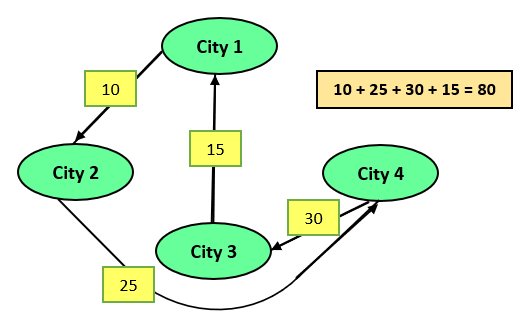
80
City(1 - 3 - 2 - 4 - 1)
95
Since we are travelling in a loop(source and destination are the same), paths like (1 - 2 - 3 - 4 - 1) and (1 - 4 - 3 - 2 - 1) are considered identical.
Out of the above three routes, route 2 is optimal. So, this will be the answer.
Let’s understand the solution approach to this problem.
Solution Approach(Brute force)
There are various ways to solve this problem. In this blog, we’ll discuss the brute force approach. The travelling salesman problem is a permutation problem. There can be n! total ways to solve permutation problems.
In this approach, we’ll generate all the possible permutations (routes). And find the one with the shortest distance.
The algorithm is as follows:
Step 1: Choose a city to act as a starting point(let’s say city1).
Step 2: Find all possible routes using permutations. For n cities, it will be (n-1)!.
Step 3: Calculate the cost of each route and return the one with the minimum cost.
Now, let’s move on to the implementation of the above algorithm. But, having known the algorithm to solve, we recommend you to give this problem a try by yourself on Coding Ninjas Studio.
The implementation is based on the example given above. We’ve passed the adjacent matrix of the graph (Also, see Data Structures) given above. An adjacent matrix is a way to represent the graph.
#include <bits/stdc++.h>
using namespace std;
#define V 4 // Total no of cities

int TSP_Implement(int Adj_matrix[][V], int s)
{
	// Store all cities apart from the source city in a vector.
	vector<int> cities;
	for (int i = 0; i < V; i++)
	if (i != s)
	cities.push_back(i);

	int min_distance = INT_MAX;
	do
	{

		// Taking starting Path distance as zero
		int curr_distance = 0;

		// compute current path distance
		int k = s;
		for (int i = 0; i < cities.size(); i++)
       		{
		curr_distance += Adj_matrix[k][cities[i]];
		k = cities[i];
		}
		curr_distance += Adj_matrix[k][s];

		// update minimum
		min_distance = min(min_distance, curr_distance);

	}
	//using following permutation method of C++
   	while(next_permutation(cities.begin(), cities.end()));

	return min_distance;
}

int main()
{
	//The adjacent matrix of the graph given in the example
	int Adj_matrix[][V] =
			{ { 0, 10, 15, 20 },
        	{ 10, 0, 35, 25 },
        	{ 15, 35, 0, 30 },
        	{ 20, 25, 30, 0 } };
	//Starting city or source
	int start = 0;
	cout <<"The minimum cost is: "<<TSP_Implement(Adj_matrix, start) << endl;
	return 0;
}
You can also try this code with Online C++ Compiler
import java.util.*;
class Main{

static int V = 4;
static int travllingSalesmanProblem(int graph[][],
                                   int s)
{
   ArrayList<Integer> vertex = new ArrayList<Integer>();

   for (int i = 0; i < V; i++)
       if (i != s)
           vertex.add(i);

   int min_path = Integer.MAX_VALUE;
   do
   {
       int current_pathweight = 0;
       int k = s;

       for (int i = 0; i < vertex.size(); i++)
       {
           current_pathweight += graph[k][vertex.get(i)];
           k = vertex.get(i);
       }
       current_pathweight += graph[k][s];
       min_path = Math.min(min_path, current_pathweight);

   } while (findNextPermutation(vertex));

   return min_path;
}
public static ArrayList<Integer> swap(ArrayList<Integer> data,int left, int right){
   int temp = data.get(left);
   data.set(left, data.get(right));
   data.set(right, temp);
   return data;
}
public static ArrayList<Integer> reverse(ArrayList<Integer> data, int left, int right)
{
   while (left < right)
   {
       int temp = data.get(left);
       data.set(left++, data.get(right));
       data.set(right--, temp);
   }
   return data;
}
public static boolean findNextPermutation(ArrayList<Integer> data)
{
   if (data.size() <= 1)
       return false;

   int last = data.size() - 2;
   while (last >= 0)
   {
       if (data.get(last) < data.get(last + 1))
       {
           break;
       }
       last--;
   }
   if (last < 0)
       return false;

   int nextGreater = data.size() - 1;
   for (int i = data.size() - 1; i > last; i--)
   {
       if (data.get(i) > data.get(last))
       {
           nextGreater = i;
           break;
       }
   }
   data = swap(data,nextGreater, last);
   data = reverse(data, last + 1, data.size() - 1);
   return true;
}
public static void main(String args[])
{
   int graph[][] = {{0, 10, 15, 20},
                   {10, 0, 35, 25},
                   {15, 35, 0, 30},
                   {20, 25, 30, 0}};
   int s = 0;
   System.out.println(travllingSalesmanProblem(graph, s));
}
}
Python Code Implementation
from sys import maxsize
from itertools import permutations
V = 4

def travellingSalesmanProblem(graph, s):
	vertex = []
	for i in range(V):
		if i != s:
			vertex.append(i)

	min_path = maxsize
	next_permutation=permutations(vertex)
	for i in next_permutation:
		current_pathweight = 0
		k = s
		for j in i:
			current_pathweight += graph[k][j]
			k = j
		current_pathweight += graph[k][s]
		min_path = min(min_path, current_pathweight)

	return min_path

if __name__ == "__main__":
	graph = [[0, 10, 15, 20], [10, 0, 35, 25],
			[15, 35, 0, 30], [20, 25, 30, 0]]
	s = 0
	print(travellingSalesmanProblem(graph, s))
Output
The minimum cost is: 80
Complexity Analysis
Time and Space Complexity
The time complexity of O(nn), where n is the number of cities as we’ve to check (n-1)! routes (i.e all permutations).
The space complexity is O(n2) as the n*n adjacency matrix needs O(n2) space, and to store the remaining cities, we need O(n) space. The overall complexity will be O(n2).
This is not an optimal solution, so we'll explore some other approaches as well. Dynamic programming is one crucial algorithm. It is used when we can divide our problem into smaller subproblems.
The implementation of the travelling salesman problem using dynamic programming is explained in Part-2. So, go check it out!
The Travelling Salesman Problem (TSP) has numerous applications in various fields. Some of the common applications of TSP are:
Logistics and transportation: The TSP is used to optimize the routing of delivery trucks, sales representatives, and service technicians. By finding the shortest route that visits all necessary locations, TSP can help minimize travel time and reduce transportation costs.
Circuit design: In the field of electronics, TSP is used to optimize the routing of electrical signals in a printed circuit board, which is a critical step in the design of electronic circuits.
DNA sequencing: In bioinformatics, TSP is used to find the shortest path to sequence a DNA molecule. DNA sequencing involves finding the order of nucleotides in a DNA molecule, which can be modeled as a TSP.
Network design: TSP is used to optimize the design of communication networks, such as the placement of cell towers, routing of fiber-optic cables, and design of wireless mesh networks.
Robotics: TSP can be applied in robotics to optimize the path planning of robots to visit a set of locations in the most efficient manner.
These are just a few examples of the many applications of TSP. The problem is widely studied and has numerous practical applications in various fields.
Academic Solutions to TSP
The Travelling Salesman Problem (TSP) is a well-studied problem in computer science and operations research. Although the problem is NP-hard and does not have a known polynomial-time algorithm, there are several academic solutions and approaches to the TSP. Some of the common ones are:
Exact algorithms
Exact algorithms solve TSP by computing the optimal solution in the entire solution space. Branch and bound, cutting-plane, and dynamic programming algorithms are commonly used to solve TSP exactly.
Approximation algorithms
Approximation algorithms are designed to provide a good, but not necessarily optimal, solution to TSP. The Christofides algorithm and the 2-opt algorithm are examples of approximation algorithms.
Heuristics
Heuristics are problem-solving strategies that do not guarantee an optimal solution but can provide a reasonably good solution in a short amount of time. The nearest neighbor algorithm and the simulated annealing algorithm are examples of heuristics used to solve TSP.
Metaheuristics
Metaheuristics are optimization algorithms that can find good solutions to TSP by exploring a large solution space. Genetic algorithms, ant colony optimization, and particle swarm optimization are examples of metaheuristics used to solve TSP.
Hybrid algorithms
Hybrid algorithms combine multiple solution methods to solve TSP. For example, a hybrid algorithm may use an exact algorithm to find the optimal solution for a small sub-problem and use a heuristic or metaheuristic for the remaining part of the problem. These are just a few examples of the many academic solutions to TSP. The choice of algorithm or approach depends on the specific instance of the problem, the problem size, and the available computational resources.
Frequently Asked Questions
What is TSP? Explain with an example.
TSP is the travelling salesman problem consists of a salesperson and his travel to various cities. The salesperson must travel to each of the cities, beginning and ending in the same. The problem's challenge is that the travelling salesman wishes to minimize the trip's total length.
What type of problem is TSP?
TSP is an optimization problem. In this, we have to optimize the route of travel
How is the travelling salesman problem related to the minimum spanning tree?
TSP and MST are two algorithmic problems that are closely connected. In particular, an open-loop TSP solution is a spanning tree, although it is not always the shortest spanning tree.
Conclusion
In this article, we ran you through the travelling salesman problem. We saw a brute force approach to solve the problem.
There are various algorithmic paradigms such as Dynamic Programming and Backtracking to solve this problem. We’ll be seeing them in upcoming blogs. After reading this, it is recommended to move to the DP approach of TSP.
As we saw earlier, TSP is somewhat related to the minimum spanning tree.








 7+ registered

