What are Neural Networks?
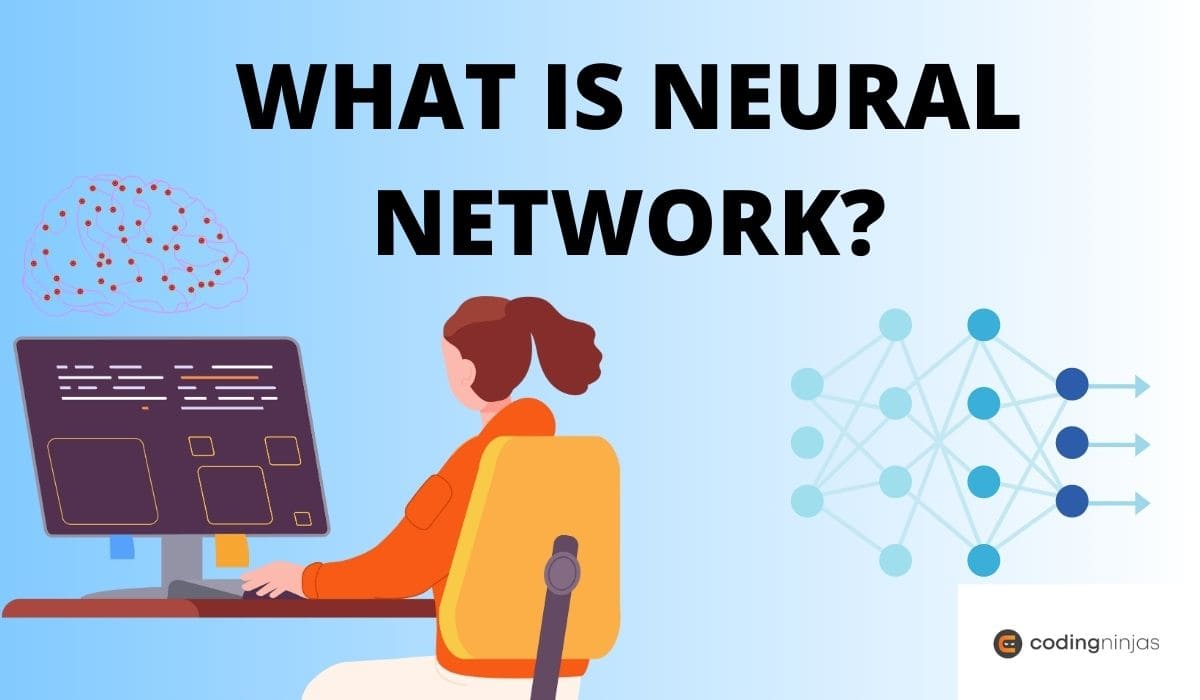
Neural networks are a type of machine learning model that are designed to mimic the way the human brain processes information. They are composed of interconnected nodes, called neurons, that are organized into layers. Each neuron receives input from other neurons, performs a computation on that input, & produces an output that is passed on to other neurons.
The basic building block of a neural network is the perceptron, which is a single neuron that takes in multiple inputs & produces a single output. The perceptron works by computing a weighted sum of its inputs & applying an activation function to that sum. The activation function determines whether the neuron fires or not based on the input it receives.
Neural networks can have multiple layers of neurons, with each layer performing a different computation on the input data. The first layer is called the input layer, & it receives the raw input data. The last layer is called the output layer, & it produces the final output of the network. Between the input & output layers, there can be one or more hidden layers that perform intermediate computations.
The power of neural networks comes from their ability to learn from data. By adjusting the weights of the connections between neurons, a neural network can learn to map input data to output data. This learning process is typically done using an optimization algorithm, such as gradient descent, which minimizes the error between the predicted output & the actual output.
Neural networks have many applications like:
1. Image recognition: Neural networks can be trained to recognize objects, faces, & scenes in images.
2. Natural language processing: Neural networks can be used for tasks such as sentiment analysis, language translation, & text generation.
3. Predictive modeling: Neural networks can be used to predict future outcomes based on historical data, such as stock prices or customer behavior.
4. Robotics: Neural networks can be used to control robots & enable them to learn from their environment.
How does Neural Networks work?
Neural networks work by taking input data, processing it through multiple layers of interconnected neurons, & producing an output. Each neuron in the network performs a simple computation on its inputs & passes the result to the next layer of neurons.
Let’s discuss the step by step working of how a neural network works :
1. Input layer: The input layer receives the raw input data, which can be in the form of numerical values, images, or text. Each input value is assigned to a different neuron in the input layer.
2. Hidden layers: The input data is passed through one or more hidden layers, where each neuron applies a mathematical transformation to its inputs. This transformation is typically a weighted sum of the inputs, followed by an activation function that introduces non-linearity into the network.
3. Output layer: The final layer of the network is the output layer, which produces the network's predictions. The output layer can have one or more neurons, depending on the task at hand. For example, in a binary classification task, the output layer would have a single neuron that outputs a probability between 0 & 1.
4. Training: To train a neural network, we feed it a large dataset of input-output pairs & adjust the weights of the connections between neurons to minimize the error between the predicted output & the actual output. This process is typically done using an optimization algorithm, such as gradient descent, which iteratively updates the weights to minimize the loss function.
5. Inference: Once the network is trained, we can use it to make predictions on new, unseen data. We simply feed the input data through the network & obtain the output predictions.
One of the key features of neural networks is their ability to learn hierarchical representations of the input data. Each layer of the network learns to extract different features from the input data, with the earlier layers learning simple features & the later layers learning more complex features. For example, in an image recognition task, the first layer of the network might learn to detect edges & corners, while the later layers might learn to detect more complex shapes & objects.
Another important aspect of neural networks is the choice of activation function. The activation function introduces non-linearity into the network, which allows it to learn complex, non-linear relationships between the input & output data. Some common activation functions include the sigmoid function, the hyperbolic tangent function, & the rectified linear unit (ReLU) function.
Learning of a Neural Network
Neural networks learn from data through a process called training. During training, the network is exposed to a large dataset of input-output pairs & adjusts its internal parameters (weights & biases) to minimize the difference between its predicted output & the true output.
There are several learning paradigms that neural networks can use, like:
1. Supervised learning: In supervised learning, the network is trained on a labeled dataset, where each input is paired with a corresponding output. The goal of the network is to learn a mapping from inputs to outputs that generalizes well to new, unseen data. Examples of supervised learning tasks include image classification, speech recognition, & language translation.
2. Unsupervised learning: In unsupervised learning, the network is trained on an unlabeled dataset, where there are no explicit output labels. The goal of the network is to discover hidden patterns or structures in the input data. Examples of unsupervised learning tasks include clustering, dimensionality reduction, & anomaly detection.
3. Reinforcement learning: In reinforcement learning, the network learns to make decisions based on feedback from its environment. The network receives rewards or penalties based on its actions & learns to maximize its cumulative reward over time. Examples of reinforcement learning tasks include game playing, robotics, & autonomous driving.
During training, the network uses an optimization algorithm to adjust its weights & biases to minimize a loss function. The loss function measures the difference between the network's predicted output & the true output, & the optimization algorithm tries to find the set of weights & biases that minimize this difference.
One of the most commonly used optimization algorithms in neural networks is gradient descent. Gradient descent works by computing the gradient of the loss function with respect to each weight & bias in the network, & then updating the weights & biases in the direction of the negative gradient. This process is repeated iteratively until the loss function converges to a minimum.
Another important aspect of neural network learning is regularization. Regularization techniques are used to prevent the network from overfitting to the training data, which can lead to poor generalization performance on new data. Some common regularization techniques include L1 & L2 regularization, dropout, & early stopping.
In summary, neural networks learn from data by adjusting their internal parameters to minimize a loss function. The choice of learning paradigm, optimization algorithm, & regularization technique depends on the specific task & dataset at hand.
Types of Neural Networks
There are several types of neural networks, each designed for specific tasks and data types.
Let’s see some of the most common types of neural networks:
1. Feedforward Neural Networks (FFNNs): FFNNs are the simplest type of neural network, where information flows in one direction from the input layer to the output layer through one or more hidden layers. FFNNs are commonly used for tasks such as classification and regression.
2. Convolutional Neural Networks (CNNs): CNNs are designed for processing grid-like data, such as images. They use convolutional layers to learn local features and pooling layers to reduce the spatial dimensions of the input. CNNs have achieved state-of-the-art performance on tasks such as image classification, object detection, and segmentation.
3. Recurrent Neural Networks (RNNs): RNNs are designed for processing sequential data, such as time series or natural language. They have feedback connections that allow them to maintain a hidden state over time, which can capture long-term dependencies in the input data. RNNs are commonly used for tasks such as language modeling, machine translation, and speech recognition.
4. Long Short-Term Memory (LSTM) Networks: LSTMs are a type of RNN that can learn to selectively remember or forget information over long sequences. They use a special type of memory cell that can store information for long periods of time and have gating mechanisms that control the flow of information into and out of the cell. LSTMs have achieved state-of-the-art performance on many sequence modeling tasks.
5. Autoencoders: Autoencoders are a type of neural network used for unsupervised learning tasks such as dimensionality reduction and feature learning. They consist of an encoder network that maps the input data to a lower-dimensional representation and a decoder network that reconstructs the original input from the lower-dimensional representation. Autoencoders can be used for tasks such as anomaly detection, denoising, and data compression.
6. Generative Adversarial Networks (GANs): GANs are a type of neural network used for generative modeling tasks, such as image synthesis and style transfer. They consist of two networks: a generator network that learns to generate realistic samples from a random noise input, and a discriminator network that learns to distinguish between real and generated samples. GANs have achieved impressive results on tasks such as photo editing, super-resolution, and video synthesis.
Simple Implementation of a Neural Networks
Now that we have covered the basics of neural networks, let's see how we can implement a simple neural network using Python. We will use the Keras library, which is a high-level neural networks API that can run on top of TensorFlow.
Let’s discuss the step-by-step example of how to implement a simple feedforward neural network for a binary classification task:
Step 1: Import the required libraries
from keras.models import Sequential
from keras.layers import Dense
Step 2: Define the model architecture
model = Sequential()
model.add(Dense(16, input_dim=10, activation='relu'))
model.add(Dense(8, activation='relu'))
model.add(Dense(1, activation='sigmoid'))
In this example, we define a feedforward neural network with three layers: an input layer with 10 nodes, a hidden layer with 16 nodes, another hidden layer with 8 nodes, and an output layer with 1 node. We use the rectified linear unit (ReLU) activation function for the hidden layers and the sigmoid activation function for the output layer.
Step 3: Compile the model
model.compile(loss='binary_crossentropy', optimizer='adam', metrics=['accuracy'])
Here, we compile the model by specifying the loss function (binary cross-entropy), the optimizer (Adam), and the evaluation metric (accuracy).
Step 4: Train the model
model.fit(X_train, y_train, epochs=10, batch_size=32)
We train the model on the training data (X_train and y_train) for 10 epochs with a batch size of 32. The model will learn to map the input features to the output labels by adjusting its weights and biases.
Step 5: Evaluate the model
score = model.evaluate(X_test, y_test)
print('Test loss:', score[0])
print('Test accuracy:', score[1])
Finally, we evaluate the trained model on the test data (X_test and y_test) and print the test loss and accuracy.
Note: That's it! With just a few lines of code, we can implement a simple neural network using Keras. Of course, this is just a very small example, and real-world neural networks are often much more complex, with many more layers and nodes, and trained on much larger datasets.
Frequently Asked Questions
What is the difference between a neural network & a deep neural network?
A neural network becomes a deep neural network when it has multiple hidden layers. Deep neural networks can learn more complex representations of the input data & have achieved state-of-the-art performance on many tasks.
How do you choose the number of layers & nodes in a neural network?
The number of layers & nodes depends on the complexity of the task & the size of the training data. A common approach is to start with a small network & gradually increase its size until performance stops improving.
What are some common problems that can occur when training neural networks?
Common problems include vanishing or exploding gradients, overfitting, & underfitting. Techniques such as gradient clipping, regularization, early stopping, & cross-validation can help mitigate these issues.
Conclusion
In this article, we have discussed what is neural network, from their basic structure & function to their applications in various domains. We explained the evolution of neural networks, their learning paradigms, & the different types of architectures used for specific tasks. We also provided a simple implementation of a neural network using Python & Keras.
You can also check out our other blogs on Code360.







 5+ registered

