Work with any data
Working with relational, non-relational, image, file, relative search, and data lakes are all possible because of Microsoft Dataverse abstraction. Since Microsoft Dataverse presents a variety of data types that let you construct your model, there is no need to comprehend the type of data.
The chosen data type is best suited to the storage type. The Data Export Service is also available to Dynamics clients.
Along with the hundreds of other connectors in those services for on-premises, infrastructure as a service (IaaS), platform as a service (PaaS), or software as a service (SaaS) services, Dataverse also provides a connector for Power Automate and Azure Logic Apps.
Common Data Model
By giving business and analytical apps a common data language to work with, Common Data Model offers reference architecture designed to speed up this process.
Thanks to the Common Data Model metadata system, data, and its meaning may be exchanged between different business processes and applications, including Power Apps, Power BI, Dynamics 365, and Azure.
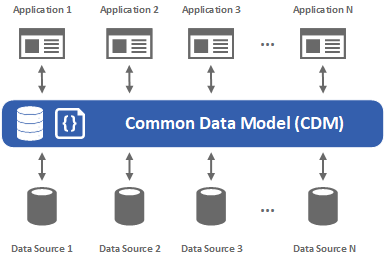
Source - Link
Microsoft and its partners have produced a set of standardized, extendable data schemas under the Common Data Model. Tables, attributes, semantic metadata, and relationships are all part of this set of predefined schemas. The Common Data Model schemas can guide the construction of tables in Dataverse.
Some of the standard Common Data Model tables are depicted in the following graphic.
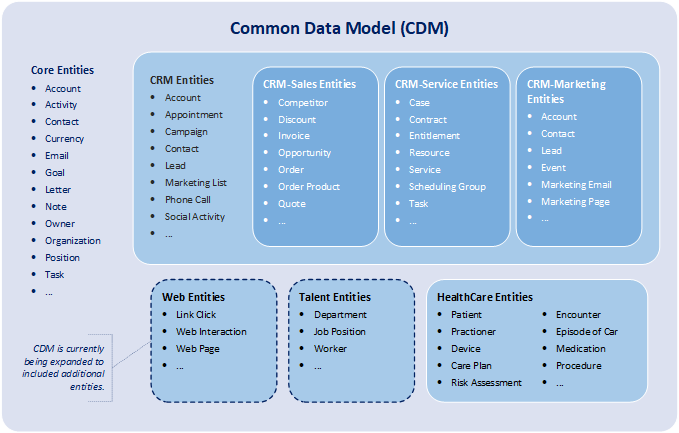
Source - Link
Tables
Tables are used in Dataverse to manage and model business data. Dataverse contains a collection of tables known as standard tables to boost productivity. The standard tables follow Common Data Model.
The term "standard tables" refers to a group of tables found in Dataverse that are often used in various industries, including User and Team.
Additionally, Dataverse makes it simple to make your unique tables.

Source - Link
Columns
Individual data pieces that can be utilized to store data in a table are defined by columns. Different sorts of data, including numeric data, texts, digital data, photographs, and files, may be contained in columns.
The data is stored in Dataverse using the optimum storage option for the developed model.
Each of these columns can be connected to one of the numerous data types that Dataverse supports.
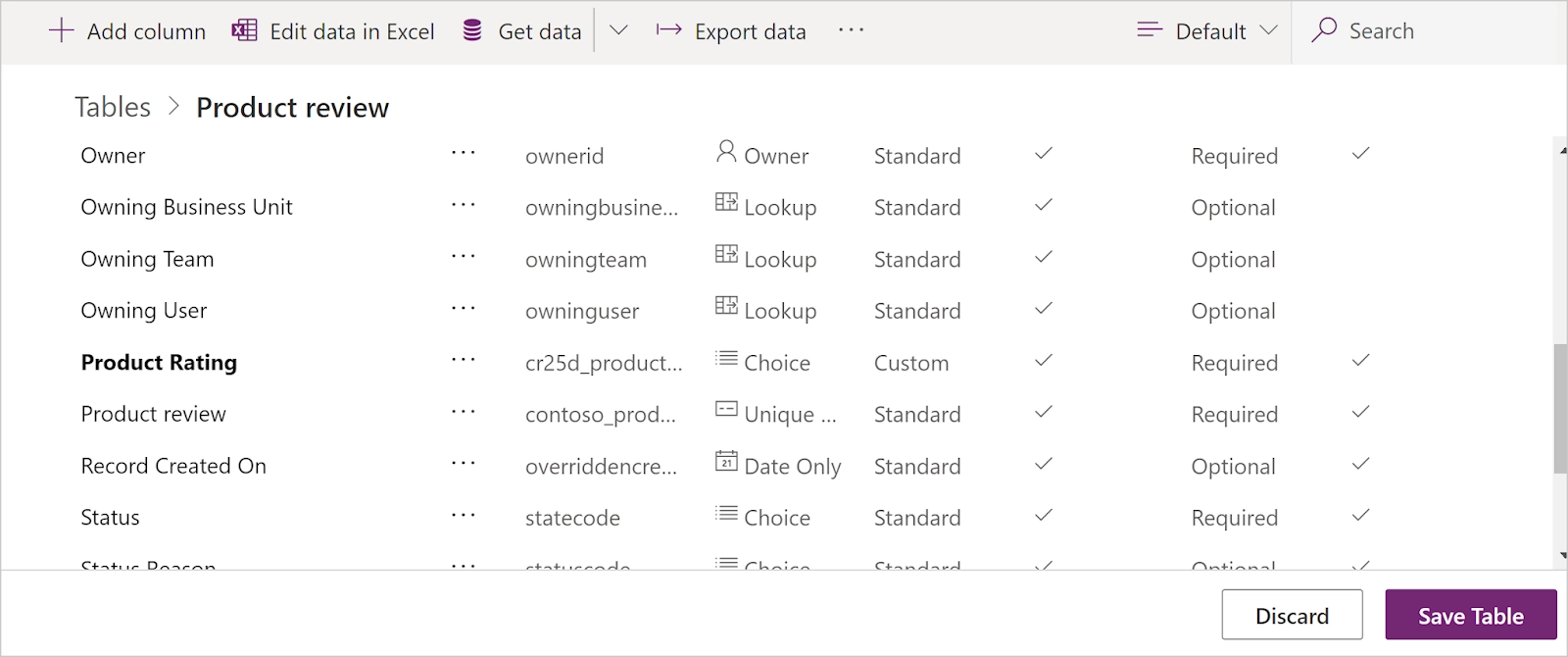
Source- Link
Relationships
In the Dataverse paradigm, table relationships specify how rows might be related to one another.
To establish the many linkages between tables, Dataverse offers simple visual designers (or between a table and itself).
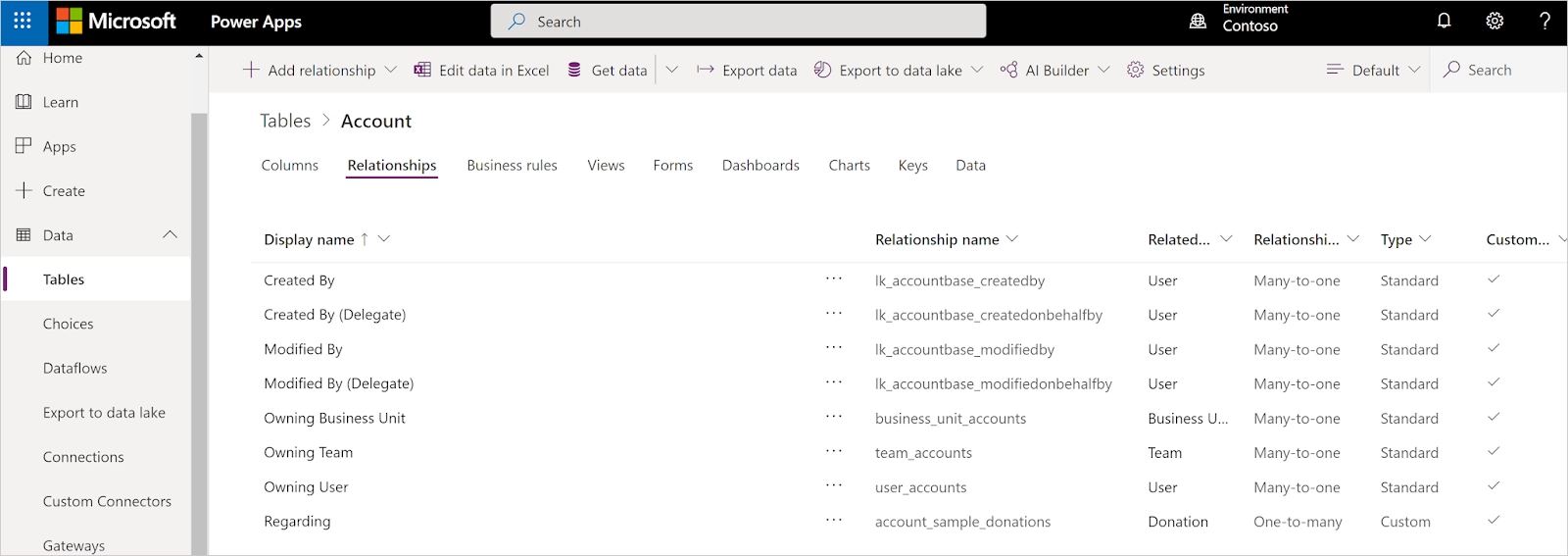
Source - Link
Work with any app
Using Dataverse with Power Apps can help a company generate new apps even more efficiently. Companies that use Power Apps can create iOS and Android mobile apps quickly.
Dataverse offers a robust REST-based API, a developer SDK, and an expanding library of samples for typical scenarios for businesses looking to integrate Dataverse data into already-existing apps or create new apps using custom code.
Bots can be swiftly created utilizing Power Virtual Agents and Dataverse data, whether they are incorporated within Power Apps or custom code.
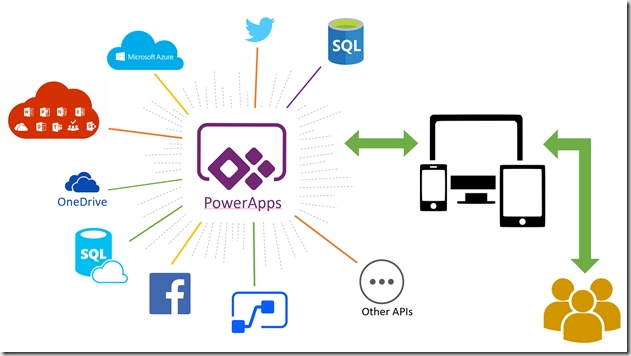
Source-Link
Dataverse should be compatible with knowledge workers' and professional developers' tools since its objective is to function with any app.
Security
A set of privileges is grouped by Dataverse using role-based security. Dataverse offers a column-level security capability to provide more granular security management at the column level because row-level access control is insufficient for some business scenarios. The manager and position hierarchies are two additional security models that can be utilized for hierarchies in Dataverse.
Compliance
Organizations' top issue is compliance. Organizations may be confident that the data stored in Dataverse is in line with strict industry standards since Microsoft frequently interacts with dozens of regulators worldwide. Dataverse complies with several standards, and third-party audits and certifications are used to confirm compliance.
Availability and scalability
Dataverse delivers a service level agreement of 99.9% uptime and is built to fulfill enterprise-level scaling requirements. Licenses set entitlement limitations on how many requests users may make daily to assure service levels, availability, and quality.
Analytics and reporting
Analytics and reporting can be utilized with Dataverse to generate insights and motivate company action. Key decision-makers can receive data and insight in several ways, thanks to Dataverse.

Source-Link
Six pre-built AI models are included in AI Builder, a component of Microsoft Power Platform. They may be used in Power Automate, Power Apps, and to analyze data in Dataverse.
Dataverse offers a managed data lake to assist advanced analytics and machine learning.
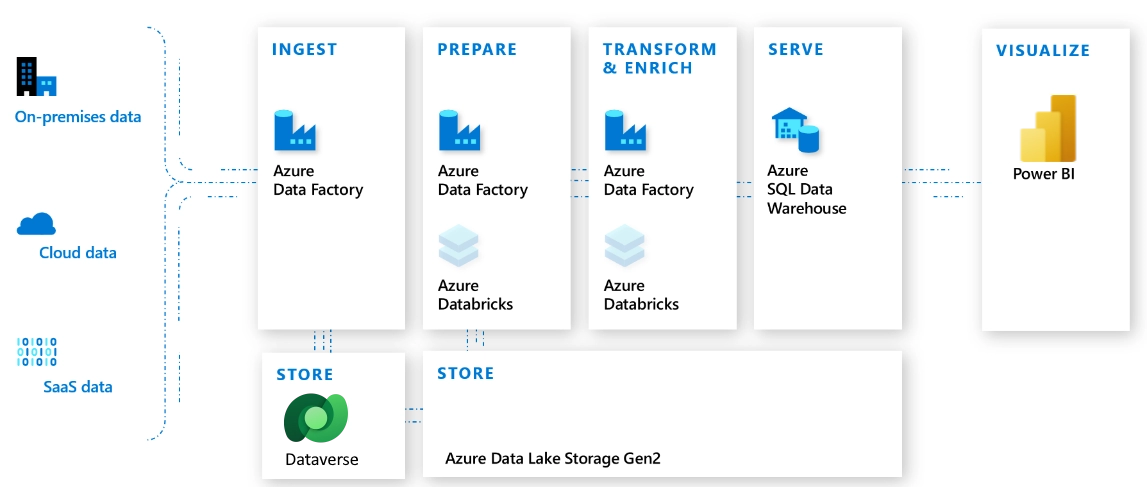
Source-Link
One advantage of having the data in Azure Data Lake is that businesses can use Azure Synapse Analytics.
Microsoft Power Platform requests
Requests on the Microsoft Power Platform are activities that users take on various products. The following are general requests for the Microsoft Power Platform: All API queries from Power Apps or Power Automate to connectors.
Entitlement limits
The maximum number of requests users can make each day is represented by entitlement limitations. See Capacity add-ons for details on how to view and distribute them.
Service protection limits
Service protection limitations are in place to safeguard the overall well-being of the service. See Dataverse API request limits for details on each service's current protection limits. Applicable to connections from Power Apps and Power Automate to Dataverse and Dynamics 365 Customer Engagement apps like Dynamics 365 Sales and Dynamics 365 Customer Service.
Capacity add-ons
A user's license determines the precise amount of Microsoft Power Platform requests permitted throughout 24 hours. The number of requests submitted about the number permitted by Dataverse's current license will be compared by entitlement limits.
Backups
Automatic backups, often known as system backups, and manual backups, are both offered by Dataverse.
System backups
System backups back up all environments. System backups for production setups with a database and one or more Dynamics 365 applications are kept for 28 days.
Manual backups
Manual backups are possible for both sandbox and production settings. The number of manual backups that can be created is unlimited, and manual backups do not count against storage restrictions.
Datacenter regions
Because so many firms conduct business internationally, so are their data demands. Thanks to its global deployment and support, organizations can feel secure knowing that Dataverse is accessible when and where they need it.
Frequently Asked Questions
What could be the most practical method to use a PowerApps app in an office setting?
Adding the app to Teams can help increase accessibility.
What are the different sorts of variables used in PowerApps?
Global variables and Context variables are used in PowerApps.
Explain Security Roles
Security Roles in Power Platform define authorization levels for specific users or teams. For every security role, you must configure the privileges and access levels.
Conclusion
This article has explained why to choose the Microsoft dataverse in-depth and how it works with any data and application, considering various security issues, compliance, and backups.
Refer to our Guided Path on Coding Ninjas Studio to upskill yourself in Data Structures and Algorithms, Competitive Programming, JavaScript, System Design, Machine learning, and many more! If you want to test your competency in coding, you may check out the mock test series and participate in the contests hosted on Coding Ninjas Studio! But if you have just started your learning process and are looking for questions asked by tech giants like Amazon, Microsoft, Uber, etc., you must look at the problems, interview experiences, and interview bundle for placement preparations.
Nevertheless, you may consider our paid courses to give your career an edge over others!
Do upvote our blogs if you find them helpful and engaging!
Happy Learning!!





 1+ registered

