Components of Cookbook
There are 6 components of a Cookbook:
Recipes
The most basic configuration component in an organization is a recipe.
-
It is written in the computer language, Ruby. This is made to read and behave predictably.
-
It mostly consists of a collection of resources that have been specified using patterns (resource names, attribute-value pairs, and actions). When necessary, auxiliary code is added using Ruby around this.
- Must specify every need needed to configure a system component.
Metadata
The name, description, and version of the cookbook are all included in this document.
-
A cookbook's version designates a set of features distinct from those in the cookbook upon which it is based.
-
A version might be present for various purposes. This is for ensuring the proper use of a third-party component, updating a bug fix, or offering an improvement. Using syntax and operators, a cookbook version is defined.
- It can be frozen and linked to environments, cookbook information, or run lists (to prevent unwanted updates from being made).
Attributes
A cookbook (or recipe) can create an attribute that can later be used to alter a node's default values.
-
These properties are compared to attributes already existing on a node. The cookbook is loaded during a Chef Infra Client run.
-
According to cookbook order, attributes defined in attribute files are loaded first. Each cookbook loads its attributes starting with the default.rb file before loading any further attribute files (if any are present) in lexical order.
- Chef Infra Client runs on the node. The updated settings and values are applied when the cookbook attributes take precedence over the default attributes.
Resources
A custom resource is an abstract concept for specifying the number of actions. We have to do this together with several properties and validation parameters (for each action).
Templates
A template is a markup-language file. That employs Ruby statements to address intricate configuration problems.
Libraries
Any Ruby code may be used in a cookbook with the help of a library. We can do it either to expand the Chef Infra Client language or to implement a new class.
Community Cookbooks
Any Ruby code may be used in a cookbook with the help of a library. Either to expand the Chef Infra Client language or to apply a new class.
The community uses Chef's collection of cookbooks frequently.
- Cookbooks kept by Sous Chefs
A number of the most popular Chef cookbooks are kept by the community organization Sous Chefs.
- Cookbooks kept by the Community
1000 cookbooks have been written by the community, ranging from popular cookbooks used by everyone to special cookbooks used by only a few groups.
Chef-Repo
On your computer, there is a directory called "chef-repo". That has all the information you need to use Chef Infra to define your infrastructure:
- Cookbooks (including recipes, attributes, custom resources, libraries, and templates)
- Data bags
-
Policy files
A version control program like it should be synchronized with the chef-repo directory. The chef-data repo's should all be regarded as source code.
To upload data from the chef-repo directory to the Chef Infra Server. Use the chef and knife commands. The data is then used by the Chef Infra Client. To manage the nodes registered with the Chef Infra Server. And make sure the right cookbooks, policy files, and settings are applied to the correct nodes in the proper sequence.
Generate the chef-repo
Create your chef-repo directory and the fundamental folder structure using the chef generate repo command. To construct a chef-repo, this command makes use of the chef command-line tool. This is included with the Chef Workstation.
chef generate repo REPO_NAME
Generate a Cookbook
To create a cookbook in Chef Infra, use the chef generate cookbook subcommand.
Using the command "chef generate cookbook custom web", a cookbook in Chef Infra with the following directory structure is produced:
. cookbooks
  - custom_web
    - recipes
      - default.rb
    - test
      - integration
        - default
          - default_test.rb
    - .gitignore
    - CHANGELOG.md
    - chefignore
    - kitchen.yml
    - LICENSE
    - metadata.rb
    - Policyfile.rb
    - README.md
Frequently Asked Questions
What is Chef in DevOps?
A DevOps chef for beginners. With the DevOps application Chef in your kitchen, being a cloud specialist is much simpler. An open-source cloud configuration management and deployment program is called Chef.
What is Chef infra server?
The Chef Infra Server is a central location for configuration data, housing cookbooks, node policies, and managed node metadata.
How do Chef cookbooks work?
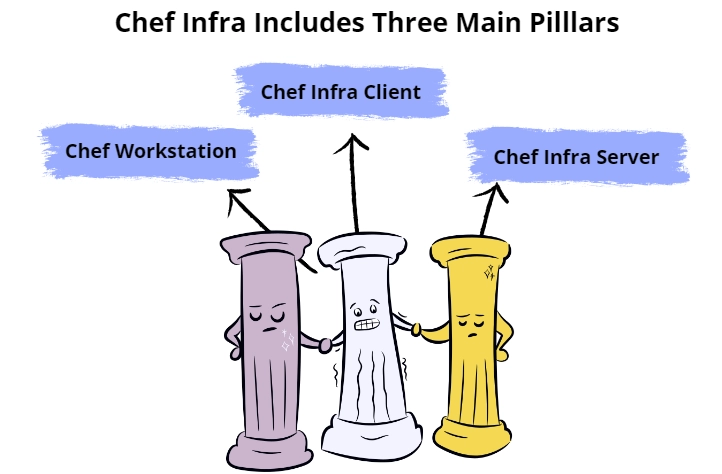
Cookbooks are essential selections for infrastructure. On the workstation, cookbooks are created and then uploaded to a Chef server.
How does a Chef cookbook operate in node?
By including the cookbook in the node's run list, you can assign the cookbook to the node directly. The role can be given a cookbook and added to the node's run list.
How do the client and server of Chef communicate to obtain a cookbook?
The workstation uses a knife to deliver the cookbook to the server. The Chef client is used by the nodes to connect to the server.
Conclusion
In this blog, we have learned about the Cookbook in Chef Infra and also a little bit about Chef infra. To know more about Chef infra-related topics, check out the following articles.
Refer to our guided paths on Coding Ninjas Studio to learn more about DSA, Competitive Programming, JavaScript, System Design, etc. Enroll in our courses and refer to the mock test and problems available. Take a look at the interview experiences and interview bundle for placement preparations.
Happy Learning Ninja! 🥷






 1+ registered

