Do you think IIT Guwahati certified course can help you in your career?
Introduction
Azure Sphere is a platform for safeguarding IoT devices from start to finish. Microcontrollers are the target audience for Azure Sphere. A microcontroller is a single-chip computer that includes a processor, storage, memory, and Internet of Things (IoT) capabilities.
Historically, we have not approached IoT Security wholistic. We attempted to secure specific components such as hardware and software. This is especially true for smaller, more limited devices such as microcontrollers. Many of these devices are 'legacy,' meaning they have been in use for a long time. The goal of Azure Sphere is to provide a secure environment for deploying and deploying IoT devices (both new and legacy). It is estimated that 9 billion MCU-based IoT devices are shipped each year. These devices are rapidly becoming connected and are an important part of our lives. These devices are becoming increasingly connected and play an important role in our social and commercial lives. The main challenge is keeping these devices secure. Once secured, IoT device data provides opportunities to create and deploy new services.
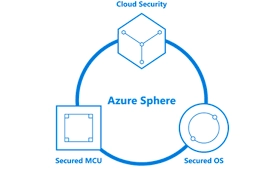
Azure Sphere is a secure, high-level application platform for internet-connected devices that includes built-in network security features. The Azure Sphere platform is made up of three parts:
A safe, linked, a crossover microcontroller unit (MCU)
A cloud-based security service that provides continuous, renewable security and
A custom high-level Linux-based operating system (OS).
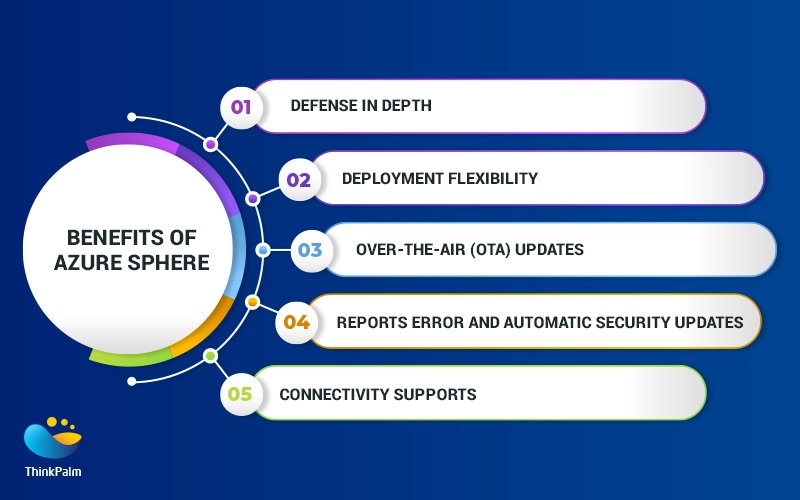
The Azure Sphere platform offers an ecosystem for the development, deployment, and maintenance of secure internet-connected IoT solutions. As a result, the Azure Sphere's primary value proposition is security. Based on the foundations of security, the Azure Sphere platform offers additional benefits such as:
The ability to maintain IoT - connected devices in the field securely and remotely.
Protection against various types of security threats such as spoofing, rogue software, and denial of service attacks
The ability to automatically receive software updates in order to combat the most recent security threats. Any connected device can receive software updates automatically from the cloud. These updates may address issues, add new features, or combat emerging attack methods.
Improved support personnel productivity through automated software update provision
The ability to collect product usage data from the field to aid in the diagnosis of problems and the design of new products.
Overall value chain benefits include customer satisfaction, product support, and future development.
Guardian modules provide support for legacy IoT devices.
How Azure Sphere works
The Azure Sphere platform's three components work together to provide final security for an IoT solution.
At a device level, the hardware architecture provides secure computing.
The software architecture allows you to provide a reliable method allowing you to focus your efforts on value-added features.
Authentication, software updates, and failure reporting are all supported by the Azure Sphere Security Service.
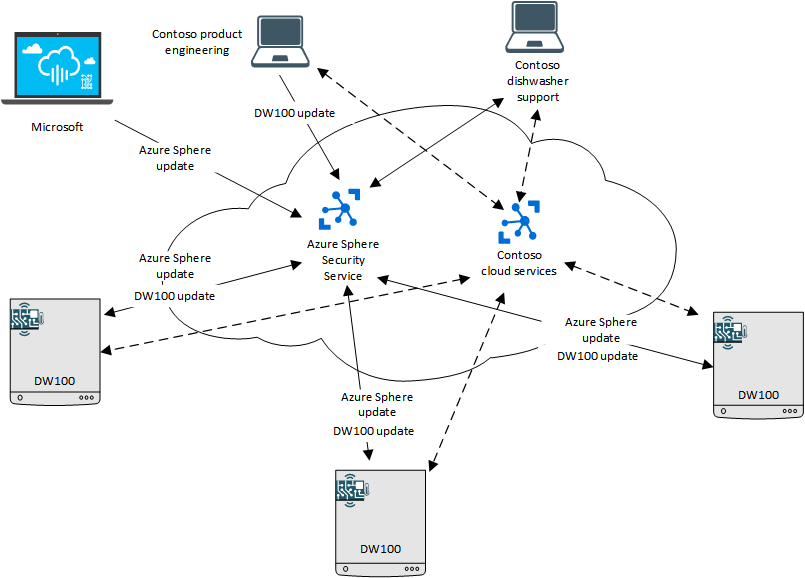
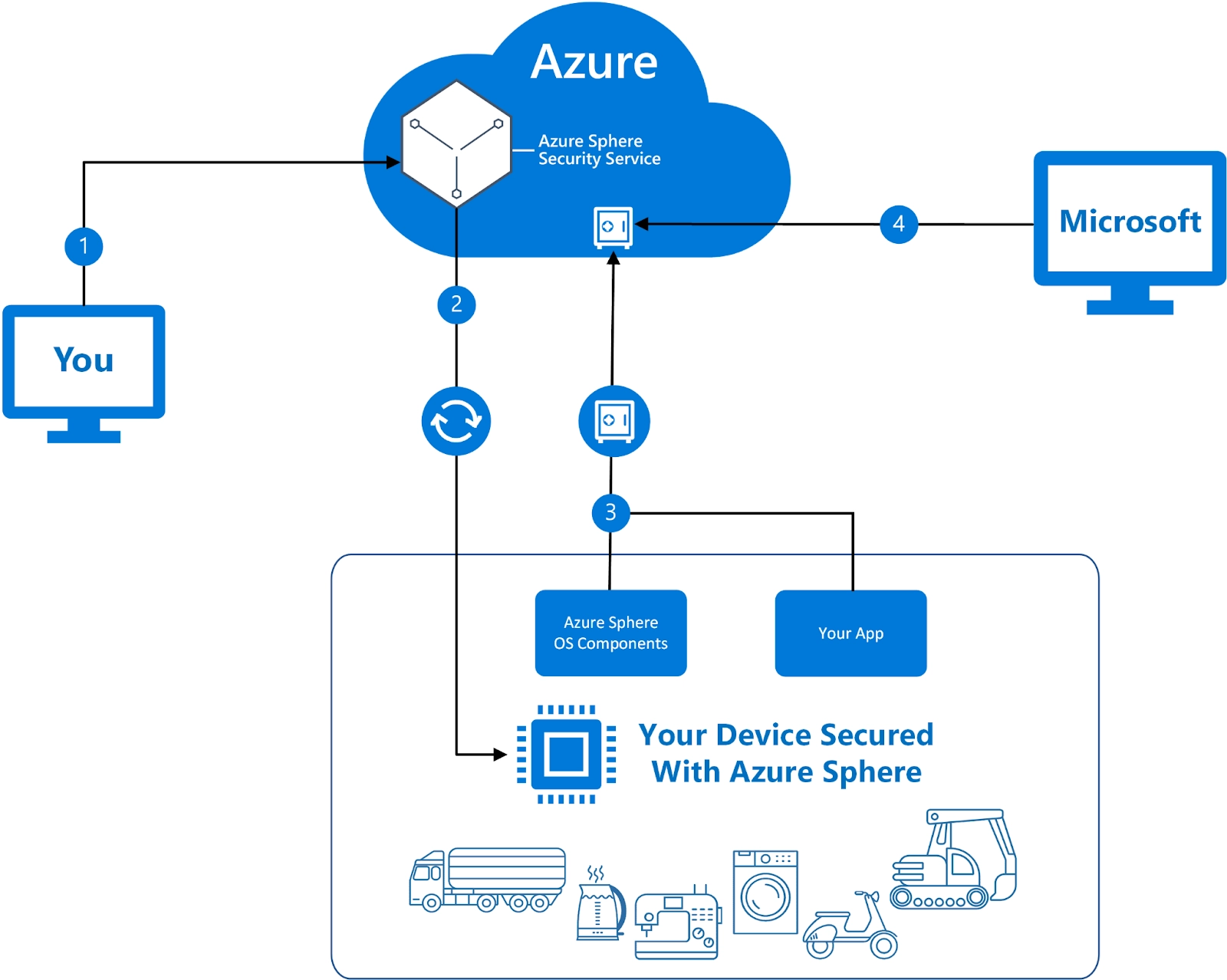
Additionally, Azure Sphere includes support for legacy IoT devices via Guardian modules. Guardian Modules is a hardware solution that connects to the Azure Sphere Security Service for security checks and automated patching. They also communicate with Brownfield devices via device-specific protocols. Below mentioned are how these components interact.
Azure Sphere Security Service: The Azure Sphere Security Service is where Microsoft releases updates for the Azure Sphere OS. After that, the product engineering team pushes updates to individual solar panels via the Azure Sphere Security Service.
Services and assistance: The solar panels collect error reporting data. If the solar panels are damaged or need cleaning, information from the sensors on the panels is captured and relayed back to the support services group.
Product Engineering: The product engineering group receives and visualizes data from solar panels in the field. The data can be used to improve the solution or to develop new ones.
Support for legacy devices: Many of the solar panels in use are older and are not connected to the Internet.
Azure sphere architecture
By combining hardware, software, and security services, Azure Sphere provides unbreakable security. This section will provide a summary of each of these architectures.
Hardware Architecture
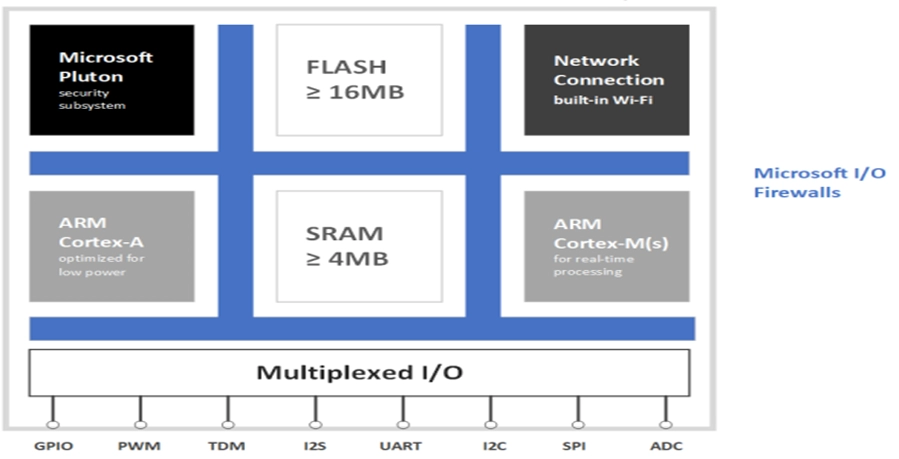
The Azure Sphere MCU is made up of multiple cores on a single die, as illustrated in the figure below.
Each core is compartmentalized to ensure that security breaches in one core do not affect other substances. Each MCU is assigned to a different trust domain. In this section, we will go over each core of MCU in detail.
Pluton security subsystem
Pluton security subsystem is a subsystem within the MCU that manages trusted and secure roots. It is made up of the following parts:
Core security processor
Engines for cryptography
Hardware random number generator
There are two types of encryption: symmetric and asymmetric.
Digital Signature Algorithm with Elliptic Curve.
Secured hardware verification bot.
Countermeasures for tampering
Unit for detecting entropy
A variety of software components and tools are also included in the pluton security subsystem. These software elements are various run-time services.
Core high-level application
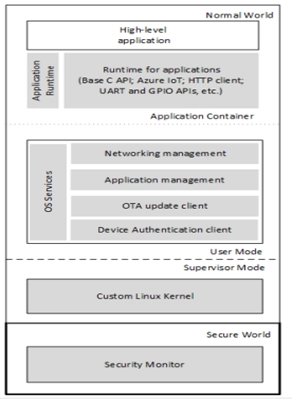
This core establishes trust boundaries between various components. It includes a memory management unit that allows for compartmentalization. This core also houses the MCU's operating system. It runs two distinct operating environments, one of which is known as Normal World (NW). NW executes code in both user and supervisor modes. Secure World (SW) is another operating environment that is in charge of running security monitors.
Cores for real-time processing:
Real-time cores can run either Real-Time Operating Systems or bare metal. They cannot communicate directly with the internet and can only communicate with internal components.
IO Multiplexed
Azure Sphere includes a plethora of IO capabilities. These IO capabilities allow the user to configure their software to meet their specific needs. The real-time operating system and higher layers can connect to IO peripherals.
Microsoft firewall
The Microsoft firewall is used to ensure that all IO peripherals are associated with the appropriate operating system. This firewall, also known as a silicon countermeasure, served as a sandbox. Firewalls enforce compartmentalization, preventing a security threat.
These firewalls are contained within the application core and affect the real-time core's access to its corresponding peripheral.
Software Architecture
An operating system and a high-level application program are part of the software architecture. This application software can interact with the internet as well as the MCU's internal operating system.
The only software component that Microsoft does not provide is high-level application. All other software components are provided by Microsoft and are digitally signed with a Microsoft security certificate. All application software updates are delivered via the Microsft pipeline, which is a trusted stream.
Azure Sphere’s seven properties
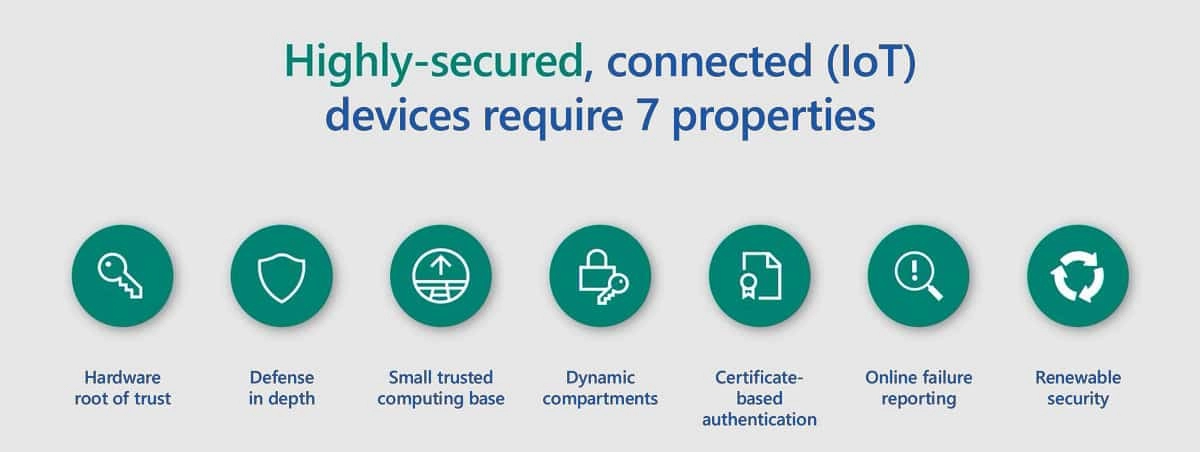
The primary motivation behind Azure Sphere is to provide the highest level of security in IoT devices at the lowest possible cost. Because IoT devices are linked via the internet, any vulnerability in one device's hardware can be used by attackers to gain access to the system. Keeping in mind the limitations mentioned above, as well as Microsoft's extensive experience in the security domain, the Azure Spheres developer designed the seven properties listed below to achieve a high level of security.
The root of Trust based on Hardware: This property confirms that the device and its identity should not be separated, preventing forgery/spoofing on that device. Each Azure Sphere MCU has its own identity. The identity key is generated by the cryptographic pluton subsystem, security microprocessor; thus, a root of trust is established from the factory to the end-user.
Small trustworthy computing: This property ensures that only trusted software is allowed to run on computing hardware. To achieve this property, Azure Sphere runs only authorized Microsoft-based pluton system, platoon security system, and security monitor on its hardware, making computing-based trusted and secure.
Depth of Defense: The defense-in-depth property provides numerous layers of security. Each layer can validate that the upper layer is secure, and thus Azure Sphere can achieve a high level of protection by employing multiple layers.
Compartmentalization: Compartmentalization, also known as dynamic compartmentation, ensures that each component of an MCU contains a countermeasure to potential threats. These components are designed in such a way that a security breach cannot reach another part.
Authentication via certificates: Azure Sphere offers password-free authentication systems that use security certificates instead of passwords. Each software component of Azure Sphere is signed with one of these certificates. Furthermore, these security certificates authenticate device-to-cloud and cloud-to-device communication, making it more secure.
Security for renewal: The renewal security property, as the name implies, ensures that software is automatically updated. The Azure security center can guard against these updates.
Failure notification: The Azure Sphere MCU can report errors to the security center. Denial of service attacks has been the most common source of device-to-cloud attacks. Azure Sphere has an early warning mechanism against potential threats to protect against denial of service attacks.
When to use Azure Sphere
Based on the following criteria, you should consider using Azure Sphere for IoT solutions.
Security: The primary goal of the Azure Sphere platform is to provide End-to-End security at a low cost. Azure Sphere specifically targets limited, price-sensitive microcontroller units that are connected to the Internet. If you have connected microcontroller devices, Azure Sphere is the best option for providing end-to-end security. The Azure Sphere platform is based on the seven characteristics of highly secure devices. This design ensures that your products are completely secure.
Productivity: Productivity is the next point to consider. Data captured in the field over secure and authenticated connections can be used to detect anomalies from individual devices. You make decisions based on operational data insights.
Opportunity: Opportunity is the final factor to consider. Support and engineering personnel can visualize and analyze data to better understand long-term trends.
In this section, we will discuss some of the basic terminologies related to Azure Sphere.
Application capabilities: The resources that software requires are referred to as application capabilities. Application capabilities include, among other things, the peripherals that the application uses, the internet hosts to which a high-level application connects, and the ability to change the network configuration. Every application must have an application manifest that contains information about these resources.
Application containers: The top (fourth) tier of the multi-layer Azure Sphere OS architecture, which provides dynamic compartments for high-level applications that are agile, secure, and robust.
Application manifest: A file containing application metadata and identifying the application capabilities that an application requires. Every application must have a manifest file called app_manifest.json.
Attestation: The procedure for proving a client's configuration to a remote server. An Azure Sphere device attests to the Azure Sphere Security Service (AS3) in order for the service to determine the device's level of trust and integrity.
Azure Sphere operating system: Microsoft's custom, Linux-based microcontroller operating system, runs on an Azure Sphere chip and attaches to the Azure Sphere Security Service as designed.
Azure Sphere project: The collection of files used to create an Azure Sphere application, typically organized into a particular directory and its subdirectories. Every Azure Sphere project includes an application manifest file and at least one source-code file, which is typically the main. c. Azure Sphere projects created with Visual Studio or Visual Studio Code will have an extra subdirectory to accommodate the IDE.
Azure Sphere SDK: The tools, libraries, and header files that allow application developers to create apps for the Azure Sphere device. The Azure Sphere SDK (software development kit) contains all of the tools needed to create and manage applications and deployments. Microsoft provides both a Windows SDK and a Linux SDK.
Azure Sphere tenant: An Azure Sphere Security Service-specific cloud-based entity that represents an organization. The Azure Sphere tenant allows an organization to manage its Azure Sphere devices separately from those of other organizations. Each device is assigned to a single Azure Sphere tenant.
Claiming: The procedure by which an Azure Sphere OEM (original equipment manufacturer) acquires control of a device. Each Azure Sphere machine must be "claimed" by an Azure Sphere tenant in order for the tenant to be aware of all of its devices and manage them as a group. A device cannot be claimed by more than one tenant or moved from one tenant to another.
Dynamic compartments: The implementation of safeguard limits within the hardware and software stacks to prevent a flaw or breach in one component from spreading to other parts of the system. To provide dynamic compartments, Azure Sphere integrates hardware-enforced barriers between software components. One of the seven highly secure device properties.
Sideload: The process of loading software that does not use the Azure Sphere Security Service (AS3) and is done directly with the device, often under the supervision of a software developer, field engineer, or another similar person. Debugging applications are sideloaded by programming environments such as Visual Studio. A developer can also start sideloading by connecting an attached device to the Azure Sphere CLI (command-line interface).
Sysroot: A collection of libraries, header files, and tools used to compile and link a high-level application targeting a specific set of APIs. Some sysroots only support production APIs, while others support both production and beta APIs. The Azure Sphere SDK includes a number of sysroots that target various API sets.
Trusted computing base (TCB): The software and hardware used to create a secure operating environment. The TCB should be reduced to a minimum to reduce the surface area exposed to attackers and the likelihood that a bug or highlight can be used to bypass security safeguards. One of the seven characteristics of highly secure devices is a small TCB. You can also read 8051 Microcontroller Pin Diagram here.
Frequently Asked Questions
What are the primary capabilities of the Azure Cloud Service?
The primary functions of the Azure Cloud Service are as follows:
It is intended to host the running application while also managing the background running application. Web processing is referred to as the "web role," whereas background processing is referred to as the "worker role."
What exactly do you imply by a domain?
The domain is the interconnected and interlinked nodes that are frequently a measure undertaken by the organization.
Differentiate between verbose and minimal monitoring.
Answer: Verbose monitoring collects metrics performance-based that enable close analysis of data fed during application processing, whereas minimal monitoring is a default structure that makes use of performance counters gathered from the host's operating system.
Conclusion
To sum it up, in this blog, we discussed the basics of Azure Sphere, how it works, and its architecture (hardware and software). Then we discussed Azure Sphere's seven properties, and when to use it. Finally, we discussed some basic terminology related to Azure Sphere.








 1+ registered

