Do you think IIT Guwahati certified course can help you in your career?
Introduction
It might be challenging and confusing to start with SALT or SALT_STACK. Numerous terms will be unfamiliar. Being unable to see how everything fits together and how you could benefit from each component makes it harder to understand how things operate as a whole.
An overview of Salt and all of its various terms are intended to be given in this article. The goal is to provide you with an understanding of what the SaltStack framework offers.
Overview of SALT
Configuration Management System: SALT can maintain thousands of remote nodes in specific states. For example, it can ensure certain packages are installed, and services are active. Assume that you have ten, or perhaps 100, servers. Imagine having to manually log into each server one at a time, run the exact instructions on each of the 100 machines, and then modify the configuration files on each of the 100 machines.
You would love to update all your servers at once by simply typing one command to solve those problems. You can find the perfect solution to all of these issues with SaltStack.
A Distributed remote execution system: SALT can run commands and data queries on distant nodes. It can run the commands on specific nodes or by applying arbitrary selection criteria.
An Orchestration tool: Orchestration, in general, is the automatic coordinating and positioning of systems. The orchestration in SALT is done via the orchestrate runner.
Flexible Interface: With the help of a simple and reasonable interface, SALT can quickly handle massive amounts of information from not just a few dozen servers but hundreds or even thousands.
Parallel Execution with Nodes
The capacity to use numerous CPU and I/O resources to carry out a single database operation is known as parallel execution. Using Parallel execution, you can decrease the Response times for data-intensive tasks on large datasets.
To perform Parallel Execution with remote systems, the primary duties of SALT are:
Enabling parallel instead of serial systems calls for commands to remote systems.
Utilise a protocol that is encrypted and safe.
Employ the quickest and lowest feasible network payloads.
Provide a simple and direct programming interface to the systems.
Additionally, Salt expands the range of remote execution controls by enabling systems to be targeted by hostname and system attributes.
How Components of SALT Communicate?
SALT uses a variety of methods and technologies. Let’s discuss some of the leading technologies used to communicate by SALT Components.
ZeroMQ: The networking layer of SALT is constructed with the outstanding ZeroMQ networking framework. ZeroMQ is a short and lightweight messaging library. The underlying implementation is done in C/C++, with native versions also available for Java and other languages. ZeroMQ is a peer-to-peer messaging system without a broker. You may quickly create a complex communication network with ZeroMQ.
AMQ broker: The Salt daemon features an effective and transparent AMQ broker. It is a multiprotocol message broker made entirely of Java. AMQ Broker includes advanced high-availability options and quick message persistence. You may integrate message-based communication into any application using the AMQ Client's messaging APIs.
AES Encryption: Authentication and encryption are essential components of Salt. It employs quicker AES encryption for payload transmission after using public keys for authentication with the master daemon.
The symmetric block cipher, the Advanced Encryption Standard (AES), protects sensitive data. To encrypt sensitive data, AES is used in hardware and software worldwide.
Message pack: Salt uses msgpack communication to enable quick and minimal network usage. The message_pack enables data transmission across many languages, much like JSON. It is an effective binary serialisation format. It is smaller and faster.
SALT Client Interface
The SALT client connects with the SALT master to issue commands, obtain responses, and display them to the user. It runs on the same machine as the salt master.
SALT execution routines can be designed as simple Python modules to support easy expansion. The master server or any other programme you choose may gather the information from SALT executions.
You may use SALT to run standalone tasks and function as an essential component of a bigger application because it can be called from a simple Python API or the command line. SALT provides many entry points into Python applications. Popular names for these entry points include*Client() APIs. Each client uniquely uses SALT, either through the master or minions.
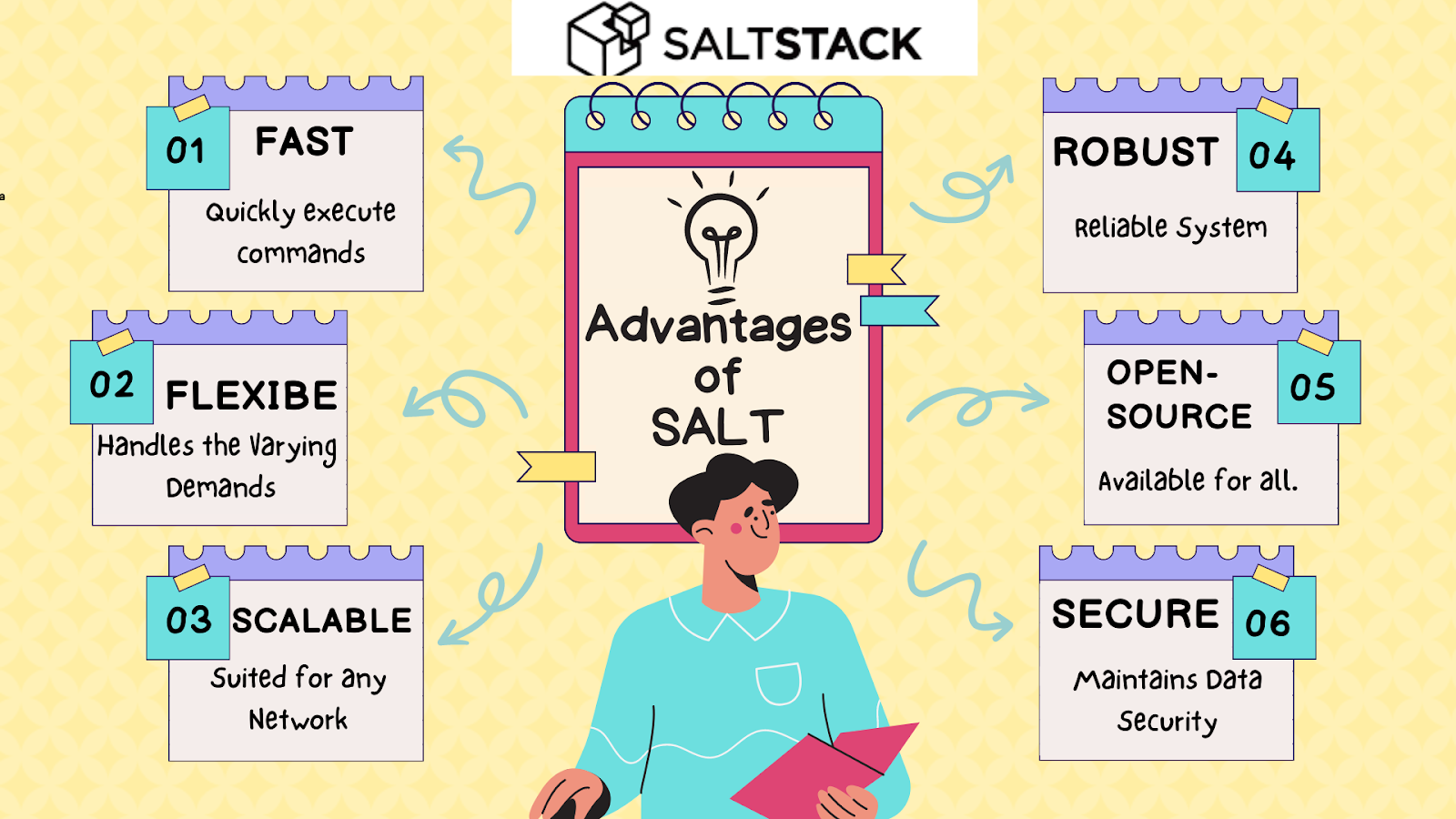
Advantages of SALT
SALT offers many advantages due to its simplicity and feature-richness. Some of the benefits are listed below.
Fast: The outcome of using SALT is a system that can quickly execute commands on target server groups, including one to many servers.
Flexible: Salt offers a single remote execution architecture that can handle the varying demands of any number of servers and is incredibly quick, simple to set up, and flexible.
Scalable: A system that is both scalable and practical, suited for any network, is produced by combining the best aspects of the remote execution industry with the Salt infrastructure.
Robust: Thousands of systems can use the Salt framework, which is robust and powerful.
Open-source: The Apache 2.0 licence governs Salt's development and can be applied to open-source and paid projects.
Frequently Asked Questions
What is a Salt Master?
The core idea of Salt is that of a Master who commands one or more Minions. The Master is the Central Management System. Executed on managed systems, the Salt minion communicates with Salt Master via instructions and configurations. Linux is the default operating system for the Salt Master, although any other system can be a minion.
What is a Minion?
Your servers, which power your apps and services, are called salt minions. These are the managed systems that respond to commands from Salt Master. The Salt master can target commands to particular minions by using the ID assigned to each minion.
How to configure Salt Master and Minions?
The master configuration file is used to configure the salt master, and the minion configuration file is used to configure the salt minion. By default, the salt-configuration master's file may be found in /etc/salt/master. The directory /etc/salt/master.d/*.conf can have atomic included configuration files. The inclusion of files with different extensions than .conf is not supported.
Conclusion
We ran through the introduction of the SALT stack. We started our discussion with an overview of SALT. Further, we discussed the parallel execution of nodes, communication of components of the SALTStack, Client Interface, and the benefits of the SALT.
We hope this blog has helped you. We recommend you visit our articles on different SALT topics, such as







 5+ registered

