

Table of contents
1.
Introduction
2.
Features
2.1.
JPA
2.2.
Hibernate
3.
Advantages
3.1.
JPA
3.2.
Hibernate
4.
Disadvantages
4.1.
JPA
4.2.
Hibernate
5.
JPA vs. Hibernate
6.
Frequently Asked Questions
6.1.
What exactly is JPQL?
6.2.
What is ORM?
6.3.
Is JPA an ORM?
6.4.
What is hibernate?
7.
Conclusions
Last Updated: Mar 27, 2024

JPA vs. Hibernate

Author Ayush Mishra
1 upvote
Career growth poll
Do you think IIT Guwahati certified course can help you in your career?

Introduction

A Java specification called JPA (Java Persistence API) is used to manage and persist data across Java objects and relational databases. It is regarded as the industry-standard methodology for object-relational mapping.

JPA illustrates how to define a POJO (Plain Old Java Object) as an entity and maintain relations with it using specific meta settings.

Hibernate is a free, open-source ORM (Object Relational Mapping) solution that offers any Java application Object-Relational persistence and query service. It implements the Java Persistence API, one of the most used ones. Because Java objects can be more readily mapped to databases, common persistence-related programming tasks are made more accessible.

This blog will look at all the points of JPA vs. Hibernate.

Features

Let us discuss some of the key features of JPA vs. Hibernate.

JPA

  • JPA supports pluggable third-party persistence providers like Hibernate and Toplink.
  • A model class can employ annotation defaults, which expedites development and reduces costs.
  • JPA enables you to create a vendor-neutral persistence layer that supports any persistence provider.
  • Additionally, the JPA application can be set up to create a database schema based on the persistence model.
  • Switching to the best-performing persistence provider is likewise reasonably simple. Moving to any commercial persistence provider is simple.
  • JPA enables polymorphic queries, polymorphism, and inheritance.
  • JPA supports both static and dynamic queries.

Hibernate

  • For developers to utilize and incorporate into their Java applications, Hibernate is open-source software for which the source code is available.
  • Hibernate has a capability that automatically creates the database table, and programmers don't have to worry about how to implement queries. Hibernate operates independently.
  • Hibernate adheres to the inheritance principle.
  • One-to-one, one-to-one, one-to-many, and many-to-many relationships are all supported by the Hibernate framework.
  • Hibernate offers a slow loading capability; utilizing this idea only fetches the essential objects for execution, improving application efficiency.
Advantages

This section will look at the advantages of using both JPA vs. Hibernate.

JPA

  • JPA supports POJO-POJI model programming.
  • JPA is Light –Weight technology to develop DB independent persistence logic. 
  • O/R mapping and database access processing make programming tasks simple.
  • The code required to create definition files is reduced using annotations.

Hibernate

  • While storing the records in the database, Hibernate can construct primary keys automatically.
  • Hibernate features its database-independent query language called the hibernate query language.
  • Hibernate supports mechanisms for caching. Adopting this caching strategy will improve an application's performance naturally as fewer round trips between the application and the database are required.
  • In addition to XML, Hibernate also supports annotations.

Disadvantages

This section will look at the disadvantages of using both JPA vs. Hibernate.

JPA

  • JPA is a specification, not a product, so you need a provider to offer an implementation to take advantage of these standards-based APIs.
  • Before it is stable, the JPA specification may need to go through significant changes.

Hibernate

  • Some queries supported by JDBC by Hibernate are not supported. To insert each object, a developer must create a different query.
  • The number of tables in a small project will be lower. Thus it would be unnecessary to introduce the complete Hibernate framework.
  • Understanding the code is challenging because we must define the mapping and input data into the XML file when there are joins and mappings between the tables.

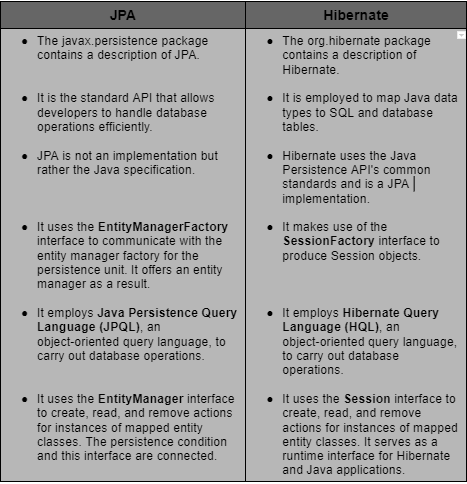
JPA vs. Hibernate

Here are some of the differences between JPA vs. Hibernate,

                                                              JPA vs Hibernate

Frequently Asked Questions

What exactly is JPQL?

The Java Persistence Query Language (JPQL) is a term that refers to the JPA specification. It is applied when creating the queries.

What is ORM?

The term "ORM" stands for "Object/Relational Mapping." The mapping of objects to the data kept in the database is a programming technique. It makes data access, data manipulation, and data generation easier.

Is JPA an ORM?

JPA is regarded as a typical ORM strategy. It is a Java specification used to manage and persist data between relational and Java object databases.

What is hibernate?

Hibernate is an open-source, compact ORM utility for storing, modifying, and retrieving data from databases.

Conclusions

Congrats on finishing the blog! This blog covered all the necessary points about JPA vs. Hibernate. We also discussed the various advantages of JPA vs. Hibernate and the disadvantages of using JPA vs. Hibernate. As a windup, we discussed some differences between JPA and Hibernate.

If you want to explore more blogs on this topic, please follow these blogs especially curated for readers like you - JDBCJDBC ConnectionGuide to ORMSpring Boot, JDBC  Hibernate Interview Questions.

Please refer to our guided pathways on Code studio to learn more about DSACompetitive ProgrammingJavaScriptSystem Design, etc. Enroll in our courses, and use the accessible sample exams and questions as a guide. For placement preparations, look at the interview experiences and interview package.

Please do upvote our blogs if you find them helpful and informative!

Happy learning!

Live masterclass


