Do you think IIT Guwahati certified course can help you in your career?
Introduction
AI has been growing and reducing the gap between the capabilities of humans and machines. The researchers work on various characteristics to make extraordinary things happen. One such area is the domain of deep learning. This field aims to train machines to view the world as humans do. It is constructed and improved with time, primarily over one particular algorithm; aConvolutional Neural Network.
A Convolutional Neural Network is the Artificial Neural Network most frequently applied to analyze images. This article will discuss LeNet5, one of the Convolution Neural Network applications. So, let us discuss what LeNet5 is.
What is LeNet5?
LeNet5 is one of the applications of the Convolution Neural Network. Yann LeCun developed it in 1989. CNN is a feed-forward neural network whose neurons can respond to the neighboring neurons and performs magnificently in a wide range of image processing.
Before we understand the architecture of LeNet5, make sure you know the basic terms of Convolution Neural Network to revise this article.
Architecture of LeNet5
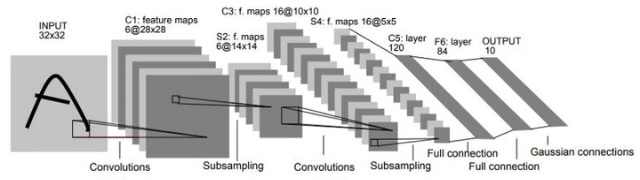
LeNet5 is a network made up of 7 layers. It consists of 3 convolution layers, two subsampling layers, and two fully connected layers.
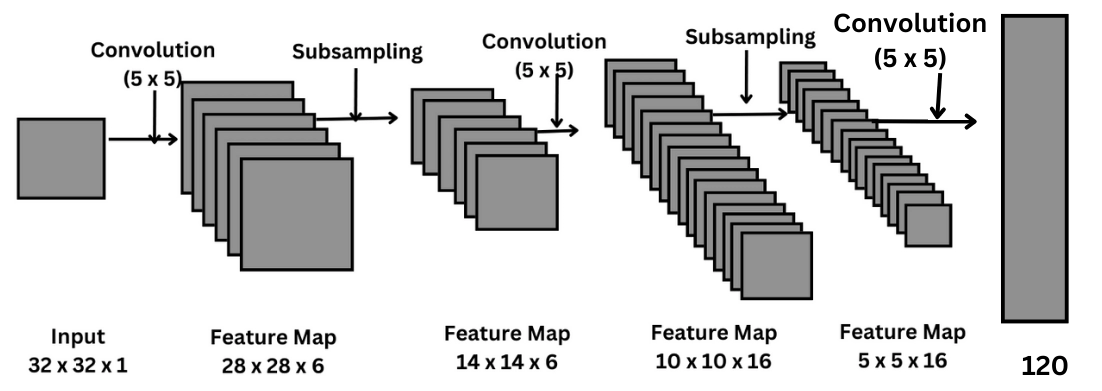
As shown in the picture, the input layer is the initial layer. However, this layer is not considered a network layer as nothing is learned at this layer. This layer's only role is to take an image of 32x32 as input and pass it on to the next layer.
First layer
After this, the first convolution step takes place, and the input image is convoluted to the size of 28x28.
Second layer
Next is the subsampling layer, in which the size is reduced to half, i.e., 14x14.
Third layer
In the third layer, convolution occurs again, but this time with 16 filters of 5x5 size. After this layer, the size of the input image is reduced to 10x10x16.
Fourth layer
The subsampling takes place, and the image size in this step is reduced to 5x5x16. In this layer, the input for the very last function diagram comes from all the remaining function diagrams.
Fifth layer
This is the final layer of the convolution-subsampling pair.
There are 120 filters in this layer with a convolution size of 5x5. After this layer, the feature map is 1x1x120, and the flattened result is 120 values.
Sixth layer
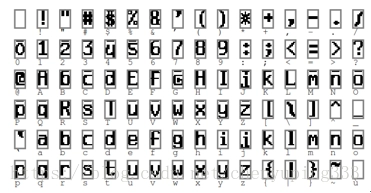
After the convolution-subsampling, pairs come to the fully connected layer. It consists of 84 nodes with a -1 (for white) and +1 (for black) code.
Credit: hackmd.io
It is referred as a layer of convolutional in preference to an ultimately linked layer because the input of LeNet5 becomes large. Its shape stays unchanged, then its output length is more prominent than 1x1, i.e., now no longer a linked layer.
Seventh layer
The last layer is the output layer, which is also fully connected to 10 nodes.
Each node represents a number between 0 and 9.
Summary of the architecture of LeNet5
Implementation of LeNet5
To implement LeNet5, we will work on the Fashion MNIST dataset.
First, we will import the necessary libraries.
# Importing essential libraries
import tensorflow as tf
from tensorflow.keras import Model, layers
from tensorflow.keras.datasets import fashion_mnist
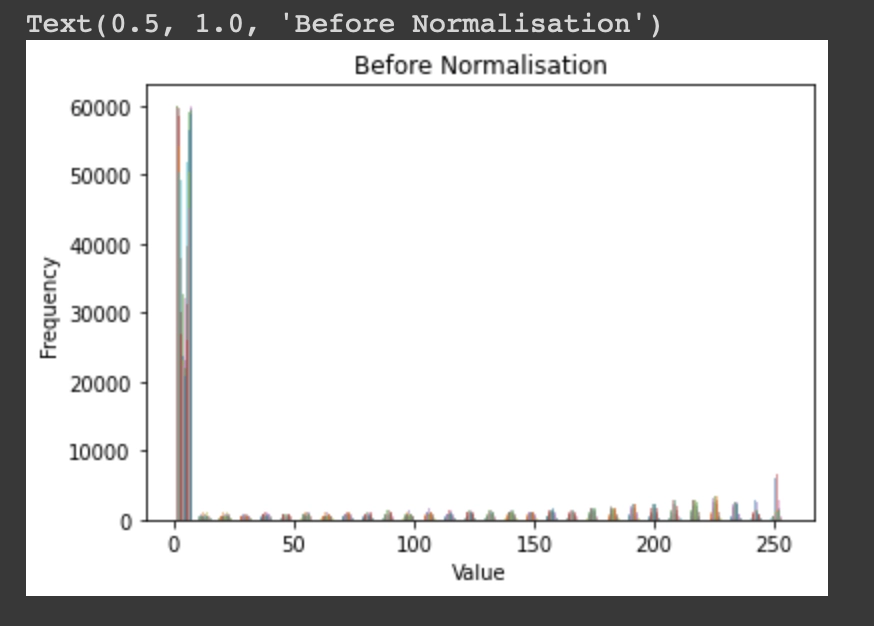
Next, we will load the Fashion MNIST dataset and divide them into training and testing datasets. Then normalise the dataset.
The graphical representation before normalisation is:
The histogram after normalisation would be:
Now after creating the training and testing datasets and reshaping them, we will implement the model.
# Defining the LeNet-5 model
class LeNet5(Model):
    def __init__(self):
        super(LeNet5, self).__init__()
        self.conv1 = layers.Conv2D(filters=6, kernel_size=(5, 5), activation='relu', input_shape=(28, 28, 1))
        self.pool1 = layers.MaxPooling2D(pool_size=(2, 2), strides=2)
        self.conv2 = layers.Conv2D(filters=16, kernel_size=(5, 5), activation='relu')
        self.pool2 = layers.MaxPooling2D(pool_size=(2, 2), strides=2)
        self.flatten = layers.Flatten()
        self.fc1 = layers.Dense(units=120, activation='relu')
        self.fc2 = layers.Dense(units=84, activation='relu')
        self.fc3 = layers.Dense(units=10, activation='softmax')

    def call(self, inputs):
        x = self.conv1(inputs)
        x = self.pool1(x)
        x = self.conv2(x)
        x = self.pool2(x)
        x = self.flatten(x)
        x = self.fc1(x)
        x = self.fc2(x)
        x = self.fc3(x)
        return x

# Create an instance of the LeNet-5 model
model = LeNet5()

# Compiling the model
model.compile(optimizer='adam', loss='sparse_categorical_crossentropy', metrics=['accuracy'])

# Training the model
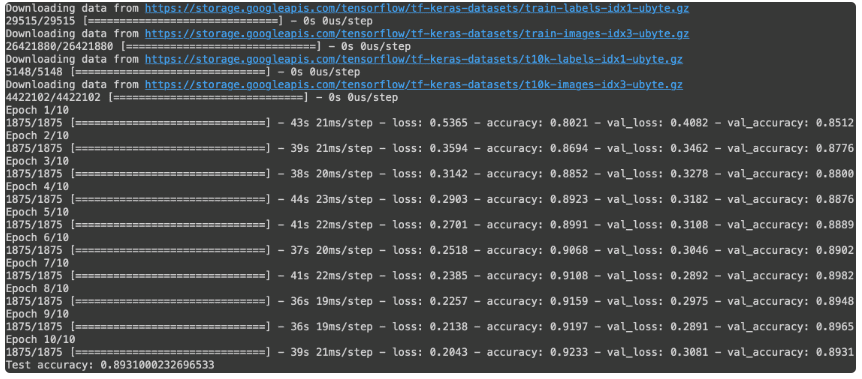
history = model.fit(x_train, y_train, batch_size=32, epochs=10, validation_data=(x_test, y_test))

# Evaluating the model on the test set
test_loss, test_acc = model.evaluate(x_test, y_test, verbose=0)
print('Test accuracy:', test_acc)
Output:
Advantages and disadvantages of LeNet5
Now, we will discuss the advantages and disadvantages of LeNet5:
Initially, Lenet was used for handwritten digit identification. Hence, it was able to outplay all other significant models. The architecture of LeNet5 was relatively easy, with only five layers of Convolution and sub-sampling.
Later, two more layers were added to improve its performance. The significant advantage of LeNet-5 is that it consists of a convolution layer with stride two and an Average pooling layer with stride 1.
On the contrary, LeNet-5 is not applied widely; instead, AlexNet and VGG-16 Net are used as they consist of deeper layers resulting in accurate classifications.
Nowadays, most commonly and widely, LeNet-5 is used to detect handwriting and match handwritten cheques by banks.
Earlier, LeNet5 was used in banks to detect the handwriting on the cheques.
Is Alexnet better than LeNet5?
AlexNet consists of 8 more layers than LeNet5, which results in more accurate classification. Therefore, AlexNet is better than LeNet5.
How many layers are there in LeNet5?
LeNet5 has seven layers: three convolution layers, two pooling layers, and two fully connected layers.
Why is LeNet5 so in demand?
The primary reason behind the popularity of LeNet5 is its simple and straightforward architecture. It is a multi-layer convolution neural network for classifying an image.
Conclusion
In this article, we extensively discussed the LeNet5 topic and its implementation in Python. We hope that this blog has helped you enhance your knowledge regarding LeNet5. You can check out our other blogs,












 5+ registered

