Get a skill gap analysis, personalised roadmap, and AI-powered resume optimisation.
OLAP (Online Analytical Processing) operations in DBMS help users analyze multidimensional data from different perspectives. They involve querying large volumes of data to extract meaningful insights for decision-making. OLAP operations consist of roll-up, drill-down, slice, dice, and pivot, which allow users to navigate and manipulate data across various dimensions and hierarchies.
In this article, we will discuss OLAP Operations in DBMS in detail.
What is OLAP?
OLAP, for Online Analytical Processing, is a class of software that enables users to extract and analyze business data from various angles. It uses pre-calculated and pre-aggregated data from various databases to enhance the data analysis.
Multiple data structures called OLAP cubes are used to organize OLAP databases.
What is OLAP Cube?
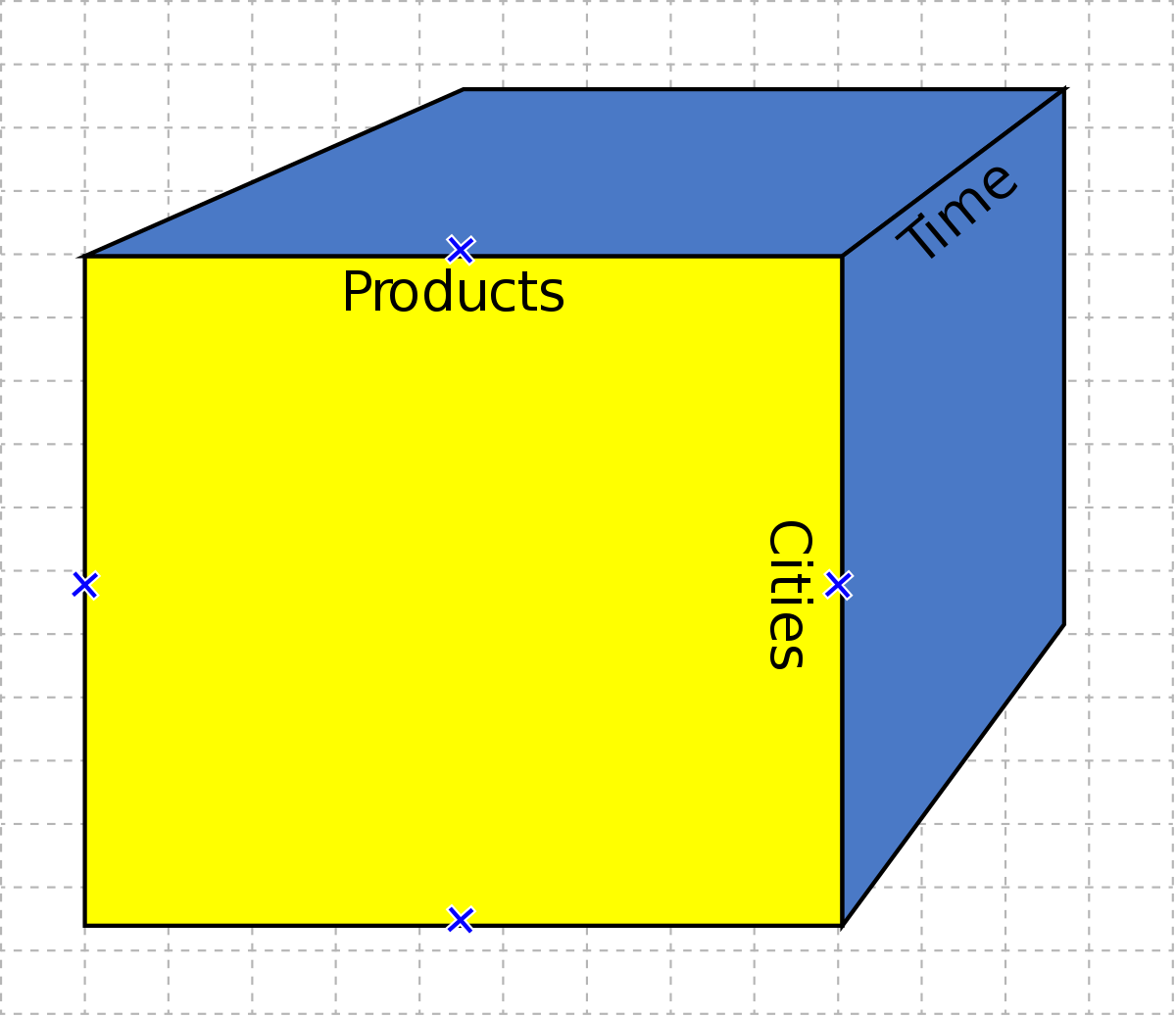
The OLAP cube, also known as the Hypercube, is a unique data structure designed for extremely fast multidimensional data analysis and storage. It is a snapshot of data taken at a specific time. Users can run multidimensional analytical queries on the data using OLAP cubes.
Types of OLAP Servers
The three main types of OLAP systems are as follows:
1. Relational OLAP (ROLAP)
These systems work with relational databases directly in OLAP operations, retrieving data using sophisticated SQL queries. Although processing large amounts of data is slower, it can handle them.
2. Multidimensional OLAP (MOLAP)
It is also referred to as the original OLAP. It stores data using a multidimensional array storage system that has been optimized. Positional techniques are used to access the data physically stored in multidimensional arrays.
3. Hybrid OLAP (HOLAP)
It combines ROLAP and MOLAP using a best-of-both-worlds strategy. It offers both the rapid computation functionality of MOLAP systems and the high scalability feature of ROLAP systems.
OLAP operations extract insights from the data stored in multidimensional hypercubes. These actions consist of the following:
Drill Down
Roll Up
Dice
Slice
Pivot
Let’s discuss them in detail.
1. Drill Down
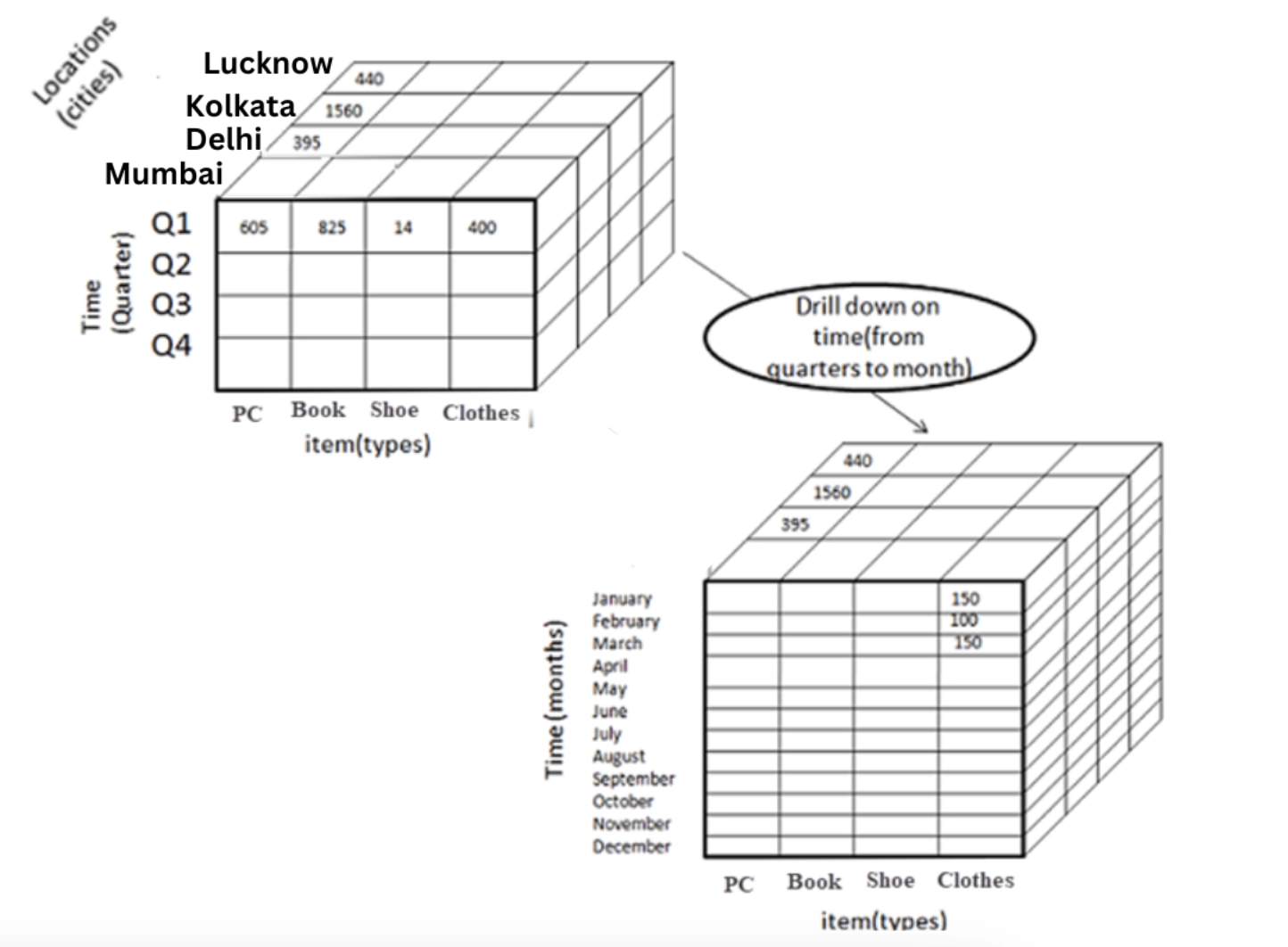
When using drill-down OLAP operations, a user can zoom in on the data cube, turning less detailed data into highly detailed data. It can be implemented by either adding more dimensions to the Hypercube or stepping down a concept hierarchy for a dimension.
Example:
From the above diagram:-
1. January, February, and March three months make up Quarter Q1. Four Quarters are drill-down to twelve months.
2. Months are added as a dimension in this example.
2. Roll Up
A drill-up OLAP operation, called an aggregation operation, is the opposite of a drill-down operation. It is a dimension reduction method that aggregates data from a data cube. Combining related dimensions along any axis, it can be done and results in less granular data.
Example:
In the above example, India has comprised Lucknow and Kolkata cities. Lucknow and Kolkata each had 440 and 1560 sales, respectively. After roll-up, they become 2000. Data location hierarchy is moved up in this aggregation process from city to country. Removing at least one or more dimensions during the roll-up process is necessary. Cities dimension is removed in this illustration.
3. Dice
Dice Operation is used to create a new sub-cube from the existing Hypercube using the dice operation. It chooses two or more dimensions from the Hypercube to create a new sub-cube for the supplied data.
In the above example, the sub-cube is selected based on the following dimensions with criteria:-
1. Location: “Mumbai” or “Delhi”
2. Time: “Q1” OR “Q2”
3. Item: “Mobile” or “Modem”
4. Slice
With the help of the slice in OLAP operations, a new sub-cube can be created by choosing just one dimension from the given cube. It presents the data from an alternative angle.
Example:
In the above example, the slice is performed only on one dimension “Q1”.
5. Pivot
It is employed to give users of the data another way to view it. As it rotates the cube's orientation to view the data from various angles, it is known as the "rotate operation."
Example:
Advantages of OLAP Operations
The advantages of OLAP Operations are given below:-
1. You can extract data for complicated analyses using OLAP systems.
2. Due to the multi-dimensional schema of an OLAP database, it can support complex queries involving numerous data facts from both recent and historical data.
3. Response times in OLAP are hundreds of times slower than in OLTP.
4. OLAP systems don't change the already existing data, so they require fewer backups.
Disadvantages of OLAP Operations
The disadvantages of OLAP Operations are given below:-
1. Redundant information and latency.
2. Almost all relational databases employ some form of SQL language to carry out operations. For data retrieval and computation, OLAP cubes may need additional languages.
3. Some OLAP systems perform significantly worse as data volumes or the number of dimensions being analyzed increase, and they perform best with a small amount of data.
OLAP (Online Analytical Processing) is used for multidimensional data analysis, allowing firms to quickly and effectively run sophisticated queries on huge datasets and get new insights.
What are OLAP operations in data mining?
The five types of OLAP operations are drill down, roll up, slice, dice, and pivot. This enable users to explore data from many levels and dimensions within a data cube.
What is OLAP and OLTP?
Online Analytical Processing (OLAP) is used for in-depth, read-intensive data analysis, whereas Online Transaction Processing (OLTP) is used for frequent, write-intensive database operations.
What is OLAP vs data mining?
When it comes to supporting decision-making, OLAP focuses on querying and analysing multidimensional data, whereas data mining looks for patterns, trends, and insights within data, frequently utilising machine learning techniques.
What are OLAP tools?
Microsoft SQL Server Analysis Services (SSAS), Oracle Essbase, IBM Cognos TM1, SAP Business Warehouse, MicroStrategy and Apache Kylin are some of the OLAP tools.
Why is OLAP faster than OLTP?
OLAP (Online Analytical Processing) is faster than OLTP (Online Transaction Processing) for querying because it uses optimized data structures like star schemas and pre-aggregated data, specifically designed for complex queries and analysis, not transaction speed.
Conclusion
In this article, we have talked about OLAP operations in DBMS, like roll-up, drill-down, slice, dice, and pivot. We discussed their advantages in analyzing multidimensional data for decision-making. Moreover, we explained the different types of OLAP servers and their characteristics. Lastly, we saw its advantages and disadvantages also.
We hope this blog has helped you enhance your knowledge of OLAP Operations in DBMS. Do not stop learning! We recommend you read some of our DBMS articles:
Refer to our Guided Path to upskill yourself! If you want to test your competency in coding, check out the mock test series and participate in the contests hosted on Code 360









 5+ registered

