Implementаtion of Online Exam Project in Java Swing without database
import java.awt.*;
import java.awt.event.*;
import javax.swing.*;

class OnlineTest extends JFrame implements ActionListener {
	JButton btnNext, btnBookmark;
	JLabel label;
	ButtonGroup bg;
	int m[] = new int[15];
	JRadioButton radioButton[] = new JRadioButton[5];
	int current = 0,count = 0, x = 1, y = 1, now = 0;

	OnlineTest(String s) {
		super(s);
		label = new JLabel();
		add(label);
		bg = new ButtonGroup();

		for (int i = 0; i < 5; i++) {
			radioButton[i] = new JRadioButton();
			add(radioButton[i]);
			bg.add(radioButton[i]);
		}

		btnNext = new JButton("Next Question");
		btnBookmark = new JButton("Bookmark Question");
		btnNext.addActionListener(this);
		btnBookmark.addActionListener(this);
		add(btnNext);
		add(btnBookmark);
		set();
		label.setBounds(30, 40, 450, 20);
		radioButton[0].setBounds(50, 80, 450, 20);
		radioButton[1].setBounds(50, 110, 200, 20);
		radioButton[2].setBounds(50, 140, 200, 20);
		radioButton[3].setBounds(50, 170, 200, 20);
		btnNext.setBounds(100, 240, 150, 30);
		btnBookmark.setBounds(270, 240, 200, 30);
		setDefaultCloseOperation(JFrame.EXIT_ON_CLOSE);
		setLayout(null);
		setLocation(250, 100);
		setVisible(true);
		setSize(700,600);
		Color c = new Color(255,150,0);
		getContentPane().setBackground(c);
	}


	/* handle all event */
	public void actionPerformed(ActionEvent e) {
		if (e.getSource() == btnNext) {
			if (qcheck())
				count = count + 1;
			current++;
			set();
			if (current == 14) {
				btnNext.setEnabled(false);
				btnBookmark.setText("Result");
			}
		}

		if (e.getActionCommand().equals("Bookmark Question")) {
			JButton bk = new JButton("Bookmark " + x);
			bk.setBounds(480, 20 + 30 * x, 150, 30);
			add(bk);
			bk.addActionListener(this);
			m[x] = current;
			x++;
			current++;
			set();
			if (current == 14)
				btnBookmark.setText("Score");
			setVisible(false);
			setVisible(true);
		}

		for (int i = 0, y = 1; i < x; i++, y++) {
			if (e.getActionCommand().equals("Bookmark" + y)) {
				if (qcheck())
					count = count + 1;
				now = current;
				current = m[y];
				set();
				((JButton) e.getSource()).setEnabled(false);
				current = now;
			}
		}

		if (e.getActionCommand().equals("Result")) {
			if (qcheck())
				count = count + 1;
			current++;
			JOptionPane.showMessageDialog(this,"You have answered " + count + " Questions correctly" );
			System.exit(0);
		}
	}


	/* SET Questions with options */
	void set() {
		radioButton[4].setSelected(true);
		if (current == 0) {
			label.setText("Que1:  Who invented C++?");
			radioButton[0].setText("Dennis Ritchie");
			radioButton[1].setText("Ken Thompson");
			radioButton[2].setText("Brian Kernighan");
			radioButton[3].setText("Bjarne Stroustrup");
		}
		if (current == 1) {
			label.setText("Que2:  Which concept allows you to reuse the written code?");
			radioButton[0].setText("Encapsulation");
			radioButton[1].setText("Abstraction");
			radioButton[2].setText("Inheritance");
			radioButton[3].setText(" Polymorphism");
		}
		if (current == 2) {
			label.setText("Que3: Which of the following user-defined header file extension used in c++?");
			radioButton[0].setText("hg");
			radioButton[1].setText("cpp");
			radioButton[2].setText("h");
			radioButton[3].setText(" hf");
		}
		if (current == 3) {
			label.setText("Que4: Wrapping data and its related functionality into a single entity is known as _____________");
			radioButton[0].setText(" Abstraction");
			radioButton[1].setText("Encapsulation");
			radioButton[2].setText("Polymorphism");
			radioButton[3].setText("Modularity");
		}
		if (current == 4) {
			label.setText("Que5:  Which of the following correctly declares an array in C++?");
			radioButton[0].setText(" array{10};");
			radioButton[1].setText("array array[10];");
			radioButton[2].setText("int array;");
			radioButton[3].setText("int array[10];");
		}
		if (current == 5) {
			label.setText("Que6: Which of the following is a correct identifier in C++?");
			radioButton[0].setText("VAR_1234");
			radioButton[1].setText(" $var_name");
			radioButton[2].setText("7VARNAME");
			radioButton[3].setText("7var_name");
		}
		if (current == 6) {
			label.setText("Que7:  Which component is used to compile, debug and execute the java programs?");
			radioButton[0].setText("JRE");
			radioButton[1].setText("JIT");
			radioButton[2].setText("JDK");
			radioButton[3].setText("JVM");
		}
		if (current == 7) {
			label.setText("Que8:  Which one of the following is not a Java feature?");
			radioButton[0].setText("Object-oriented");
			radioButton[1].setText("Use of pointers");
			radioButton[2].setText("Portable");
			radioButton[3].setText("Dynamic and Extensible");
		}
		if (current == 8) {
			label.setText("Que9: Which of these cannot be used for a variable name in Java?");
			radioButton[0].setText("identifier & keyword");
			radioButton[1].setText("identifier");
			radioButton[2].setText("keyword");
			radioButton[3].setText("none of the mentioned");
		}
		if (current == 9) {
			label.setText("Que10: What is the extension of java code files?");
			radioButton[0].setText(".js");
			radioButton[1].setText(".txt");
			radioButton[2].setText(".class");
			radioButton[3].setText(".java");
		}
		if (current == 10) {
			label.setText("Que11: Which is more effective while calling the C++ functions?");
			radioButton[0].setText("call by object");
			radioButton[1].setText("call by pointer");
			radioButton[2].setText("call by value");
			radioButton[3].setText("call by reference");
		}
		if (current == 11) {
			label.setText("Que12: Which of the following is used to terminate the function declaration in C++?");
			radioButton[0].setText(";");
			radioButton[1].setText("]");
			radioButton[2].setText(")");
			radioButton[3].setText(":");
		}
		if (current == 12) {
			label.setText("Que13: Which keyword is used to define the macros in c++?");
			radioButton[0].setText(" #macro");
			radioButton[1].setText("#define");
			radioButton[2].setText("macro");
			radioButton[3].setText("define");
		}
		if (current == 13) {
			label.setText("Que14:  The C++ code which causes abnormal termination/behaviour of a program should be written under _________ block.");
			radioButton[0].setText("catch");
			radioButton[1].setText(" throw");
			radioButton[2].setText("try");
			radioButton[3].setText("finally");
		}
		if (current == 14) {
			label.setText("Que15: Which of the following symbol is used to declare the preprocessor directives in C++?");
			radioButton[0].setText("$");
			radioButton[1].setText("^");
			radioButton[2].setText("#");
			radioButton[3].setText("*");
		}

		label.setBounds(30, 40, 450, 20);
		for (int i = 0, j = 0; i <= 90; i += 30, j++)
			radioButton[j].setBounds(50, 80 + i, 200, 20);
	}

	/* declare right answers. */
	boolean qcheck() {
		if (current == 0)
			return (radioButton[3].isSelected());
		if (current == 1)
			return (radioButton[2].isSelected());
		if (current == 2)
			return (radioButton[2].isSelected());
		if (current == 3)
			return (radioButton[1].isSelected());
		if (current == 4)
			return (radioButton[3].isSelected());
		if (current == 5)
			return (radioButton[0].isSelected());
		if (current == 6)
			return (radioButton[1].isSelected());
		if (current == 7)
			return (radioButton[1].isSelected());
		if (current == 8)
			return (radioButton[2].isSelected());
		if (current == 9)
			return (radioButton[3].isSelected());
		if(current == 10)
			return(radioButton[3].isSelected());
		if(current == 11)
			return(radioButton[0].isSelected());
		if(current == 12)
			return(radioButton[1].isSelected());
		if(current == 13)
			return(radioButton[2].isSelected());
		if(current == 14)
			return(radioButton[2].isSelected());
		return false;
	}

	public static void main(String s[]) {
		new OnlineTest("Online Exam Portal");
	}
}

You can also try this code with Online Java Compiler
Output
Exam portal view of Online Exam Project in Java Swing without database

Bookmark view of Online Exam Project in Java Swing without database
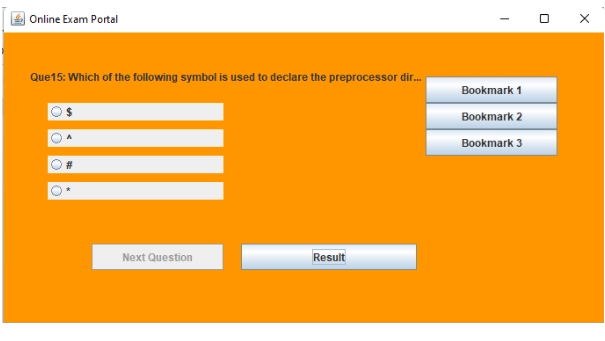
Result view layout of Online Exam Project in Java Swing without database

Frequently Asked Question
What is Java Swing used for?
Swing is a collection of software elements for Java programmers, that enables the creation of graphical user interface (GUI) elements like buttons and scroll bars that are independent of the windowing system for a particular operating system.
Is Java Swing different from Java?
Java is used to write Swing components. The Java Foundation Classes include it (JFC).
Is Java Swing a framework?
Swing is a framework that relies on components, and all of its components eventually derive from the JComponent class.
What is AWT and Swing?
The two toolkits for creating interactive Graphical User Interfaces are AWT and Swing (GUI). The primary distinction between AWT and Swing in Java is that Swing is a GUI widget toolkit for Java that is an extension of AWT, whereas AWT is Java's traditional platform-dependent, graphics, and user interface widget toolkit.
What is a JFrame in Java?
A top-level container called JFrame offers a window on the screen. In reality, a frame serves as the foundational window onto which other elements such as the menu bar, panels, labels, text fields, buttons, etc.
Conclusion
In this article, we have extensively discussed how the project URL source generator in Java
We hope that this blog has helped you enhance your knowledge regarding java swing applications and if you would like to learn more, check out our articles on
Refer to our guided paths on Coding Ninjas Studio to learn more about DSA, Competitive Programming, JavaScript, System Design, etc.
Enroll in our courses and refer to the mock test and problems available.
Take a look at the interview experiences and interview bundle for placement preparations.

Do upvote our blog to help other ninjas grow.
Happy Coding!








 1+ registered

