Do you think IIT Guwahati certified course can help you in your career?
Introduction
A web service provides software application resources through networks by utilising standard technologies. Web services can interact because they are built on standard interfaces and run on multiple operating systems and languages. As a result, they are an ideal technique for developing distributed applications that must integrate several systems over a network. Web services have many benefits and advantages which we will see in this article, so let's begin our journey with full concentration.
Web Service
A Web service is any program, cloud technology ,or application solution designed to allow bidirectional application-to-application or machine-to-machine communication across a network. They enable various apps to communicate and share data in real-time.
Web services define a recognized method of connecting Web-based applications utilizing open standards such as XML, SOAP, WSDL, and UDDI across an Internet protocol backbone.
XML is used to tag data,
SOAP is used to transmit data,
WSDL is used to describe accessible services.
UDDI is used to list which services are available.
Web services, which are largely used by businesses to connect with clients, allow organizations to transmit data without detailed knowledge of each other's IT systems behind the firewall.
Web services are platform and technology neutral, a major element of interoperability. This implies that they may be built in a wide range of programming languages while still communicating - independent of the operating system or device type - by sharing data among clients and servers. A web service, for example, can allow a .NET program to exchange information with a Java application and vice versa.
How does a Web Service Work?
The diagram above represents a simplified representation of how a web service might function. The client would send a series of web service queries to a server hosting the web service.
These queries are made via a technique known as remote procedure calls. Remote Procedure Calls (RPC) are requests to methods hosted by the appropriate web service.
Amazon, for example, provides a web service that displays pricing for things sold online through amazon.com. The front end or display layer can be written in .Net or Java, but any programming language or operating system can connect with the web service.
The data that is exchanged between the client and the server is the essential component of a web service architecture, and it is XML. XML (Extensible markup language) is an intermediate language that is understood by numerous programming languages and is a counterpart to HTML.
When apps communicate with one another, they do so in XML. This provides a common platform for applications written in multiple programming languages to communicate with one another.
For transmitting XML data between applications, web services employ SOAP (Simple Object Access Protocol). The data is transmitted over standard HTTP. A SOAP message is data that is transmitted from the web service to the application. The SOAP message is simply an XML document. The client application that calls the web service can be created in any programming language because the content is written in XML.
Functions of Web Service
A web service's essential functions include the following:
Web Service employ a standardized messaging and tagging system based on JSON or XML.
Web services are accessible via the internet as well as intranet networks.
Web services may be found using a simple location strategy.
They are not constrained by a particular operating system (OS) or programming language because all communication is via XML.
Limited system integration and interoperability have long restricted data sharing across many technologies, formats, suppliers, and B2B (business-to-business) activities. In today's digital world, web services have made system integration and interoperability ubiquitous.
Because of their decreased complexity, IT experts can simplify connectivity and provide effective technology distribution over a whole network, resulting in a greater return on investment (ROI).
Advantages of Web Services
The primary advantages of adopting web services may be divided into three categories:
Improved development productivity: Web services improve the development process by allowing multiple systems to exchange data and functionality. Instead of creating a new application for each feature, developers may utilize web services to draw data and functionality from other apps and provide it to the end user.
Extend the life of legacy systems:Web services enable new applications to exchange data with legacy systems. Web services, rather than replacing a complete system or network infrastructure, can introduce current functionality to aging systems.
Cloud adoption: An increasing number of businesses are implementing SaaS solutions and migrating applications to cloud hosts. This is increasing the demand for integration. Web services enable the integration of cloud, on-premises, and SaaS applications. They let applications interact and share data irrespective of their physical location.
Web Services Architecture
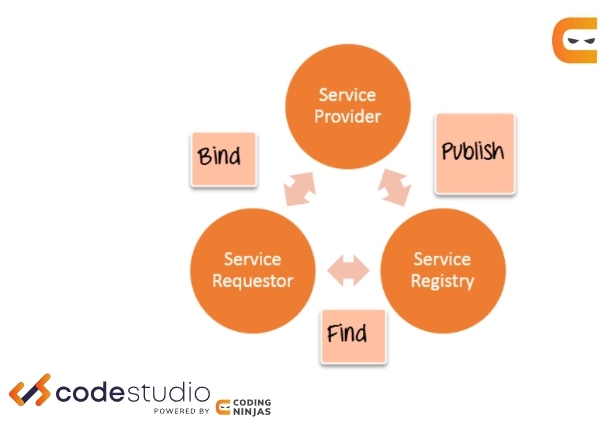
Every framework requires some form of architecture to ensure that the entire framework functions properly; similarly, web services require some form of architecture. The Web Services Architecture is divided into three main responsibilities, as shown below:
Provider - The provider develops the web service and makes it available to client applications that wish to utilize it.
Requestor - A requestor is just a client application that needs to communicate with a web service. A client application might be a. Net, Java, or any other language-based program that seeks functionality via a web service.
Broker - The broker is just the program that offers access to the UDDI. As previously explained, the UDDI allows the client application to locate the web service.
The diagram below depicts the interactions between the Service provider, Service requestor, and Service registry.
Publish - To make the web service available to clients, a provider notifies the broker (service registry) of its existence using the broker's published interface.
Find - The requestor seeks advice from the broker in order to locate a published online service.
Bind - Using the information obtained from the broker (service registry), the requestor can bind or invoke the web service.
Web Service Characteristics
Web services exhibit the following unique behavioral traits:
Document Exchange is supported - One of the primary advantages of XML is its ability to describe not only data but also complex texts in a general manner. These papers might be as basic as a current location or as complicated as an entire book.
Support for Remote Procedure Calls (RPCs) - Web services allow clients to use an XML-based protocol to invoke functions, procedures, and methods on remote objects. Remote procedures offer input and output parameters that must be supported by a web service.
They are XML-based - At the representation and data transportation levels, Web Services employ XML to represent data. Using XML removes any operating system, networking, or platform reliance because XML is a universally known language.
Loosely coupled - It indicates that the client and the web service are not connected to each other, which means that even if the web service changes over time, the way the client contacts the web service should not change. Adopting a loosely connected design makes software systems easier to maintain and enables easier integration between different systems.
Frequently Asked Questions
What is a Web Service?
A Web service is any software, cloud technology, or application solution that allows bidirectional application-to-application or machine-to-machine communication via a network. They let different programs communicate and share data in real-time.
What are the applications of Web Services?
Web services are software and services that allow users to engage and communicate through the internet. Web services are often written in many languages, yet they may still communicate with one another via Gmail, Whatsapp, Facebook, and many more.
What are the Benefits of Web Service?
The most common benefits of Web services are they employ a standardized messaging and tagging system based on JSON or XML. Web services are accessible via the internet as well as intranet networks. Web services may be found using a simple location strategy.
What is the Architecture of Web Service?
Within the web service architecture, there are three key roles: service provider, service requestor, and service registry.
What are the Characteristics of Web Service?
Some most common Characteristics of Web Service are Document Exchange is supported, Support for Remote Procedure Calls (RPCs), They are XML-based and Loosely coupled.
Conclusion
Ideally, this article has given you a better grasp of Web service capabilities, particularly for resolving a large number of cross-stage availability challenges that software engineers and framework designers face. Making a Web service entails many of the same ideas and tasks that we confront when developing any type of program.










 1+ registered

