Do you think IIT Guwahati certified course can help you in your career?
Introduction
Hello Ninja! Are you learning to use Cinder? Great going! Cinder is an open-source library. It was developed to improve C++'s visual analytic features.
If you know C++ programming language, you’ll be aware that in C++, the media facility is non-existent. The standard libraries don’t have graphics drawings, 2D vectors, or 3D. To solve this issue, you need to use third-party stuff. Therefore, Cinder is one of the best options to accomplish these media needs.
Cinder
Cinder is designed for experts having lot of experience in C++. It is a community-driven, open-source library that is free to use. The basics of image processing, face identification, OpenCV integration, and animation are addressed, as well as graphics, audio, video, and computational geometry.
Media-related functionality is missing from the C++ standard libraries. The features of Cinder C++ Software Development Kit fill this void. The Cinder toolkit contains every input, audio, or visual functionality that your C++ program would need.
It may be considered a C++-based substitute for Adobe Flash or Microsoft Silverlight. Additionally, Windows, iOS, macOS, UWP (Universal Windows Platform), and Linux are all officially supported.
Let us check out some of Cinder's features.
Features Of Cinder
Cinder provides the following features:
💁Libraries for math.
💁Media (Video, Audio, OpenCV).
💁Integrate ImGUI( Immediate Mode Graphic User Interface).
The term "XML" stands for "eXtensible Markup Language." It is a type of data storage format.
Extensible Markup Language (XML) is a widely used, straightforward text-based language that may be used for inter-application communication. It is regarded as a standard method of storing and moving the data. Some programming languages offer first-rate assistance and a comprehensive library collection to parse, alter, or research XML documents.
XML in Cinder
We can process XML in Cinder using the XmlTree class. The XmlTree class is designed to parse and represent an XML document hierarchically. This class is recursive, which means an XmlTree can contain other XmlTrees as its offspring(children). This design is similar to XML, where an element can contain children elements in a hierarchical format.
XmlTree Guide
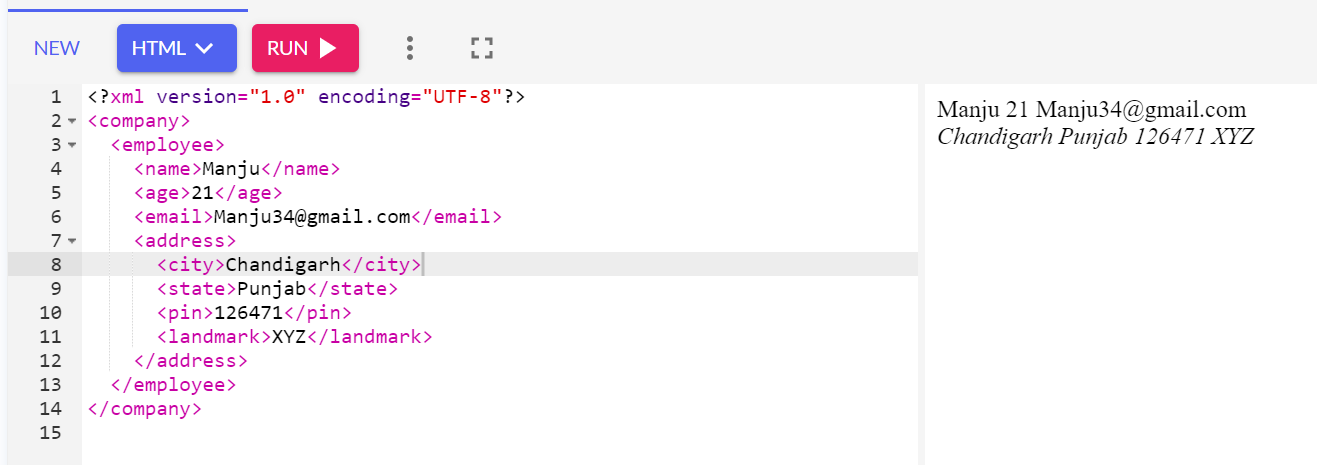
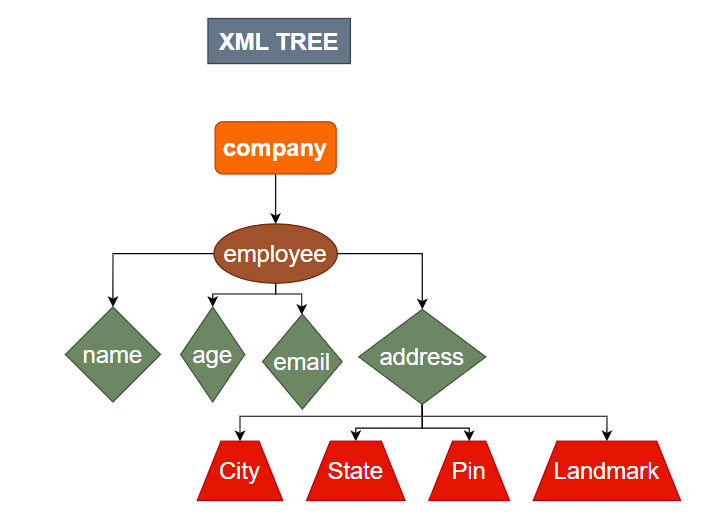
The root item is at the top of an XML document's tree structure, and the child elements are related to it in the same way that leaves nodes are connected to trees by branches. We'll first look at an example of an XML document before drawing a tree structure based on it.
XML parsing is the process of reading an XML document. It provides an interface for the user application to access the document.
An XML parser is a tool that scans XML files and makes the data contained in those files available to programs and computer languages, generally through a well-known interface like the DOM (Document Object Model).
Generally, XML documents have some type of data storage. You must parse the data, which involves reading each line or node and collecting information bits to include it in your software.
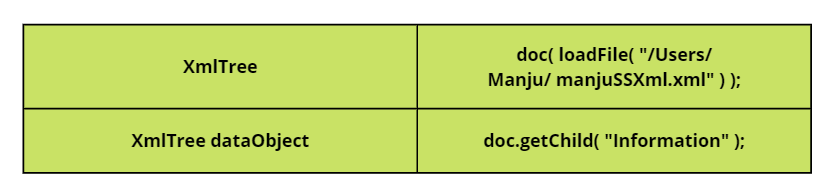
🫵 loadFile(): It is used to create an XML tree from a data source to write an XML block. 🫵 loadUrl(): The HTTP Server is parsed using it. 🫵 loadResource(): It is utilized to parse XML-containing resources.
Iterating XmlTrees
The XmlTree::getChild() method can be used to retrieve a specific child of a node by name:
An XmlTree::ExcChildNotFound exception is triggered if the child is missing. Use the function XmlTree::hasChild() to determine whether a child exists.
🫵 As previously mentioned, calling getTag will return a node's tag (or name). 🫵getValue can be used to obtain a node's value as a string. 🫵 A string of any type that implements the istream>>XmlTree can automatically parse the operator as it becomes easy. 🫵The XmlTree allows checking and going through the node's characteristics. You can use the function getAttributeValue() to obtain an attribute's value as a string. 🫵In the case that a node lacks some certain attribute, you can also provide a default value. It The following will be done if we desire the default size for nodes without a size attribute to be 1.
What is the difference between C++ based openFrameworks and Cinder?
Cinder uses system-specific libraries for better performance, while openFrameworks affords better control over its underlying libraries.
What is OpenGL?
Open Graphics Library (OpenGL) is a cross-platform and cross-language API for rendering 2D and 3D vector graphics.
Why use Cinder?
A combination of Cinder with the speedy C++ makes the library appropriate for heavily abstracted projects, including art installations, commercial campaigns, and other advanced animation work.
What if Cinder is not running on my system?
Cinder depends on a few submodules. It supports macOS, Windows, Linux, and iOS. It requires Xcode 11.3.1 or later for development on the Mac and Visual C++ 2019 or later on Windows.
Conclusion
This article taught you what Cinder is and the XML in Cinder. We also discussed why to use Cinder and what all functions are provided for XML in Cinder.









 1+ registered

