Do you think IIT Guwahati certified course can help you in your career?
Introduction
Technology has come a long way over the years, and computers have played a pivotal role in shaping the modern world. From the massive machines of the past to the sleek and powerful devices of today, computers have continually evolved to meet the ever-increasing demands of society. The latest leap in computer technology has led us to the era of the 5th generation of computers, which promises to revolutionize the way we interact with technology. In this blog post, we will delve into the world of 5th generation computers, exploring their features, applications, and potential impact on various industries.
A Brief History of Computer Generations
To understand the significance of the 5th generation of computers, we need to take a trip down memory lane and revisit the history of computer generations.Computer generations are typically categorized based on the advancements in hardware, software, and computing capabilities. Let's take a quick look at the different generations of computers:
1st Generation (1940s-1950s): The first generation of computers used vacuum tubes and magnetic drums for processing and storage. They were massive, expensive, and had limited processing power.
2nd Generation (1950s-1960s): The second generation of computers replaced vacuum tubes with transistors, making them smaller, faster, and more reliable. They also introduced punched cards for input and magnetic tapes for storage.
3rd Generation (1960s-1970s): The third generation of computers saw the development of integrated circuits, which allowed for further miniaturization and increased computing power. They also introduced operating systems and high-level programming languages.
4th Generation (1970s-1980s): The fourth generation of computers brought about microprocessors, which made computers even smaller and more affordable. They also saw the rise of personal computers and graphical user interfaces (GUIs).
The 5th generation of computers refers to the latest wave of computer technology that is still in development and holds tremendous potential.The fifth generation era began in the 1980s and continues to this day. During this time, VLSI technology advanced to ULSI (Ultra Large Scale Integration) technology, which allowed for the creation of microprocessor chips containing up to ten million electronic components. These computers are known for their ability to process data at an unprecedented speed and their advanced capabilities in Artificial Intelligence (AI) and machine learning (ML). Unlike previous generations of computers, which focused on improving hardware and processing power, the 5th generation of computers places a significant emphasis on software and AI-driven technologies.
Examples of Fifth Generation of Computer
Some examples of the fifth generation of computers include:
IBM Deep Blue: This supercomputer defeated Garry Kasparov, a human chess grandmaster, in 1997
Watson: This computer system won the Jeopardy! quiz show in 2011
Google Translate: This online translation service uses artificial intelligence to translate text from one language to another
Amazon Alexa: It is a voice-activated personal assistant that uses natural language processing to understand and respond to user requests
Features of Fifth Generation of Computers
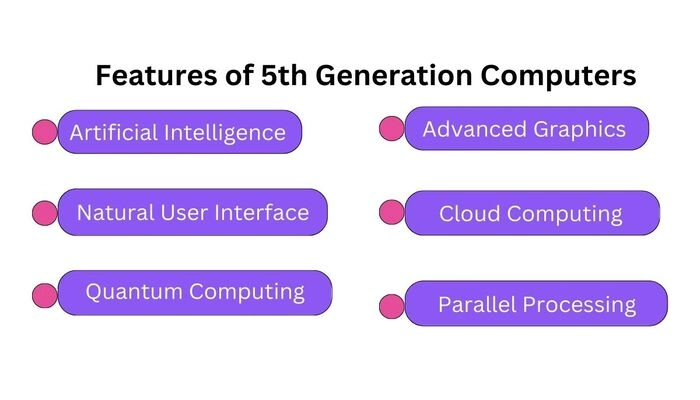
The 5th generation of computers boasts several remarkable features that set them apart from their predecessors. Here are some of the key features of 5th generation computers:
Artificial Intelligence
One of the defining features of the 5th generation of computers is their advanced AI capabilities. These computers can mimic human intelligence, learn from experience, and make decisions based on data analysis. This allows them to perform complex tasks, such as natural language processing, image recognition, and pattern recognition, with remarkable accuracy and speed.
Parallel Processing
5th generation computers are designed to process tasks simultaneously, allowing for faster and more efficient data processing. This is achieved through the use of parallel processing techniques, where multiple tasks are executed simultaneously, leading to a significant boost in overall computing performance.
Advanced Graphics
The 5th generation of computers also excels in graphical processing, making them ideal for applications such as video gaming, virtual reality, and computer-aided design (CAD). These computers are capable of rendering high-quality graphics in real-time, providing an immersive and realistic user experience.
Natural User Interface (NUI)
NUI is a key feature of 5th generation computers that enables users to interact with computers in a more intuitive and natural way. This includes features such as voice recognition, gesture recognition, and facial recognition, allowing users to interact with computers using natural movements and commands.
Cloud Computing
5th generation computers are heavily reliant on cloud computing, which allows for the storage and processing of data on remote servers rather than local devices. This enables users to access and process data from anywhere and on any device, making computing more flexible and scalable.
Quantum Computing
Another exciting feature of the 5th generation of computers is the potential for quantum computing. Quantum computers leverage the principles of quantum mechanics to perform computations at an exponentially faster rate than traditional computers. This has the potential to revolutionize fields such as cryptography, drug discovery, and optimization problems.
Applications of Fifth Generation of Computers
The capabilities of 5th generation computers open up a wide range of applications across various industries. Here are some examples of how these computers can be used:
Healthcare
5th generation computers can revolutionize healthcare by enabling advanced medical imaging and diagnostics, personalized treatment plans, and drug discovery. With their AI capabilities, these computers can analyze vast amounts of data, such as patient records and genetic information, to provide more accurate diagnoses and treatment options.
Finance
In the finance industry, 5th generation computers can be used for high-frequency trading, risk assessment, fraud detection, and portfolio optimization. Their advanced AI and data processing capabilities can help financial institutions make better-informed decisions and manage risks more effectively.
Manufacturing
5th generation computers can optimize manufacturing processes by analyzing data from sensors and devices in real-time, predicting maintenance needs, and optimizing production schedules. This can lead to increased efficiency, reduced downtime, and improved quality control.
Transportation
In the transportation industry, 5th generation computers can enable autonomous vehicles, traffic optimization, and predictive maintenance. With their advanced AI capabilities, these computers can analyze data from sensors, cameras, and other sources to make real-time decisions and improve transportation systems.
Entertainment
5th generation computers can transform the entertainment industry with their advanced graphics and virtual reality capabilities. They can provide realistic gaming experiences, virtual simulations, and immersive entertainment content.
Advantages of Fifth Generation of Computer
Some of the Advantages of the Fifth Generation of Computers are:
Faster processing speed. Fifth generation computers are much faster than previous generation because they make use of parallel processing and superconductor technology
More powerful. Fifth generation computers are more powerful than previous generations due to the use of ULSI chips and artificial intelligence
More portable. Fifth generation computers are more portable than previous generations due to the use of smaller and lighter components
Easier to repair. Fifth generation computers are easier to repair than previous generations due to the use of modular components
More user-friendly. Fifth generation computers are more user-friendly than previous generations due to the use of natural language processing and graphical user interfaces.
Disadvantages of Fifth Generation of Computer
Some of the Disadvantages of Fifth Generation of Computers are:
Expensive. Fifth generation computers are more expensive than previous generations because of advanced technology that is used in them and the cost of semiconductors is also high at present
Complex. Fifth generation computers are more complex than previous generations which makes them difficult to use and troubleshoot
Dependency on artificial intelligence. Fifth generation computers are more reliant on artificial intelligence which can make them vulnerable to hacking and other security threats
Frequently Asked Questions
What are the features of 5th generation computer?
There are so many features of fifth-generation computers like they have been utilising artificial intelligence and machine learning. They also use parallel processing and superconducting technology to achieve high speeds and efficiency.
Who started the 5th generation of computer?
The Japanese government started the fifth generation of computers in the early 1980s. The Japanese government invested heavily in AI research in the hope of creating computers that could surpass human intelligence.
When was the fifth generation of computer?
The fifth-generation computer is still in development and has not been fully realized, but it is believed that it could be in the 2030s or so.
What kind of technology is used in computers of the fifth generation?
The VLSI architecture, parallel processing techniques like data flow control, logic programming, knowledge bases based on relational databases, and applied artificial intelligence and pattern processing are the critical technologies for the Fifth Generation Computer System (FGCS).
Conclusion
In this blog, we discussed the 5th generation of computers that comprises advanced AI capabilities, parallel processing, advanced graphics, and other features. Don't come to a halt here. Check out our other articles like:







 7+ registered

