The main components of the CPU include the Control unit and the arithmetic logic unit. Now, we will be discussing only about the control unit.
The main function of the control unit is to inform ALU, input/output device and computer’s memory about how to respond or answer the given set of instructions. The Control unit itself does not involve any processing tasks. It only controls and directs the task. It acts as the supervisor of the computer controlling all activities of the computer, including fetching instructions from the main memory and then executing them.
What is a Hardwired Control Unit?
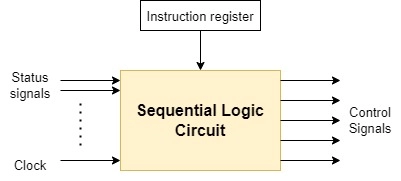
As the name suggests, these control units are designed using hardware components such as sequential logic circuits or some finite state machines, for example, logic gates, flip-flops, decoders, resistors and other digital circuits to generate a specific sequence of control signals.
Here inputs are status signals, i.e., any instructions’ particular status and clock input, and the output we get is control signals. Instruction registers are used to keep track of current instruction and the next instruction.
Control memory is absent in this control unit. This control unit uses RISC (Reduced Instruction Set Computer) microprocessors.
Factors Considered for the design of the hardwired control unit.
Amount of hardware - Minimise the number of hardware used.
Speed of operation - If a single IC can replace a group of IC, replace it. The amount of hardware and speed of operation are inversely proportional to each other.
Cost- It has a smaller size and hence the cost is relatively lower.
What is a Microprogrammed Control Unit?
As the name suggests, these control units are designed with the help of a micro-program. This micro-program is a collections of micro-instructions stored in the control memory. This control unit uses CISC (Complex Instruction Set Computer) microprocessors.
Example of micro-instruction:
MAR←R3
In the above instruction, we are fetching the operand.
The control signal for the above example:
MARᵢₙ, R3ₒᵤₜ
A micro-instruction consist of one or more micro-operations to be executed and the address of the next micro-instruction.
If the control memory grows horizontally, due to an increase in control signals, it is referred to as horizontal microprogramming. If the control memory grows vertically, due to an increase in control signals, and the bits are decoded then it is referred to as vertical microprogramming. If we are using two-level control memory providing both the advantage of horizontal and vertical microprogramming, then it is referred to as nanoprogramming. Memory access time in nono programming is increased as two levels are to be traversed.
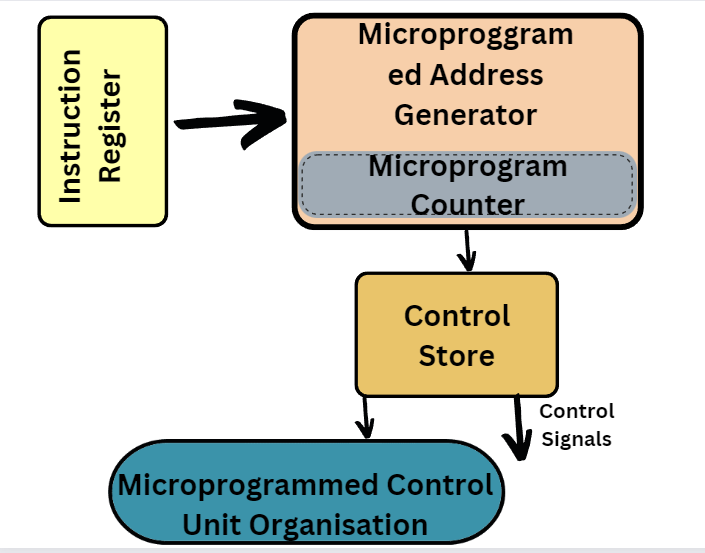
Micro programmed control unit with a single level control store passes instruction from the main memory to the instruction register, then the microinstruction address generation unit sends the data to the address register, from where it is decoded and sent to the control store. Then the data is stored in the operations part of the micro-instruction register and after decoding in understandable form, it is received in the form of the control signal.
In a microprogrammed control unit with a two-level control store, the mechanism remains the same with a microprogrammed control unit with a single level control store except that this structure includes nano-instruction memory. This is the optimised version of the control unit with a single-level store. Here the redundant data is discarded. In this way, unnecessary storing of the same operation parts of microinstructions is avoided.
Characteristics of Hardwired Control Unit
Fixed Functionality: Hardwired control units have fixed functionality determined during the design phase and cannot be easily modified or reprogrammed.
Implemented with Logic Gates: Control logic in hardwired units is implemented using combinational logic circuits, typically composed of logic gates like AND, OR, and NOT gates.
High Speed: Due to their direct hardware implementation, hardwired control units can execute instructions very quickly, making them suitable for high-performance applications.
Dedicated Circuitry: Each instruction has dedicated circuitry responsible for generating control signals, resulting in deterministic and predictable behavior.
Minimal Overhead: Hardwired control units have minimal overhead compared to microprogrammed control units, as there's no need for storing and fetching control signals from memory.
Limited Flexibility: Hardwired control units lack flexibility and cannot easily accommodate changes or updates without significant hardware redesign.
Designing of Hardwired Control Unit
Instruction Decoding: The instruction decoder interprets the instruction fetched from memory and generates control signals based on the opcode and operands.
Control Signal Generation: Control signals are generated based on the decoded instruction to coordinate various components of the CPU, such as the ALU, registers, and memory.
Logic Circuit Design: Combinational logic circuits, typically implemented using logic gates like AND, OR, and NOT gates, are designed to generate the required control signals for each instruction.
Multiplexers and Demultiplexers: Multiplexers are used to select inputs for various components based on control signals, while demultiplexers are used to distribute outputs to the appropriate destinations.
Finite State Machines: Finite state machines (FSMs) are often employed to sequence through the various states of instruction execution and generate the necessary control signals accordingly.
Testing and Verification: Extensive testing and verification are essential to ensure that the designed hardwired control unit correctly interprets instructions and generates the expected control signals for all possible scenarios.
Optimization: The design may undergo optimization to improve performance, minimize hardware resources, and reduce propagation delays in the control logic circuits. Integration with CPU Components: The designed control unit is integrated with other CPU components, such as the instruction register, ALU, and data paths, to ensure seamless operation during instruction execution.
Working of a Hardwired Control Unit
Instruction Fetch: The CPU fetches the instruction from memory and places it into the instruction register.
Instruction Decoding: The opcode of the fetched instruction is decoded to determine the control signals needed for execution.
Control Signal Generation: Based on the decoded opcode, the control unit generates specific control signals that dictate the operation to be performed by other CPU components.
Execution Phase: The control signals are sent to various components such as the ALU, registers, and memory, directing them to perform the required operations specified by the instruction.
Next Instruction Fetch: After executing the current instruction, the control unit increments the program counter to fetch the next instruction from memory, initiating the next cycle of instruction execution.
Deterministic Behavior: The behavior of the hardwired control unit is deterministic, as each instruction has dedicated circuitry responsible for generating control signals, ensuring predictable execution.
High Speed: Due to its hardware-based design, the hardwired control unit operates at high speed, enabling efficient execution of instructions without the overhead associated with microprogrammed control units.
Limited Flexibility: Unlike microprogrammed control units, hardwired control units lack flexibility and cannot be easily modified or reprogrammed without hardware redesign.
Difference between Hardwired and Microprogrammed Control Unit
Parameter
Hardwired Control Unit
Microprogrammed Control Unit
Control Signal Generation
Generates control signals using hardware.
Uses microinstructions to generate control signals.
Speed
Faster, as control signals are directly produced by hardware.
Slower due to microinstruction-based signal generation.
Flexibility
Difficult to modify once designed.
Easier to modify and update.
Cost
More expensive due to complex hardware implementation.
Less expensive as it relies on microinstructions.
Complexity
Circuit design is complex, making it difficult to handle complex instructions.
Can handle complex instructions efficiently.
Other Differences between Hardwired and Microprogrammed Control Unit
Other differences between Micro-programmed control unit and Hardwired control unit are the following:
Due to the hardware implementation, a small number of instructions are used in the Hardwired control unit while numerous control signals for various instructions can be produced in the Micro-programmed control unit.
The hardwired control unit operates at a very high rate. The microprogrammed control unit, however, requires regular memory access. Consequently, a microprogrammed control unit operates slowly.
A Hardwire Control Unit is implemented significantly differently from a Micro-programmed Control Unit. The microprogrammed control unit will save us money when we implement it.
It will be quite challenging to conduct instruction decoding in the hardwired control unit. However, it will be quite simple for us if we accomplish the same thing in a microprogrammed control unit.
Reduced Instruction Set Computer uses the hardwired control unit. Contrarily, a Complex Instruction Set Computer uses a microprogrammed control unit.
Frequently Asked Questions
What is hardwired and microprogrammed control unit?
Hardwired and microprogrammed control units are used to generate control signals to fetch and run instructions. The hardwired control unit uses the logic circuits for it. While, the microprogrammed control unit uses the microinstructions for it through programming.
What is a microprogrammed control unit?
A microprogrammed control unit generates control signals using a sequence of microinstructions stored in memory, making it flexible and easier to modify.
Which is faster, hardwired or microprogrammed?
A hardwired control unit is faster because it directly generates control signals using hardware, while a microprogrammed control unit relies on stored microinstructions.
What are the two types of control units?
The two types of control units are Hardwired Control Unit, which uses fixed hardware circuits, and Microprogrammed Control Unit, which uses stored microinstructions.
Conclusion
This article taught us about the Difference between Hardwired and Microprogrammed Control Unit. We discussed different types of Control units, their pros and cons. We hope you could easily take away all critical and conceptual techniques by walking over the given examples.







 1+ registered

